Most men don’t walk into therapy saying,
“I think I have an anxious attachment style.”
Instead, they say things like:
- “I get triggered in relationships very easily.”
- “I struggle saying No to people.”
- “I feel something is wrong when everyone is silent around me.”
- “I overthink conversations after they happen.”
- “I can’t relax when someone doesn’t answer my call.”
Anxious attachment in men often hides behind perfectionism, over-responsibility, and quiet shame & because the world rarely encourages men to explore emotional wounds, these patterns often go unnoticed even while they create deep anxiety in dating, relationships, work, and daily life. And for many men, these patterns don’t come from “being too sensitive” they come from emotional environments that shaped how they learned to relate, attach, and survive.
The Hidden Roots: How Childhood Emotional Trauma Creates Anxious Attachment in Men
Not all trauma is loud. Many men grow up in families where they were provided for physically but emotionally left on their own.
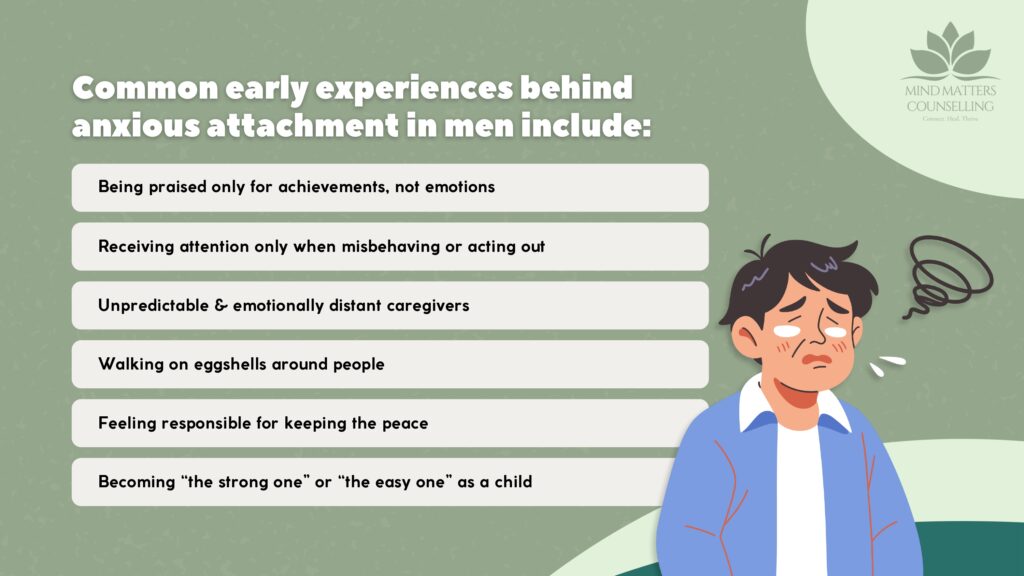
Common early experiences behind anxious attachment in men include:
- being praised only for achievements, not emotions
- receiving attention only when misbehaving or acting out
- unpredictable & emotionally distant caregivers
- Walking on eggshells around people
- feeling responsible for keeping the peace
- becoming “the strong one” or “the easy one” as a child
These environments don’t teach emotional safety.
They teach self-doubt.
Men learn:
- “Don’t make mistakes.”
- “Don’t upset anyone.”
- “Don’t show too much.”
- “Don’t need too much.”
This is the birthplace of anxious attachment — long before a romantic relationship even exists.
How Anxious Attachment Shows Up in Romantic Relationships
Anxious attachment in men is misunderstood.
It’s not clinginess.
It’s not neediness.
It’s not insecurity.
It’s a hyper-attunement built from survival.
Common relationship patterns include:
1. Overthinking your partner’s tone or behavior
A sigh, delay, or shift in energy can feel like rejection.
2. Difficulty tolerating distance
Not because you’re controlling, but because your body associates distance with danger.
3. People-pleasing or over-functioning
Trying to keep your partner happy to avoid triggering abandonment fears.
4. Sensitivity to conflict
Arguments feel less like disagreements and more like threats to connection.
5. Strong fear of disappointing your partner
Even small mistakes feel catastrophic.
6. Feeling “too much” emotionally and shutting down
You’ve learned to minimize your needs out of fear of being a burden.
7. Choosing partners who are emotionally unavailable
Because the nervous system is conditioned to chase inconsistent love.
These patterns are not signs of weakness — they’re adaptive responses that once helped you survive.
Why Men With Anxious Attachment Often Feel Misunderstood
Society tells men:
- “Don’t be emotional.”
- “Be confident.”
- “Stop overthinking.”
- “Man up.”
But these messages ignore the deeper reality:
Men feel deeply.
Men attach deeply.
Men carry childhood trauma quietly.
Anxious attachment is not an issue of masculinity — it’s an issue of emotional safety.
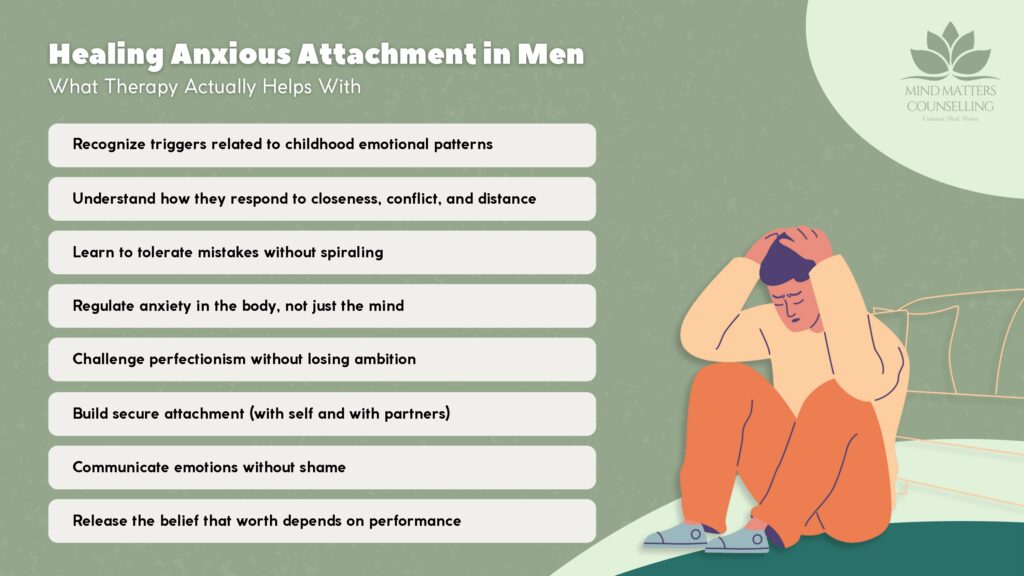
Healing Anxious Attachment: What Therapy Actually Helps With
In counselling for anxious attachment in men, the work is not about “fixing” your emotions.
It’s about understanding and regulating your nervous system.
Therapy helps men:
- recognize triggers related to childhood emotional patterns
- understand how they respond to closeness, conflict, and distance
- learn to tolerate mistakes without spiraling
- regulate anxiety in the body, not just the mind
- challenge perfectionism without losing ambition
- build secure attachment (with self and with partners)
- communicate emotions without shame
- release the belief that worth depends on performance
Approaches like CBT, attachment therapy, somatic work, and parts work (IFS) all support this process.
Healing happens not by forcing yourself to “be less anxious” — but by slowly teaching your nervous system that connection is safe.
What Partners of Men Should Know
If you’re in a relationship with a man who has anxious attachment, know this:
He is not being dramatic.
He is not being difficult.
He is not “too emotional.”
His nervous system learned early in life that love must be protected — not taken for granted.
Your gentle consistency helps more than you realize.
If This Blog Feels Familiar — You’re Not Alone
If you’re a man who finds yourself overthinking, over-performing, or struggling in relationships despite trying your best — there is nothing wrong with you.
You’re human.
You’re emotional.
You’re wired for connection.
And your attachment patterns can absolutely be healed.
At Mind Matters Counselling, we support men across Metro Vancouver — including Burnaby, New Westminster, Surrey, Coquitlam, and Vancouver — in healing these attachment wounds.
Book a session with an anxiety and attachment therapist at Mind Matters Counselling serving men in Vancouver, Burnaby, Surrey & New Westminster.