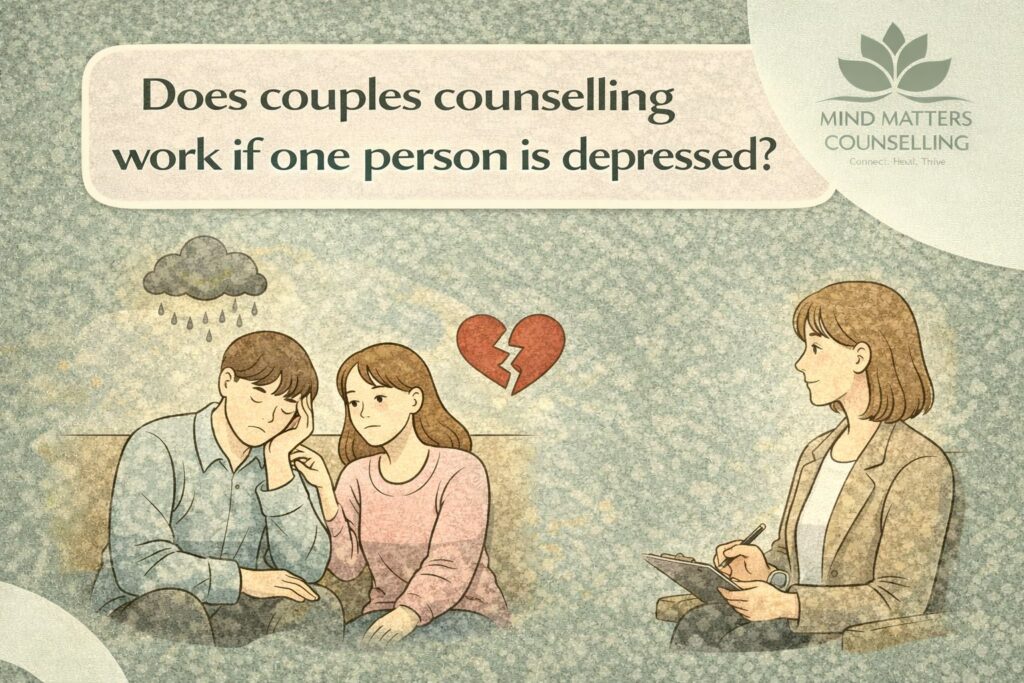
If you’re in a relationship where one person is depressed, life can feel heavy. Silent. Many small things become more difficult. You struggle to talk. To connect. To be intimate. You may even feel angry or guilty for feeling angry. So it’s natural to ask: can couples counselling help if one person has depression?
The answer is yes. Sort of. Not explaining that last part fully is like putting blue paint without telling your partner it tastes like strawberries. It won’t make for a great masterpiece.
When one person is depressed, both parties are affected. That’s why living with someone with depression can feel so lonely and complex. The good news is that couples counselling can help, if you know how to approach it.
Understanding the Intersection of Depression and Relationship Strain
Depression is not a character flaw or a lack of effort. It is a clinically recognized mental health condition that affects how a person thinks, feels, and functions and its ripple effects extend well beyond the individual.
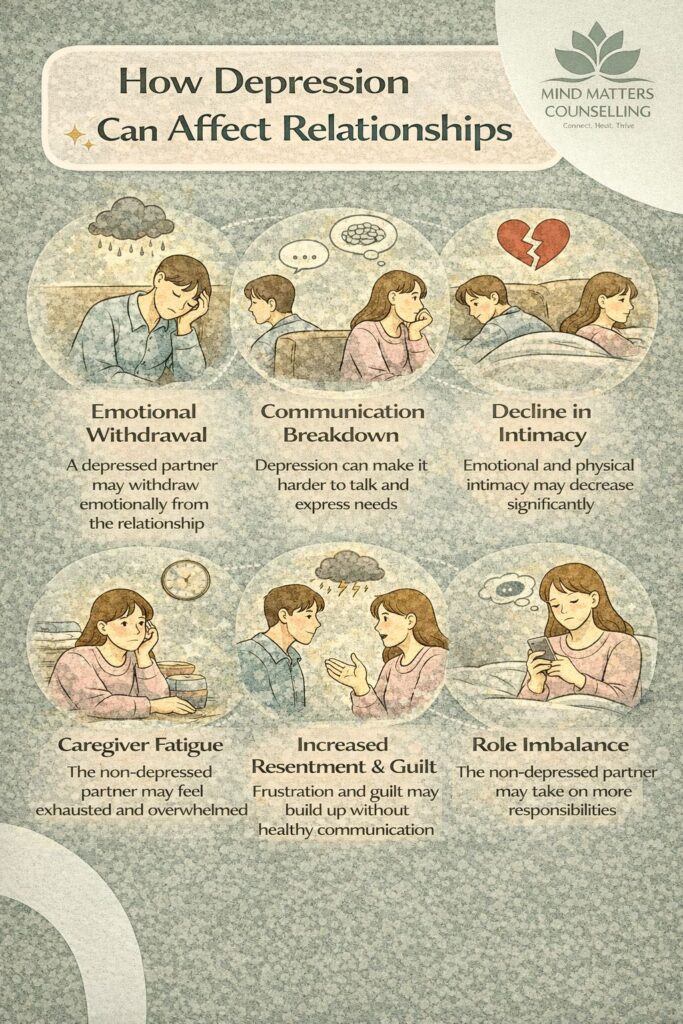
When one partner experiences depression, common relationship patterns tend to emerge:
- Emotional withdrawal: The depressed partner may pull away, leaving the other feeling rejected or disconnected.
- Communication breakdowns: Depression often mutes the ability to express needs clearly, leading to misunderstandings.
- Shifts in intimacy: Both physical and emotional intimacy can decline, creating distance.
- Caregiver fatigue: The non-depressed partner may take on more responsibilities, eventually leading to burnout.
- Resentment and guilt: Both partners can develop conflicted feelings that are hard to voice without professional support.
None of these patterns mean the relationship is failing. They mean the relationship is under stress and stress, when addressed thoughtfully, can become an opportunity for deeper connection.
Can Couples Therapy Work When One Partner Has Depression?
Yes. In fact research backs this up over and over again. Couples counselling and individual therapy for depression go hand in hand – they are most effective when combined.
Research published in the Journal of Consulting and Clinical Psychology discovered that Behavioural Couples Therapy (BCT) was equally effective at treating depression when compared to individual therapy. It was far superior at helping relationships.
Subsequent research has supported this study’s conclusions.
Let me explain why couples counselling is so effective even, when depression is involved:
1. It Treats the Relationship as a Unit
Depression does not live in isolation. When one partner is struggling, the entire relationship system is affected. Couples therapy addresses this system, helping both individuals understand how their dynamics are influencing each other.
2. It Provides a Safe Space for Honest Dialogue
A skilled couples therapist creates a structured, non-judgmental environment where both partners can speak honestly about how depression is affecting them. Often, these are conversations the couple has never been able to have on their own.
3. It Builds Compassion in Both Directions
For the depressed partner: therapy helps them articulate what they are experiencing and what kind of support they need.
For the non-depressed partner: therapy offers education about depression, reducing the likelihood of taking withdrawal personally and increasing empathy.
4. It Does Not Replace Individual Counseling, It Complements It
Couple counselling works best when the depressed partner is engaged in, or considering, individual counselling for depression. The two complement each other: individual counselling can save marriages on your inner experience of depression and couple counselling works on how depression affects your relationship.
Signs That Couples Counselling May Be the Right Next Step
Relationships counselling isn’t necessary for every couple where one or both partners are depressed. But if any of these statements ring true, counselling may be able to help:
• You argue about the same things, without resolution
• You feel like your spouse/partner’s parent/caregiver
• Your partner has withdrawn from you
• You’re walking on eggshells
• Emotional or physical intimacy is lacking
• You want to help each other feel better, but don’t know how
• Things have been this way for months
There’s no shame in asking for help. Asking for help means that your relationship isn’t broken…that you both care enough to work on it.
What About Individual Counseling for Depression Alongside Couples Work?
Individual therapy for depression often plays an important role and may need to come first or be done in conjunction with couples work.
If someone is really down in the dumps, they might not have the capacity to do the emotional work needed in couples counselling. A therapist seeing a couple will likely suggest that the depressed individual start individual therapy to even out, before fully engaging in couple work.
That said, in many cases, both can be pursued simultaneously. Individual therapy focuses on:
- Identifying the root causes and triggers of depression
- Developing coping strategies and emotional regulation skills
- Rebuilding a sense of self-worth and motivation
- Processing past trauma or unresolved grief that may be fueling the depression
Couples therapy focuses on:
- Rebuilding trust, communication, and connection
- Helping the non-depressed partner understand and respond effectively
- Establishing healthier patterns of interaction
- Strengthening the relationship as a source of support, not strain
The two approaches are not competing, they are complementary.
How Mind Matters Counselling Supports Couples Navigating Depression
Are you searching for couples counselling in New Westminster? Browsing online for evidence based counselling for couples in the Lower Mainland? Mind Matters Counselling provides the sensitive personalized care your situation requires.
Mind Matters Counsellling is staffed by Registered Clinical Counsellors (RCC). We offer a safe, confidential and truly non-judgmental environment where you are experiencing depression in one partner, constant bickering, or just a sense that things have slowly drifted off course. We balance clinical expertise with real care and understanding.
Here is how their team can guide you:
- Integrated assessment: Counsellors assess both the individual’s mental health needs and the relational dynamics at play, ensuring no aspect of the situation is overlooked.
- Evidence-based approaches: Including Cognitive Behavioural Therapy (CBT), Emotionally Focused Therapy (EFT), Gottman Therapy and mindfulness-based interventions, all adapted to the couple’s unique situation.
- Individual and couples sessions: The flexibility to offer individual counseling for depression alongside couples therapy, so both partners receive the support they need.
- Culturally sensitive care: Sessions are tailored to reflect the values, backgrounds, and preferences of each couple.
- Skill-building focus: Sessions go beyond talking; clients learn concrete skills to better cope with life’s challenges and restore emotional balance together.
Common Misconceptions About Couples Counselling and Depression
There are several myths worth addressing directly:
Myth 1: “Couples counselling is only for relationships on the verge of ending.” In reality, early intervention leads to better outcomes. Waiting until the relationship is in crisis makes the work harder.
Myth 2: “My depressed partner has to be ‘fixed’ before we can benefit from couples therapy.” Not true. Couples therapy can actually accelerate individual recovery by reducing relational stressors.
Myth 3: “Couples therapy means the therapist will take sides.” A skilled therapist maintains neutrality and advocates for the health of the relationship not for either individual over the other.
Myth 4: “We are not married, so couples counselling does not apply to us.” Couples therapy is for any committed partnership married, common-law, or otherwise. Counseling for married couples is simply one context within a broader range of offerings.
Final Thoughts: Depression Does Not Have to Define Your Relationship
Depression is one of the most misunderstood forces acting on a relationship not because it isn’t common, but because it’s often hiding in plain sight. Depression can disguise itself as emotional unavailability, conflict avoidance, loss of interest, or other problems you might not realize are connected. When left unsupported, couples sometimes spend years blaming the wrong problem and drifting farther apart.
When given the right support, however, couples can break through depression to discover, as odd as it might sound, a greater understanding of each other. People who get through depression with their partner and proper support have cited better communication, empathy, and relationship strength than they had previously.
If you’re ready to take that step towards healing, you don’t have to take it alone. Whether you’re searching for couples counselling in New Westminster, counseling for married couples near me, or even just a place to start individual counseling for depression; there is qualified, compassionate help for you.
Frequently Asked Questions
1. Can couples counselling make depression worse?
When delivered by a qualified therapist, couples counselling should not worsen depression. In fact, reducing relational conflict is often one of the most effective ways to ease depressive symptoms. However, if the depressed partner is in an acute crisis, individual therapy may need to be prioritized first.
2. What if my partner refuses to come to couples counselling?
Individual counseling for depression and relationship-focused individual therapy can still be highly effective. A skilled therapist can help you develop strategies to improve the relationship dynamic even when working alone and sometimes, one partner’s positive changes inspire the other to eventually engage.
3. Is couples counselling covered by insurance in British Columbia?
Coverage depends on your benefits plan. Many extended health plans cover sessions with Registered Clinical Counsellors (RCC). It is worth checking with your employer’s benefits provider or contacting Mind Matters Counselling directly for guidance.
4. How do I know if couples counselling in New Westminster is right for us?
If depression is creating a noticeable strain on your relationship through communication breakdowns, emotional distance, or role imbalances, couples counselling is likely a valuable option. The first step is often a consultation to assess your needs and determine the best approach.
5. How is couples therapy different from individual therapy for depression?
Individual counseling for depression focuses on the internal experience, thoughts, emotions, history, and coping strategies. Couples therapy focuses on the relational dynamic between two people. Both are valuable, and many couples benefit from pursuing both simultaneously with the support of a coordinated clinical team.
| Ready to Take the First Step Together? Whether one or both of you is struggling with depression, support is available. The compassionate team at Mind Matters Counsellling is here to help you navigate this journey with professional, evidence-based care. [ Book Your Free Consultation Today ] |