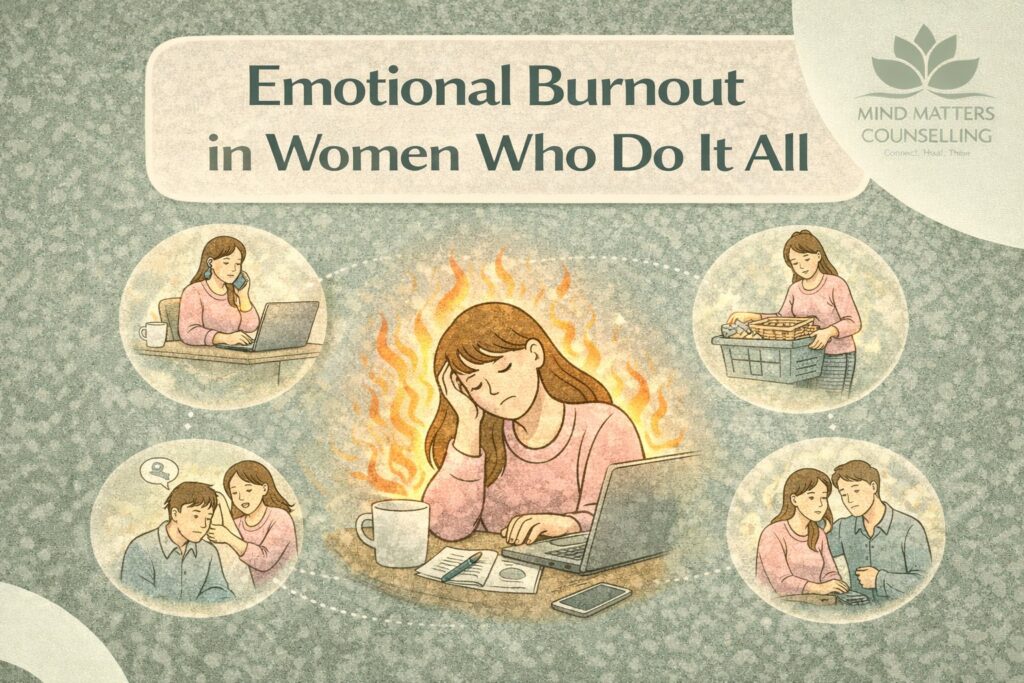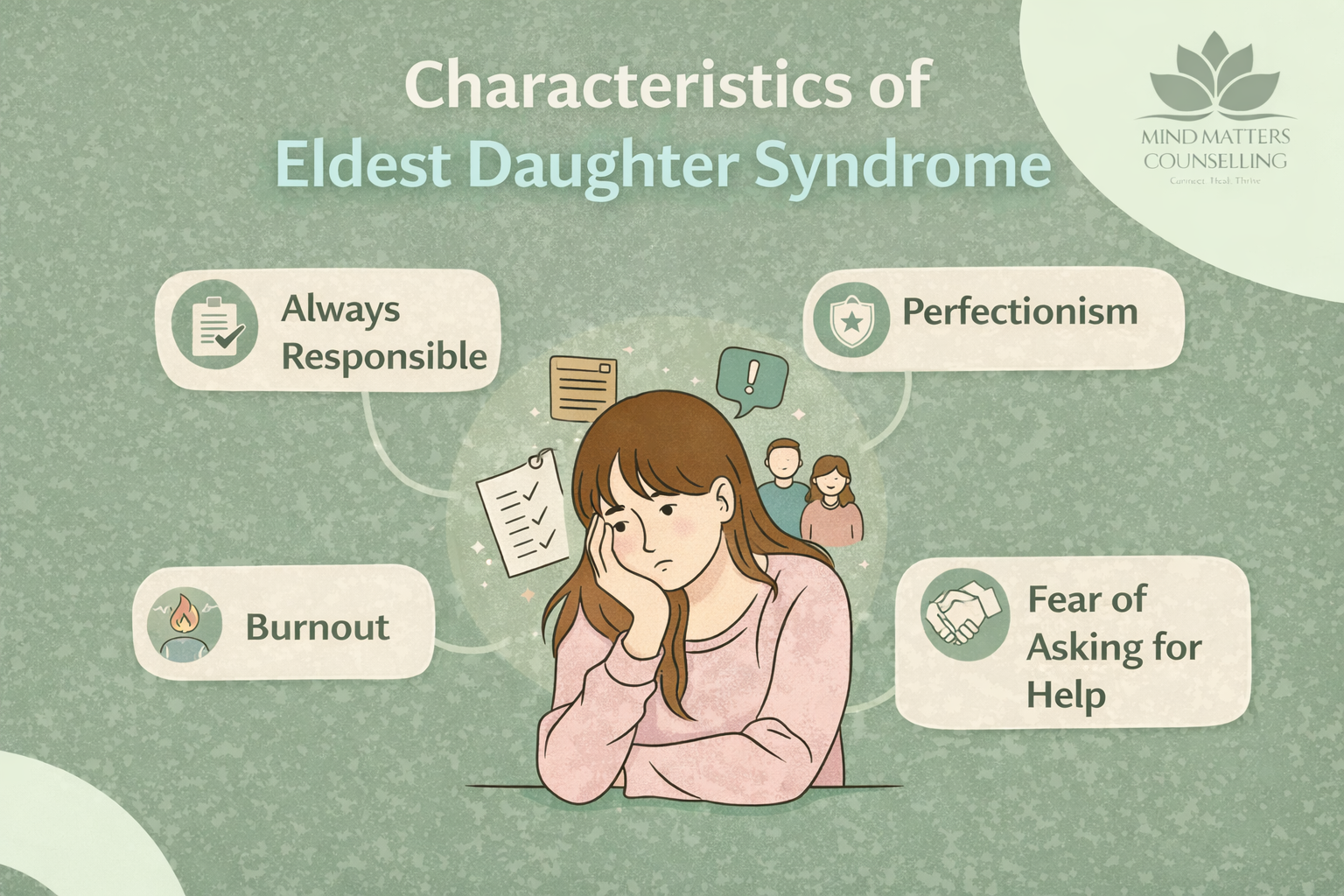
She’s accomplished. Dependable. Type-A. The one others lean on.
She’s also burned out.
Many successful, overfunctioning women (& eldest daughters especially) come into individual therapy anxious, overwhelmed, and bewildered about why they can’t just “chill.” Their lives look AMAZING on paper. They kill it at their jobs, keep their households running, show up for their partners, and rarely miss a beat.
But on the inside they’re running on empty.
If you’re reading this and nodding along, know that you’re not alone.
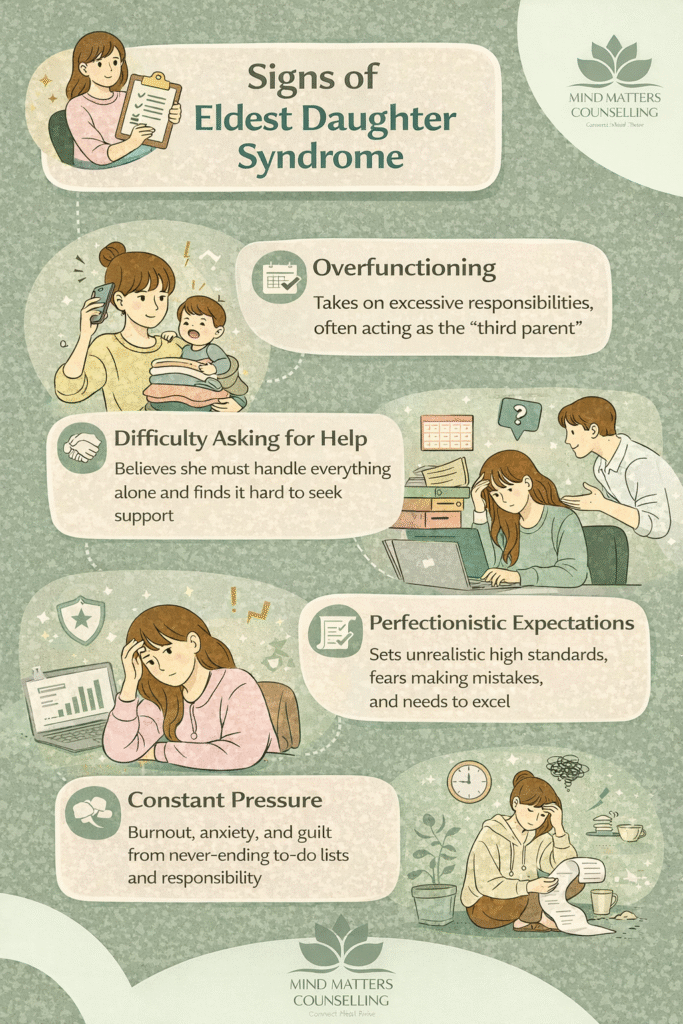
The High-Achieving Eldest Daughter Pattern
There is often a pattern that begins early.
As the eldest daughter, you may have been:
- The responsible one
- The helper
- The emotional support for others
- The example siblings were compared to
Over time, responsibility became identity.
You learned that being dependable meant being valued. That excelling meant being safe. Those mistakes meant disappointment.
In adulthood, this often turns into chronic overfunctioning, taking on more than your share in relationships, at work, and within your family.
Women seeking therapy for high-achieving stress often describe:
- Difficulty delegating
- Feeling uncomfortable when things aren’t done “properly”
- Trouble switching off
- Irritability when others don’t step up
- Anxiety when not in control
This isn’t about personality flaws. It’s often a nervous system that learned early on that control equals safety.
Read More: Eldest Daughter Syndrome Treatment
Perfectionism and the Fear of Making Mistakes
Perfectionism gets a bad wrap. It’s about so much more than striving to reach high standards. For many women, perfectionism is fuelled by fear.
- Fear of letting others down.
- Fear of judgement.
- Fear of losing approval.
- Fear of appearing inadequate.
In my individual counselling sessions, we discuss how perfectionism relates to anxiety. When self-worth is linked to how you perform, messing up feels earth shattering vs. human.
High-achieving women may:
- Replay small errors repeatedly
- Avoid trying new things unless they are confident they’ll excel
- Be overly self-critical
- Struggle to tolerate feedback
Over time, this constant internal pressure contributes to anxiety, burnout, and even depression.
If you are seeking anxiety and depression counselling and identify with perfectionism, it is worth exploring what’s underneath the drive to always “get it right.”
Overfunctioning in Relationships
Overfunctioning doesn’t just show up at work, it often appears in romantic and family relationships.
You may notice that you:
- Take responsibility for planning and organizing everything
- Manage emotional conflicts
- Step in quickly when others struggle
- Feel resentful but don’t express it
- Have difficulty trusting others to handle things
Overfunctioning fosters imbalance. When one person does more, there’s less room for the other to contribute. It leads to frustration, disconnection and power struggles.
In my relationship counselling practice, many successful women come to realize how their need to control – protective as it is – can unconsciously push others away.
It’s not about blame. It’s about awareness.
Why Asking for Help Feels So Hard
Many high-achieving women struggle deeply with asking for help.
It may feel:
- Uncomfortable
- Inefficient
- Vulnerable
- Weak
If you’ve been strong your whole life, asking for help can feel weird. You might fear that once people meet the real you, they’ll reject you.
In therapy, we explore that idea softly and safely. You might discover that it starts when you were young and roles are assigned. Maybe you weren’t allowed to be vulnerable – or it wasn’t safe to.
Asking for help doesn’t make you weak or dependent. It creates equilibrium.
When Achievement Masks Anxiety
High-functioning anxiety can be unseen from the outside.
- You meet your deadlines.
- You go above and beyond.
- Everything seems calm.
On the inside, you’re overwhelmed. Racing thoughts. Maybe insomnia. Muscle tension. Irritability. Feeling like there’s never “enough.”
Individual counselling for high-achieving women focuses on:
- Separating identity from productivity
- Building tolerance for imperfection
- Understanding attachment patterns
- Reducing anxiety through emotional regulation
- Learning to share responsibility in relationships
This work does not reduce your ambition. It helps you sustain it without burning out.
Individual Counselling for High-Achieving Women in Surrey BC
At Mind Matters Counsellling, we understand that some of our clients identify as strong women who tend to overfunction. Individual counselling in New Westminster, BC can provide you with a safe and culturally informed space to address perfectionism, anxiety, overfunctioning and relational patterns.
Therapy may include:
- Attachment-based approaches
- Cognitive Behavioural Therapy (CBT)
- Emotionally Focused Therapy (EFT)
- Mind-body awareness work
Whether you are searching for counselling near me or therapy for high-achieving women, the goal is not to change who you are, it is to help you feel less burdened by who you’ve had to be.
You Don’t Have to Carry It All
Capable is powerful. Driven is powerful. Responsibleness is powerful.
But shouldering it all doesn’t have to be who you are.
High-achieving, people pleasing women who battle with perfectionism, anxiety or relationship struggles can benefit from individual counselling. Let’s uncover those patterns together and create a new path forward for you.
You are worth being supported too.
Book a session with Mind Matters Counselling.
Frequently Asked Questions
1. What are eldest daughter syndrome symptoms?
Eldest daughter syndrome is a behavioral pattern that can affect first-born daughters. Characteristics include people pleasing, over-responsibility, feeling overly dependable, trying to be perfect, anxiety or perfectionism, needing to hold the family together emotionally and difficulty delegating.
2. What does psychology say about the eldest daughter?
It is commonly said by psychologists that eldest daughters face special pressures such as being seen as the responsible one and the “example” that siblings look up to. Chronic overfunctioning, perfectionism and asking for help can develop due to this. This behavior usually starts in early childhood.
3. Which sibling struggles the most?
Each sibling might have their own challenges growing up, but eldest siblings, especially eldest daughters have a larger load placed on them. They may become perfectionists and experience anxiety. They might also have trouble delegating tasks and trusting others to do them. Middle children and youngest siblings can experience sibling issues too like feeling replaced or ignored.
4. Is the most depressed family member the eldest daughter?
It’s not universally the case, but the eldest daughter may experience higher levels of stress, anxiety, and depression due to the expectations placed on her. Being responsible for others, striving for perfection, and the pressure to succeed can contribute to mental health struggles. However, depression can affect any family member, regardless of birth order.
5. What age are people happiest and saddest?
Happiness and sadness fluctuate throughout life, and age can play a significant role. Research often shows that people tend to be happiest in their late teens and early 20s, as they experience new freedoms and opportunities. On the other hand, sadness or emotional difficulties can peak in middle age (around 40–50 years) due to life stressors, career pressures, and personal transitions.