Most people imagine anxiety or depression as visible — crying, panic attacks, shutting down, not getting out of bed. But for many high-achieving adults, the struggle looks very different.
High-functioning anxiety and depression often wear a polished mask.
You show up.
You work hard.
You answer texts.
You keep your life moving.
On the outside, it looks like you’re “fine.”
But inside, the emotional exhaustion is real.
The Hidden Reality of High-Functioning Anxiety & Depression
People with high-functioning anxiety or depression often say things like:
- “I don’t feel bad, I just don’t feel anything lately.”
- “I’m productive but not happy.”
- “I’m always ‘stressed,’ even when nothing is wrong.”
- “I’m tired in a way rest doesn’t fix.”
It’s hard to notice the struggle when you’re still able to function. You keep going things and achieving goals. But your nervous system is constantly in survival mode and it’s silently taking a toll.
Why High Achievers Miss the Signs
High-functioning emotional distress often shows up in subtle ways:
• Emotional numbness
You’re moving through life on autopilot. You can function, but you’re not feeling grounded or ever rested.
• Overthinking everything
Emails, tone of voice, decisions and even simple interactions feel heavier than they should.
• Chronic tension in the body
Jaw clenching, tight shoulders, stomach knots, gut issues & headaches. Your body feels the stress even when your mind “pushes through.”
• Difficulty slowing down
Rest feels unproductive and causes guilt. Constantly doing something becomes a coping strategy.
• Feeling alone while surrounded by people
You’re connected socially but even around people you feel emotionally disconnected.
• Perfectionism that comes from fear, not pride
You are constantly driven, but that drive comes from pressure to perform, & not passion.
For many people, these patterns start years before they realize anything is wrong.
The Nervous System Perspective: Why Functioning Doesn’t Mean You’re Okay
High-functioning anxiety and depression often stem from nervous system dysregulation.
This means your body has learned to stay in “go mode” even when you don’t want it to.
Neither You’re dramatic nor are you weak. Your system is simply doing what it has learned to do: keep going, stay alert, hold it all together.
Often, this comes from:
- growing up in environments where emotional expression wasn’t accepted
- being the responsible one or the easy one
- feeling pressure to perform, succeed, or “be okay”
- learning to suppress needs to keep peace
This internal pressure can look impressive from the outside — but inside, it leads to exhaustion, disconnection, and quiet burnout.
How Therapy Helps When You’re Functioning but Not Feeling Fine
Therapy for high-functioning anxiety and depression isn’t about taking your strengths away.
It’s about easing the internal load you’ve been carrying.
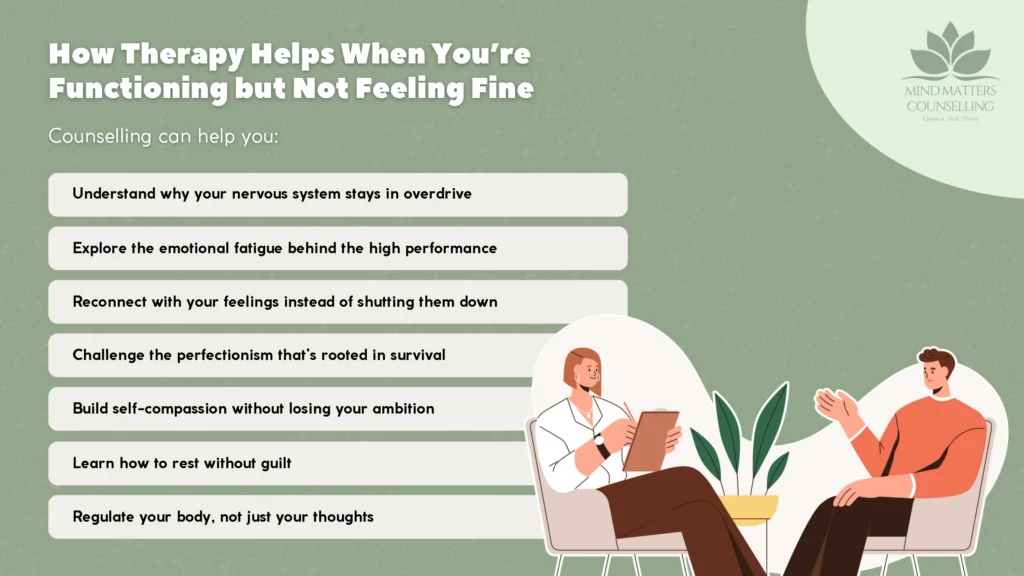
Counselling can help you:
- understand why your nervous system stays in overdrive
- explore the emotional fatigue behind the high performance
- reconnect with your feelings instead of shutting them down
- challenge the perfectionism that’s rooted in survival
- build self-compassion without losing your ambition
- learn how to rest without guilt
- regulate your body, not just your thoughts
Using approaches like CBT, attachment work, somatic therapy, and IFS, we look beneath the surface — not to pathologize you, but to support you.
You don’t have to stop being strong.
You just don’t have to be strong alone.
If This Feels Familiar — You’re Not Alone
High-functioning anxiety and depression are deeply misunderstood because they’re deeply hidden.
If you’ve been holding everything together but feel disconnected inside, this is your reminder:
Your feelings deserve space too.
Your exhaustion is real.
And healing doesn’t require everything to fall apart first.
If you’ve been functioning on the outside but feeling disconnected on the inside, therapy can help you slow down, breathe, and reconnect with yourself.
Book a session with a therapist at Mind Matters Counselling in New Westminster, Burnaby, and across Metro Vancouver.