Let’s face it: one of the first questions you have to answer when deciding to seek therapy is this: which type of therapy should I try? Two of the most popular (and evidence-based) types of therapy discussed around are Emotionally Focused Therapy vs Cognitive Behavioural Therapy. They’re both backed by research, both practiced commonly by registered clinical counsellors, and both can help facilitate real, lasting change but how they do that differs significantly.
Whether you’re dealing with relationship issues, occupational burnout, anxiety, or the silent stress of perfectionism, knowing the difference between EFT and CBT can help you decide which type of counselling will work best for you. This guide will discuss what each modality involves, in simple terms, point you towards which type of counselling might work best for your situation, and tell you why working with a qualified counsellor who can tailor their approach to your unique needs is crucial.
What Is Cognitive Behavioural Therapy (CBT)?
CBT stands for Cognitive Behavioural Therapy. It is a type of talk therapy that is goal-oriented and structured. CBT works off of the idea that our thoughts influence our emotions, and our emotions affect our behaviour. Thoughts that create negative emotions and poor behaviours are identified and changed. These irrational thought patterns are known as cognitive distortions.
CBT tends to be more short-term focused. It is used to target specific problems and teach skills to overcome them. There may be homework, journaling, thought records, behavioural activation, and exposure tasks involved in CBT. The therapist will help you set goals for your therapy and track your progress.
CBT is often particularly effective for:
- Anxiety disorders, including generalized anxiety, social anxiety, and panic disorder
- Depression and low mood
- Phobias and obsessive-compulsive patterns
- Stress management and burnout
- Perfectionism and self-critical thinking, concerns commonly seen in therapy for ambitious professionals
- Building practical coping strategies in a relatively short timeframe
What Is Emotionally Focused Therapy (EFT)?
Emotionally Focused Therapy began in the 1980s with Sue Johnson and Leslie Greenberg’s development of Emotionally Focused Couples Therapy. Since then EFCT has expanded and adapted to include work with individuals, as well as families. Emotionally focused individual therapy uses the same foundational theoretical structure, the science of attachment to understand how one’s early experiences with relationships inform one’s present-day emotion dynamic, sense of self, and approach to relationships.
Whereas CBT focuses on cognitions or “thoughts,” EFT emphasizes emotions. In EFT, we help clients gently pause, approach, and process their challenging emotions so that habitual, often frozen emotional responses can thaw into healthier, more flexible ones. Through the therapeutic relationship, clients become empowered to access and explore deeper and more vulnerable emotions, sadness, shame, fear, yearning and expand their capacity to experience and process these emotions, leading to transformation on a deep identity level.
Emotionally Focused Individual Therapy tends to be especially helpful for:
- Attachment-related struggles, including fear of intimacy, emotional withdrawal, or abandonment anxiety
- Processing complex or long-standing grief and loss
- Relationship dissatisfaction or recurring relational patterns
- Low self-worth, shame, and identity confusion
- Trauma that is emotionally stored rather than cognitively understood
- Individuals who feel stuck even after trying cognitive or solution-focused approaches
EFT vs CBT: Key Differences at a Glance
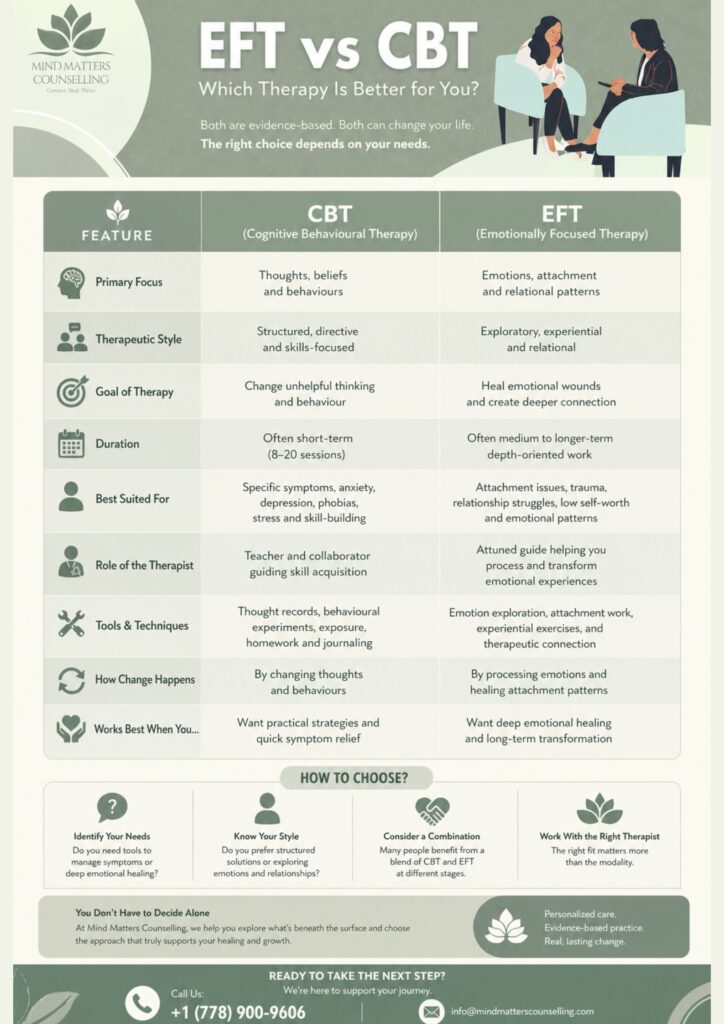
While both therapies are evidence-based and widely respected, their core philosophies and methods differ in meaningful ways. Here is a simplified comparison to help clarify how each approach works:
Primary Focus
- CBT: Thoughts, beliefs, and behaviours
- EFT: Emotions, attachment, and relational patterns
Therapeutic Style
- CBT: Structured, directive, skills-focused
- EFT: Exploratory, experiential, relational
Duration
- CBT: Often shorter-term (8–20 sessions)
- EFT: Often medium to longer-term, depth-oriented work
Best Suited For
- CBT: Specific, identifiable symptoms and skill-building needs
- EFT: Emotional patterns, relational struggles, identity-level change
Role of the Therapist
- CBT: Teacher and collaborator, guiding skill acquisition
- EFT: Attuned guide, helping clients process emotional experience
Which Therapy Is Better for Ambitious Professionals?
Therapy with high-achievers. People who thrive under pressure and lean heavily into their careers have some specific needs when it comes to counselling. They tend to show up to counselling highly analytical, goal-oriented, and potentially… sketched out about feeling vulnerable. Talk therapy that focuses solely on emotion can feel weird and unnatural to them at first (and, frankly, CBT can feel very intuitive).
However, many high-functioning clients report that while CBT can help with symptoms, it doesn’t quite get at the heart of that gnawing feeling like you’ll never be good enough, or why they still feel so emotionally distant from their partner, or that dull sense of discontent when they “should” be happy with all their success. That’s where EFT can MAGIC.
Truthfully, there’s no right or wrong answer. There’s not a specific type of therapy that is “better” for high-achievers. It kind of just depends on what you’re looking to work on, what you’re open to working on, and how you vibe with your therapist. Some folks will do CBT work to manage symptoms and then move into EFT work to delve deeper. Some people like a combination of both.
How Mind Matters Counselling Can Help You Navigate This Choice
You don’t have to decide if EFT or CBT is right for you. In fact, that’s the kind of question you can bring to a registered clinical counsellor.
Mind Matters Counselling is located in New Westminster, BC, and consists of a team of RCC’s who practice individual counselling tailored to you and your needs – not a cookie cutter approach. Our counsellors will help you to process what you’ve been through at your own pace in a safe, confidential, and non-judgmental environment. You’ll learn skills to cope with the challenges life throws your way and begin to regain your emotional equilibrium.
What differentiates Mind Matters Counselling from other therapists is we want to meet you where you’re at. Whether that’s CBT and building skills, Emotionally Focused Individual Therapy that helps make sense of your past in the context of attachment, or a balance of both approaches your counsellor will help you decide what type of therapy will best suit your goals, history, and where you’re at in your readiness to change.
Not sure where to start with individual counselling in New Westminster? Book yourself an intake session. You don’t have to know what type of therapy you want when you come – you just have to show up.
Common Misconceptions About EFT and CBT
Several persistent myths surround both therapeutic approaches. Addressing these can help you enter therapy with more realistic and empowering expectations.
Myth 1: CBT is only for people with severe mental illness.
CBT is highly adaptable and effective for a wide range of concerns from managing everyday stress and perfectionism to building resilience in high-demand careers. You do not need to be in crisis to benefit from it.
Myth 2: EFT means you will spend every session crying.
While EFT does involve emotional depth, it is a carefully paced and supported process. Therapists trained in Emotionally Focused Individual Therapy are skilled at helping clients access emotions in a way that feels manageable rather than overwhelming.
Myth 3: You have to choose one or the other.
Many registered clinical counsellors are trained in multiple modalities and work integratively. If both CBT and EFT have elements that appeal to you, it is entirely possible and often beneficial to work with a counsellor who draws from both frameworks.
Making the Decision: Questions to Ask Yourself
If you are still unsure whether EFT or CBT is the better starting point for you, the following reflective questions can help guide your thinking:
- Do I want to build specific skills to manage anxiety, stress, or unhelpful thinking? (CBT may be a strong fit)
- Do I want to understand and shift deeper emotional patterns or recurring relational dynamics? (EFT may be a strong fit)
- Am I dealing with concerns that feel primarily cognitive, or does it feel like something deeper is going on emotionally?
- How comfortable am I with sitting with difficult emotions in a therapeutic setting?
- Am I looking for shorter-term, practical help, or am I open to a longer, more exploratory process?
- Do I want my counsellor to guide me toward specific tools, or to accompany me in processing my inner world?
Final Thoughts: The Best Therapy Is the One That Fits You
There is no clear-cut winner in the EFT vs CBT debate. Each is an extremely effective, evidence-based form of therapy that has restored hope and helped thousands of people to live happier, more emotionally free lives. The important question is not which therapy is better overall—it’s which therapy will work better for you at this time based on your unique situation, goals, and internal landscape.
If you’re ready to start or further your journey into therapy by partnering with a registered clinical counsellor who will take the time to understand your unique needs, Mind Matters Counsellling is here for you. We don’t try to squeeze you into a one-size-fits-all model, we walk with you on your journey to greater awareness, connection, and emotional health.
You do not need to have everything figured out before you reach out. You just need to take one step.
Frequently Asked Questions
1. Is EFT or CBT better for anxiety?
CBT has the strongest research base for anxiety disorders and is often the first-line recommendation. However, if your anxiety stems from deep-rooted attachment fears, chronic self-criticism, or unresolved emotional experiences, Emotionally Focused Individual Therapy may address the root cause more effectively. Many individuals benefit from a combination of both.
2. How do I find individual counselling in New Westminster?
You can connect with a Registered Clinical Counsellor in New Westminster through the BC Association of Clinical Counsellors directory, Psychology Today’s therapist finder, or by reaching out directly to practices like Mind Matters Counselling. When searching, consider what approach you are drawn to, whether you prefer in-person or virtual sessions, and whether the counsellor’s areas of focus align with your concerns.
3. What is Emotionally Focused Individual Therapy (EFIT)?
Emotionally Focused Individual Therapy (EFIT) is an adaptation of EFT designed for one-on-one work rather than couples or families. It draws on attachment theory to help individuals explore and transform habitual emotional patterns that interfere with their sense of self and their ability to connect meaningfully with others.
4. Is therapy for ambitious professionals different from regular therapy?
Not categorically — but a good therapist will recognize and work within the specific context of high-achieving clients. Ambitious professionals often face unique pressures including performance anxiety, identity tied to productivity, burnout, imposter syndrome, and difficulty slowing down enough to connect with emotional needs.
5. How many sessions of CBT or EFT will I need?
The number of sessions depends on your individual goals, the complexity of your concerns, and the therapeutic approach. CBT is typically shorter-term, often ranging from 8 to 20 sessions for specific issues. EFT tends to be a longer process, particularly when working through deep emotional patterns or attachment-related concerns.