Understanding Guilt, Marriage, Family Expectations, and Boundaries in South Asian Families
You love your husband. You love your family. You want everyone to get along and everything to stay happy. And yet, sometimes you find yourself feeling caught between your marriage and your relationship with your in-laws.
Maybe your mother-in-law passes a comment or you are expected to attend a wedding every weekend.
Sometimes out of nowhere a comment on how you didn’t help with errands, or cooked meals how they like it in your in-laws’ family.
Maybe everyone has an opinion about how you should run your home.
Maybe you want more privacy with your spouse.
Maybe you want to say no.
But then the guilt starts.
“Am I being disrespectful?”
“Will they think I’m selfish?”
“What if they say I’m changing their son?”
“What if my husband thinks I’m creating problems?”
“Maybe I should just adjust.”
This is where boundaries can become particularly complicated for South Asian newlyweds. Because you’re not only learning how to build a marriage. You’re often learning how to navigate an entire family system.
At Mind Matters Counselling, we support individuals and couples navigating boundaries, family expectations, cultural stress, people pleasing, anxiety, and relationship difficulties in New Westminster, Burnaby, Surrey, and surrounding Lower Mainland communities.
Marriage Doesn’t Always Mean You Are Joining Just One Person
In many South Asian families, marriage can involve much more than two individuals.
It can mean becoming part of:
- a larger family system
- established traditions
- family expectations
- cultural roles
- religious or cultural celebrations
- different ideas about respect
- expectations around caregiving
- expectations around visiting
- expectations around communication
For some couples, this can be beautiful.
There can be tremendous support, connection, and belonging. But it can also become complicated when the couple’s needs don’t align with the expectations of the extended family. You may suddenly realize:
“I thought I was marrying my partner. I didn’t realize I was also learning how to navigate an entire family system.”
Why Do Boundaries With In-Laws Feel So Personal?
In many Western contexts, saying:
“We’re not available this weekend.”
may simply be viewed as a scheduling decision.
Within some South Asian families, the same sentence can be interpreted as:
“You don’t want to spend time with us.”
Or:
“You think you’re better than us.”
Or:
“Marriage has changed you.”
Or:
“She is keeping our son away from us.”
Suddenly, a simple boundary feels like a statement about loyalty. This can make boundaries incredibly difficult. Because you’re not only managing the practical issue.
You’re managing the meaning attached to the boundary.
“If I Say No, Does That Make Me a Bad Daughter-in-Law?”
This is one of the biggest struggles for women navigating extended family expectations. You may have been taught:
Respect your elders.
Don’t talk back.
Adjust.
Keep the peace.
Family comes first.
These values can be meaningful. But there is a difference between respect and self-abandonment. Respect doesn’t have to mean unlimited access to your time. Respect doesn’t mean you cannot have privacy. Respect doesn’t mean you have to agree with everything. Respect doesn’t mean you cannot have different expectations for your marriage.
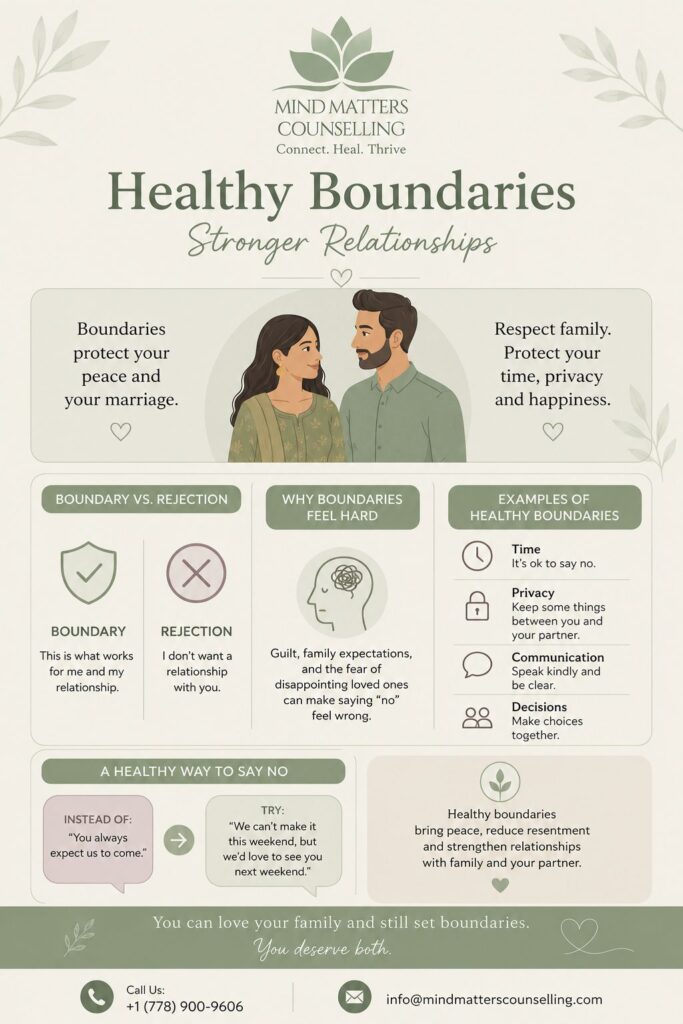
The Difference Between a Boundary and Rejection
This distinction can change how you think about boundaries.
A boundary says:
“This is what works for me.”
Rejection says:
“I don’t want you.”
A boundary might sound like:
“We’d love to see you, but we’re going to have a quiet weekend at home.”
That isn’t rejection.
It is simply communicating what you need.
Another boundary might be:
“We won’t be able to attend every wedding event, but we’ll let you know which ones we can make.”
Again, this doesn’t mean:
“We don’t care about the family.”
It means:
“We have limits.”
Why Newlywed Women Can Feel Especially Guilty
The early stages of marriage can involve a huge identity transition.
You may be figuring out:
Who am I now?
What traditions do I want to keep?
What traditions don’t work for me?
What does being a wife mean to me?
What role do I want with my in-laws?
What does our marriage look like separately from our families?
And if you’re also trying to establish yourself in a new family, you may feel pressure to prove that you’re:
- respectful
- loving
- flexible
- helpful
- easygoing
- appreciative
- family-oriented
This can create a trap. You may start saying yes to everything because you want to make a good impression.Then months later, you’re exhausted and resentful.
When “Adjusting” Becomes Self-Abandonment
There is nothing inherently wrong with compromise.
Marriage requires compromise.
Families require compromise.
Relationships require flexibility.
But compromise becomes unhealthy when one person is always the one adjusting.
Ask yourself:
Am I compromising because this matters to both of us?
Or:
Am I compromising because I’m afraid of what will happen if I say no?
Those are very different experiences.
If you repeatedly suppress your needs to prevent conflict, eventually the relationship may appear peaceful on the outside while resentment grows underneath.
The Resentment That Comes From Unspoken Boundaries
This can look like:
Your in-laws ask you to attend another family event.
You say yes.
You didn’t want to go.
You spend the entire day feeling irritated.
You come home exhausted.
Your husband doesn’t understand why you’re upset because:
“You said you were okay with going.”
And technically, you did.
But what you may actually be feeling is:
“Why do I always have to be the one to adjust?”
This is why boundaries are important.
Without them, you may start expecting your partner or family to somehow recognize needs you haven’t communicated.
And when they don’t, resentment grows.
Why Your Husband’s Role Matters
When extended family is involved in a marriage, the spouse who belongs to that family often has an important role in helping establish boundaries.
This doesn’t mean:
“Choose your wife over your family.”
And it doesn’t mean:
“Choose your family over your wife.”
The goal is to create a marriage where both partners can say:
“We love our families, and we are also building our own family.”
Your marriage needs its own identity.
Your own routines.
Your own privacy.
Your own decisions.
Your own boundaries.
Boundaries Don’t Have to Be Aggressive
A boundary doesn’t have to sound harsh.
It doesn’t have to involve confrontation.
And you don’t need to list everything someone has done wrong.
Try:
“We won’t be able to come this weekend, but we’d love to see everyone next weekend.”
Instead of:
“You guys always expect us to be there.”
Try:
“We’re trying to create more downtime for ourselves, so we’re going to be more selective about how often we attend gatherings.”
Instead of:
“Please stop giving me advice.”
Try:
“I appreciate that you care. I’m going to try this approach and see how it works for us.”
The goal isn’t to win.
The goal is to communicate clearly.
What If They Get Upset?
This is where boundary-setting becomes difficult.
You can communicate a boundary respectfully and still have someone dislike it.
They may become upset.
They may disagree.
They may make comments.
They may tell you that things were different in their generation.
They may interpret your boundary personally.
And you may feel guilty.
But remember:
Someone’s emotional reaction does not automatically mean your boundary was wrong.
You are allowed to have limits even when someone doesn’t like them.
This is one of the hardest parts of moving away from pleasing people.
The Guilt After Setting a Boundary
Sometimes the boundary isn’t actually the hardest part.
It’s what happens afterward.
You say no.
Then you spend three hours thinking:
“Maybe I should have just gone.”
“Maybe I was rude.”
“Maybe I should call and apologize.”
“What if they’re upset with me?”
This is boundary guilt.
And the goal isn’t necessarily to make the guilt disappear immediately.
The goal is to learn:
“I can feel guilty and still know that my boundary was reasonable.”
Guilt is an emotion.
It isn’t always evidence that you’ve done something wrong.
South Asian Families and the Meaning of Respect
Culture matters when we talk about boundaries.
For many South Asian families, values such as family connection, respect for elders, collectivism, responsibility, and interdependence are deeply meaningful.
These values should not be treated as problems that need to be “fixed.”
The goal of culturally informed counselling is not to tell you:
“Ignore your family and do whatever you want.”
It is to help you ask:
“How can I honour my family and culture while also creating a healthy marriage and maintaining my own sense of self?”
You don’t necessarily have to choose between:
family OR boundaries.
There may be a third option:
family WITH healthy boundaries.
What Healthy Boundaries With In-Laws Can Look Like
Healthy boundaries might involve:
Privacy
Your marriage does not need to be discussed with everyone.
Time
You don’t need to attend every gathering.
Decision-making
You and your spouse get to make decisions about your home and relationship.
Communication
You can decide how and when you communicate with extended family.
Emotional boundaries
You can care about someone’s feelings without taking responsibility for fixing them.
Physical boundaries
You are allowed to have personal space and time.
Financial boundaries
Couples can establish their own approach to money, spending, and family support.
Parenting boundaries
Parents may seek advice from extended family while still making final decisions for their children.
What If I’m Scared My In-Laws Will Think I’m Selfish?
You might be.
And they might.
But your goal cannot be to control everyone’s interpretation of you.
If you have spent years trying to be liked, approved of, and understood by everyone, boundaries will feel uncomfortable.
You may have to tolerate being misunderstood sometimes.
You may have to tolerate someone thinking:
“She’s changed.”
And perhaps you have.
Maybe marriage has taught you that you need more privacy.
Maybe becoming an adult has taught you that your needs matter.
Maybe you are realizing that being agreeable isn’t the same thing as being healthy.
Change isn’t necessarily disrespectful.
What If My Husband Doesn’t Support My Boundaries?
This is where the issue can become a couples problem, rather than simply an in-law problem.
You may say:
“I need us to have more privacy.”
Your husband may respond:
“That’s just how my family is.”
Now the real conversation isn’t only about your mother-in-law.
It’s about:
How do we make decisions as a couple?
How do we handle family pressure?
What happens when our families have expectations that conflict with our needs?
How do we protect our relationship without cutting off our families?
These are important conversations for many couples.
When Family Boundaries Start Affecting Your Marriage
Consider seeking couples counselling if:
- you and your spouse repeatedly argue about family
- one partner feels caught in the middle
- you feel your spouse doesn’t defend or understand you
- family involvement is affecting intimacy
- you are constantly arguing about visits
- one partner feels responsible for keeping their family happy
- resentment is building
- you avoid talking about family because it always becomes a fight
The goal isn’t to decide who is right.
It’s to help the couple become a stronger team.
How Counselling Can Help With In-Law Boundaries
At Mind Matters Counsellling, therapy can provide a space to explore the emotional and cultural layers underneath family conflict.
Counselling may help you:
- identify your boundaries
- understand boundary guilt
- reduce people-pleasing
- communicate needs clearly
- manage conflict
- navigate cultural expectations
- strengthen your marriage
- develop a shared approach to extended family
- understand family roles
- reduce resentment
- build confidence in your decisions
For couples, therapy can also help partners move away from:
“Your family is the problem.”
toward:
“How can we handle this together?”
That shift can be incredibly important.
You Can Love Your Family and Still Need Boundaries
You don’t have to choose between being a good daughter-in-law and having a healthy marriage.
You don’t have to become cold.
You don’t have to stop caring.
You don’t have to cut people off.
And you don’t have to say yes to everything to prove that you respect someone.
Healthy boundaries are not about creating distance for the sake of distance.
They are about creating relationships where connection doesn’t require self-abandonment.
At Mind Matters Counselling, we support individuals and couples navigating South Asian family dynamics, newlywed adjustment, people pleasing, anxiety, communication difficulties, and boundaries in New Westminster, Burnaby, Surrey, and surrounding Lower Mainland communities.
If you find yourself constantly asking:
“How do I keep everyone happy without losing myself?”
That may be something worth exploring.
You can build a marriage that honours your culture, your family, your partner and you.
Book a counselling session with Mind Matters Counselling to explore boundaries, family expectations, and your relationship in a supportive and culturally informed space.
Frequently Asked Questions
Is it normal to have difficulty setting boundaries with in-laws?
Yes. Boundaries with in-laws can be particularly complicated when family relationships are close, expectations are strong, or cultural values emphasize respect, family involvement, and adjustment.
How do I set boundaries with my mother-in-law without being disrespectful?
Use clear, respectful language and focus on what works for you rather than criticizing the other person. You can communicate a limit without making the relationship the problem.
Why do I feel guilty setting boundaries with family?
If you learned that being a good family member means being available, agreeable, or accommodating, saying no can trigger guilt. Therapy can help distinguish genuine responsibility from learned people-pleasing patterns.
Should my husband set boundaries with his family?
Boundaries are ultimately a shared responsibility within a marriage. Partners can work together to determine what boundaries are needed and how they want to communicate them to their respective families.
How do I balance my marriage and my in-laws?
A healthy marriage doesn’t necessarily require choosing between your spouse and your extended family. Couples can create their own expectations around time, privacy, decision-making, communication, and family involvement while maintaining meaningful family relationships.
Can couples counselling help with in-law problems?
Yes. Couples counselling can help partners communicate about family expectations, reduce resentment, establish shared boundaries, and develop a united approach to extended-family conflict.
Is setting boundaries selfish?
No. A boundary communicates what you can and cannot participate in. Healthy boundaries allow relationships to continue without requiring one person to consistently sacrifice their needs.
Can Mind Matters Counselling help with South Asian family issues?
Mind Matters Counselling provides culturally informed counselling for individuals and couples navigating family expectations, boundaries, relationships, anxiety, people pleasing, and cultural stress in New Westminster, Burnaby, Surrey, and surrounding communities.