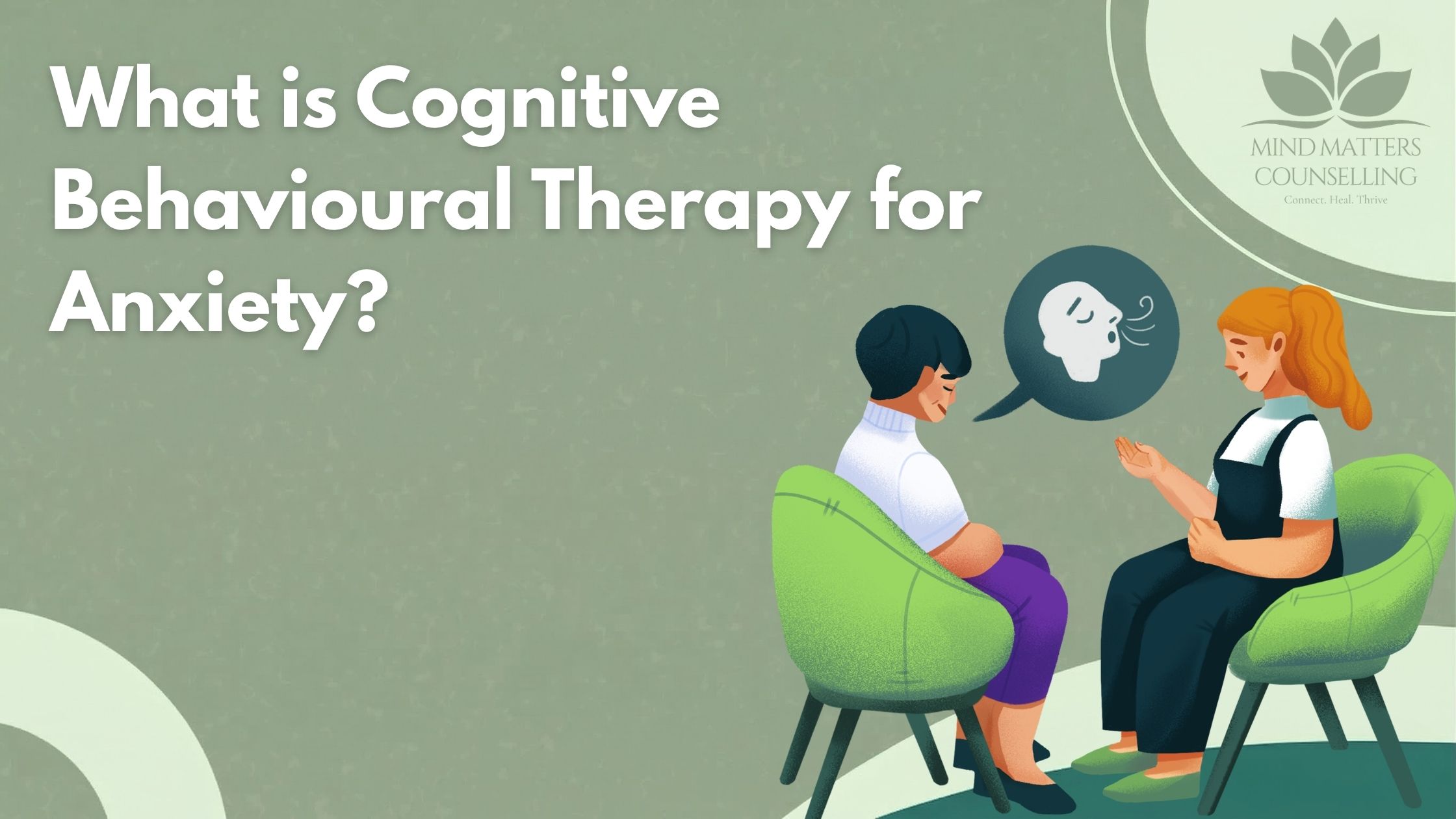
Cognitive therapy for anxiety focuses on the connection between your thoughts, emotions, physical symptoms, and behaviours. Learn how cognitive therapy and CBT can help you manage anxiety and develop healthier ways of responding to anxious thoughts.
You know that feeling when your mind takes one small possibility and turns it into ten different worst-case scenarios?
What if something goes wrong?
What if they are upset with me?
What if I make a mistake?
What if I can’t handle it?
What if something happens to my family?
You may know logically that the thought isn’t necessarily true. But knowing that doesn’t always make the anxiety go away. This is where cognitive behavioural therapy for anxiety can be helpful.
Cognitive behavioural therapy looks at the relationship between the way we think and the way we feel and behave. When anxiety repeatedly tells you that something is dangerous, catastrophic, or impossible to handle, therapy can help you slow that process down and examine the thoughts driving the anxiety.
At Mind Matters Counselling, our therapists use approaches including Cognitive Behavioural Therapy (CBT) to support individuals experiencing anxiety, depression, stress, relationship difficulties, and other concerns. We provide in-person and virtual counselling from our New Westminster practice and support clients throughout the Lower Mainland.
What Is Cognitive Behavioural Therapy?
Cognitive therapy is a form of psychotherapy based on the idea that our thoughts, emotions, and behaviours are connected. The way you interpret a situation can influence how you feel about it and what you do next. For example, imagine your partner hasn’t responded to your text for several hours.
The situation is:
“My partner hasn’t responded.”
Your mind might interpret that situation in several different ways.
Thought 1:
“They’re probably busy.”
You may feel relatively calm.
Thought 2:
“They’re probably upset with me.”
You may feel anxious.
Thought 3:
“Something must be wrong.”
Your anxiety may increase significantly.
Thought 4:
“They’re tired of me and our relationship is falling apart.”
Now you may feel panicked, start repeatedly checking your phone, send multiple messages, or seek reassurance.
The external situation hasn’t changed.
The interpretation has.
Cognitive Behavioral therapy helps you examine that interpretation and manage the perception.
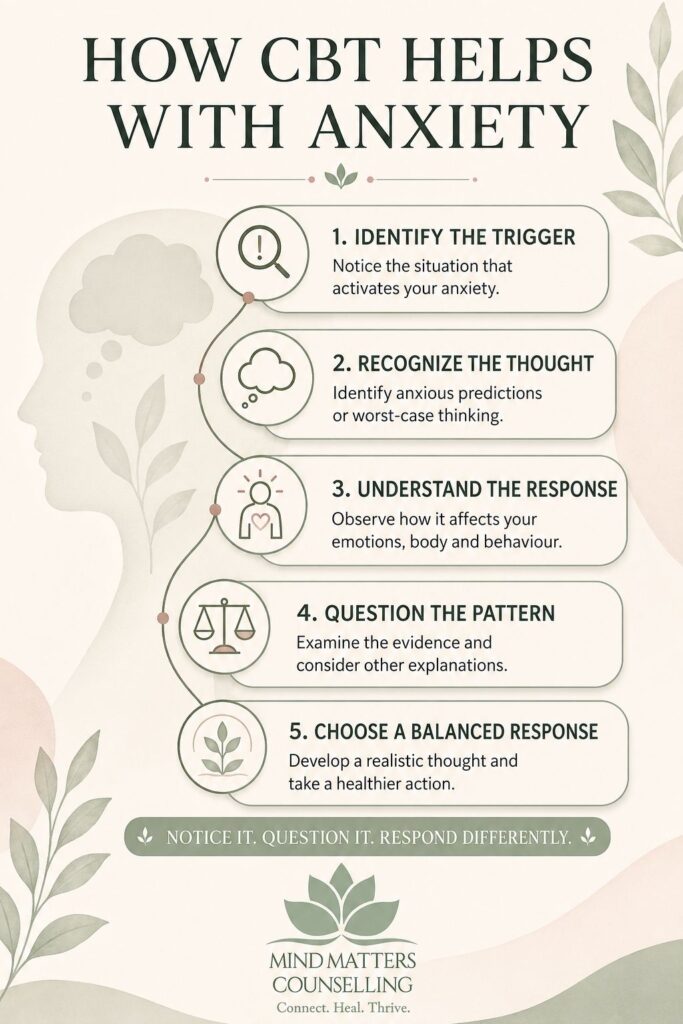
How Does Cognitive Behavioural Therapy Help Anxiety?
Anxiety often involves patterns of thinking that make situations feel more threatening than they may actually be.
The American Psychological Association explains that cognitive-behavioural therapy can help people identify and manage factors contributing to anxiety, including the thought patterns associated with anxiety symptoms.
Some common anxious thinking patterns include:
- catastrophizing
- assuming the worst
- overestimating danger
- underestimating your ability to cope
- all-or-nothing thinking
- mind reading
- overgeneralizing
- excessive “what if” thinking
- self-criticism
- needing certainty before making decisions
Cognitive therapy doesn’t involve simply telling yourself:
“Don’t think negatively.”
That’s usually much easier said than done.
Instead, therapy helps you become more aware of the thought, understand where it comes from, examine whether it is accurate or helpful, and develop a more balanced way of responding.
What Is the Difference Between Cognitive Therapy and CBT?
You may have searched for:
“cognitive therapy for anxiety”
and then come across:
“CBT for anxiety.”
So are they the same thing?
They’re closely related, but there is a distinction.
Cognitive therapy focuses primarily on identifying and changing unhelpful patterns of thinking.
Cognitive Behavioural Therapy (CBT) incorporates cognitive strategies alongside behavioural strategies.
CBT looks at the relationship between:
Thoughts → Feelings → Behaviours
For example:
“I’m going to embarrass myself.” ( THOUGHT )
↓
Anxiety ( FEELING)
↓
Avoiding the social event ( BEHAVIOUR)
↓
Temporary relief
↓
More anxiety about future social situations Therapy can help interrupt this cycle.
Instead of automatically avoiding the situation, you can gradually learn to respond differently.
The American Psychological Association describes CBT as a psychotherapy that integrates cognitive and behavioural approaches and targets the relationship between cognition, emotion, and behaviour.
What Does Anxiety Actually Have to Do With Thoughts?
Anxiety is not simply “thinking too much.”
It involves emotional, physical, cognitive, and behavioural responses.
You might experience:
- racing thoughts
- excessive worry
- difficulty concentrating
- irritability
- restlessness
- muscle tension
- difficulty sleeping
- feeling constantly on edge
- rapid heartbeat
- stomach discomfort
- shortness of breath
- avoidance
- reassurance seeking
The American Psychological Association notes that anxiety can involve persistent worry, physical tension, difficulty concentrating, irritability, and sleep difficulties, depending on the type of anxiety being experienced.
Your thoughts and your body’s response can also reinforce one another. You notice your heart beating faster.
You think:
“Something is wrong.”
That thought increases your fear. Your body becomes more activated. You notice the physical symptoms again. And the cycle continues.
The Anxiety Thought Cycle
Consider someone who is worried about an upcoming work presentation.
They think:
“What if I mess this up?” ( Thought )
That creates anxiety.
They begin thinking about everything that could go wrong. They avoid practicing because thinking about the presentation makes them uncomfortable.Because they haven’t practiced, they feel even less confident.
Then they think:
“See? I’m definitely going to fail.” ( Feeling )
The cycle becomes stronger.
Cognitive therapy can help identify the different points in that cycle.
The goal isn’t to convince yourself:
“Everything will definitely go perfectly.”
That’s another form of unrealistic thinking.
Instead, you may work toward something more balanced:
“I might feel nervous. I may make a mistake. But I can prepare, and I can handle an imperfect presentation.”
That’s a very different way of relating to anxiety.
Does Cognitive Therapy Try to Get Rid of Negative Thoughts?
No.
This is an important distinction.
Everyone has negative thoughts.
Everyone worries sometimes.
Everyone has moments of self-doubt.
The goal of therapy isn’t to create a mind where you never have an anxious thought.
Instead, the goal is to help you:
Notice the thought.
Understand the thought.
Question the thought.
Respond to the thought differently.
You may still experience:
“What if something goes wrong?”
But instead of automatically treating that thought as a prediction, you may learn to respond:
“That’s my anxiety trying to prepare me for uncertainty.”
That shift can be powerful.
Common Cognitive Distortions That Can Fuel Anxiety
A major part of cognitive therapy may involve identifying patterns of thinking that contribute to anxiety.
Catastrophizing
You immediately imagine the worst possible outcome.
“If I make one mistake at work, I’ll lose my job.”
All-or-Nothing Thinking
Everything becomes either a complete success or a complete failure.
“If I can’t do this perfectly, I’m terrible at it.”
Mind Reading
You assume you know what another person is thinking.
“They didn’t respond because they’re angry with me.”
Fortune Telling
You treat an uncertain future as though you already know what will happen.
“This is definitely going to go badly.”
Overgeneralizing
One difficult experience becomes evidence that everything will be difficult.
“That relationship ended badly. I’ll never have a healthy relationship.”
Should Statements
You create rigid rules for yourself.
“I should be able to handle everything.”
“I shouldn’t feel this anxious.”
“I should always know what to do.”
Recognizing these patterns doesn’t mean criticizing yourself for having them.
It gives you something you can work with.
What Happens in Cognitive Therapy for Anxiety?
Many people feel nervous about starting therapy because they don’t know what actually happens during a session.
Cognitive therapy is generally collaborative and structured.
Your therapist may begin by understanding:
- what you’re experiencing
- when your anxiety started
- what triggers it
- how it affects your daily life
- what thoughts tend to come up
- what you do when you feel anxious
- what you have already tried
- what you want to change
Together, you may identify a specific anxiety cycle.
For example:
- Trigger: Partner doesn’t respond.
- Thought: “They’re angry with me.”
- Feeling: Anxiety.
- Physical response: Heart racing.
- Behaviour: Repeatedly checking the phone.
- Short-term result: Temporary reassurance.
- Long-term result: Greater dependence on reassurance.
Once the cycle becomes visible, you have something concrete to work on.
Will My Therapist Tell Me That My Thoughts Are Wrong?
Not necessarily.
Therapy isn’t about your therapist sitting across from you and saying:
“That’s irrational.”
A more useful approach is often curiosity.
For example:
“What makes you believe that?”
“What evidence supports that thought?”
“Is there another possible explanation?”
“If your friend were in this situation, would you expect them to interpret it the same way?”
“What are you predicting will happen?”
“If the worst-case scenario did happen, how would you cope?”
These questions can help create distance between having a thought and believing that thought is a fact.
What About Behaviour?
This is where CBT can go beyond changing thoughts.
Sometimes anxiety is maintained by what we do to feel safer.
You may:
- avoid certain situations
- constantly check things
- seek reassurance
- repeatedly Google symptoms
- ask your partner if everything is okay
- cancel plans
- procrastinate
- avoid difficult conversations
- stay home because you’re afraid of feeling anxious
These behaviours can provide temporary relief.
But avoiding anxiety can sometimes strengthen it over time. The APA notes that avoidance can backfire and contribute to maintaining anxiety.
For example:
You feel anxious about driving.
You avoid driving.
You feel better because you’re no longer anxious.
Your brain learns:
“Avoiding driving kept me safe.”
The next time you think about driving, the anxiety may become even stronger.
This is one reason behavioural strategies can be an important part of CBT.
Does Cognitive Therapy Include Homework?
It can. Depending on your therapist and treatment plan, you may practice skills between sessions.
This might include:
- tracking anxious thoughts
- identifying triggers
- completing thought records
- practicing alternative responses
- gradually approaching avoided situations
- practicing relaxation or grounding skills
- monitoring reassurance seeking
- journaling patterns
- trying new communication strategies
This doesn’t mean you will be given a huge workbook and told to complete pages every night.
The purpose is to help you take what you’re learning in therapy and apply it to your actual life.
Who Can Benefit From Cognitive Therapy for Anxiety?
Cognitive and CBT-based approaches can be helpful for many forms of anxiety, including concerns involving:
- generalized anxiety
- social anxiety
- panic symptoms
- excessive worry
- performance anxiety
- health anxiety
- relationship-related anxiety
- perfectionism
- fear of making mistakes
- difficulty tolerating uncertainty
The right approach depends on the person, their symptoms, their history, and their goals.
Therapy should be individualized rather than treating every person’s anxiety exactly the same way.
What If My Anxiety Is Connected to My Relationships?
Sometimes anxiety doesn’t exist in isolation. When anxiety is contributing to communication difficulties, reassurance seeking or recurring conflict, couples counselling in New Westminster may help partners understand these patterns and respond more constructively.
You may notice that your anxiety becomes particularly strong when:
- your partner doesn’t respond
- you think someone is upset with you
- you’re afraid of abandonment
- you’re worried about disappointing someone
- you’re having conflict
- you’re uncertain about your relationship
- you feel rejected
- you’re constantly seeking reassurance
In these situations, cognitive strategies may be useful, but it can also be important to understand the relational or attachment patterns underneath the anxiety.
For example:
“My partner hasn’t texted back.”
may trigger:
“They’re losing interest.”
which may connect to a deeper fear:
“People eventually leave me.”
Understanding the thought is important.
Understanding why that thought feels so believable can be equally important.
At Mind Matters, our therapists integrate approaches based on each client’s needs, including CBT, attachment-based approaches, and other evidence-informed modalities.
Can Cognitive Therapy Help With Perfectionism and Overthinking?
It can be particularly relevant when perfectionism and overthinking are connected to anxiety.
You might find yourself thinking:
“I need to get this exactly right.”
“What if I make the wrong decision?”
“I should have handled that conversation better.”
“What if people think badly of me?”
“I need to think this through one more time.”
The problem isn’t that thinking is bad.
The problem is when thinking becomes a way of trying to achieve complete certainty in situations where certainty isn’t possible.
Therapy can help you recognize when problem-solving ends and rumination begins.
How Long Does Cognitive Therapy for Anxiety Take?
There is no single number of sessions that works for everyone.
Some people notice meaningful changes relatively quickly.
Others have longstanding anxiety, trauma, relationship patterns, or multiple concerns that require more time.
The length of therapy can depend on:
- the type of anxiety
- how long symptoms have been present
- severity
- other mental-health concerns
- personal goals
- how much anxiety affects daily functioning
- whether you are able to practice skills between sessions
The APA notes that anxiety is treatable and that many people experience improvement with psychotherapy, with treatment tailored to the individual.
Is Cognitive Therapy the Same as Medication for Anxiety?
No.
Cognitive therapy is a form of psychotherapy.
Medication is a medical treatment prescribed and managed by an appropriate healthcare professional.
Some people use psychotherapy.
Some use medication.
Some use both.
The right treatment depends on the individual’s circumstances and should be discussed with qualified healthcare professionals.
What If I Don’t Know Exactly Why I’m Anxious?
You don’t need to arrive at therapy with a diagnosis or a perfect explanation.
You can simply say:
“I don’t know what’s wrong. I just don’t feel like myself.”
Or:
“My mind won’t stop.”
Or:
“I know I’m overthinking, but I can’t stop.”
Or:
“Everything looks fine from the outside, but I’m constantly anxious.”
That’s enough to start exploring what is happening.
A therapist can help you identify patterns that may not be obvious to you yet.
Cognitive Therapy for Anxiety in New Westminster, Burnaby & Surrey
If you’re looking for anxiety counselling in New Westminster, Burnaby, Surrey, or the surrounding Lower Mainland, Mind Matters Counselling provides individual counselling both in person and virtually. The practice offers support for anxiety, depression, grief, stress, relationship concerns, and other mental-health challenges.
Our therapists use evidence-informed approaches and tailor therapy to the individual rather than assuming one approach works for everyone.
At Mind Matters, cognitive and CBT-based strategies may be integrated with other approaches depending on what you’re experiencing and what you want to work on.
You don’t have to wait until your anxiety becomes unbearable to seek support.
If you’re constantly overthinking, avoiding situations, seeking reassurance, worrying about the future, or feeling like your mind never switches off, counselling can give you a space to understand the pattern and begin developing different ways of responding.
You Don’t Have to Believe Every Thought Anxiety Gives You
An anxious thought can feel incredibly convincing.
But a thought isn’t automatically a fact.
And feeling anxious doesn’t necessarily mean something is wrong.
Cognitive therapy can help you slow down the cycle between thoughts, emotions, physical sensations, and behaviours, understand the patterns that keep anxiety going, and develop more flexible ways of responding.
You don’t need to become someone who never worries.
The goal is to become someone who can notice worry without allowing it to make every decision for you.
If anxiety is interfering with your relationships, work, sleep, confidence, or everyday life, support is available.
Mind Matters Counsellling provides anxiety counselling and individual therapy in New Westminster, Burnaby, Surrey, and surrounding communities, with virtual counselling options also available.
Book a free 15-minute consultation with Mind Matters Counselling to discuss what you’re experiencing and whether counselling may be a good fit for you.
Frequently Asked Questions
What is cognitive therapy for anxiety?
Cognitive therapy for anxiety is a form of psychotherapy that focuses on identifying and changing unhelpful patterns of thinking that contribute to anxiety. It can help you examine anxious predictions, assumptions, and interpretations and develop more balanced ways of responding.
Is cognitive therapy the same as CBT?
Cognitive therapy and CBT are closely related but not exactly the same. Cognitive therapy focuses primarily on thoughts and interpretations, while CBT combines cognitive strategies with behavioural approaches.
Does CBT work for anxiety?
CBT is an evidence-based psychotherapy commonly used to treat anxiety disorders. It can help people understand the relationship between thoughts, emotions, behaviours, and anxiety symptoms.
Can therapy help with overthinking and anxiety?
Yes. Cognitive and CBT-based approaches can help you identify patterns of overthinking, catastrophizing, reassurance seeking, and other behaviours that may maintain anxiety.
Can cognitive therapy help with panic attacks?
Cognitive and CBT approaches can be used as part of treatment for panic symptoms. Therapy may help you understand the thoughts and behaviours associated with panic and gradually develop different responses to physical sensations and feared situations.
Can anxiety therapy help with relationship anxiety?
It can. Therapy may help you explore anxious thoughts related to rejection, abandonment, reassurance seeking, conflict, and uncertainty while also examining attachment and relationship patterns.
How do I know if I need anxiety counselling?
Consider seeking counselling if anxiety is interfering with your sleep, relationships, work, school, daily activities, or ability to enjoy life—or if you feel like worry and overthinking are becoming difficult to control.
Where can I find anxiety counseling in New Westminster?
Mind Matters Counselling provides individual counselling in New Westminster, with virtual options available. The practice supports clients experiencing anxiety, depression, grief, stress, relationship difficulties, and other concerns.
Can I see an anxiety therapist in Burnaby or Surrey?
Mind Matters Counselling is based in New Westminster and offers virtual counselling, allowing clients in surrounding Lower Mainland communities to access counselling depending on the therapist and service.