Grief counselling helps by giving your grief somewhere to go. It gives you protected time to talk about the person and the death, loosens the guilt and avoidance that keep grief stuck, and helps you rebuild routines and an identity that fit life after the loss. It helps most for people whose grief isn’t easing on its own.
That last sentence is the part most articles leave out. Grief counselling isn’t equally useful for everyone, and the research is fairly clear about who gets the most from it. Knowing that can help you decide whether now is the right time to book.
Key Takeaways
- Grief counselling works on avoidance, guilt, trauma around the death, and rebuilding daily life.
- A 2008 review of 61 controlled studies found the clearest benefits for people already struggling to adapt.
- In a 2005 JAMA trial, 51% of people with complicated grief responded to grief-focused treatment, versus 28% with standard therapy.
- If grief is stuck, the type of grief work matters.
How does grief counselling help?
Most of what grief counselling does is about getting grief moving again, not making it disappear. The person stays important to you. What changes is how much the loss controls your days. In practice, the work usually covers five things.
It gives grief a place to go
Friends and family often run out of room to hear about the loss after the first few months. A weekly session is an hour where you can talk about the person without watching someone’s face for signs they’ve had enough.
It loosens guilt and “what ifs”
Almost everyone replays the death. A counsellor helps you look at the replay honestly: what you knew then, what you couldn’t have known, and what you’re blaming yourself for that belongs somewhere else.
It works with avoidance, gently
Avoiding their room, their photos, the hospital route or even their name keeps pain manageable at first. Over time, it can freeze grief in place. Counselling helps you approach those reminders at a pace you pick.
It separates trauma from grief
When a death is sudden, violent or witnessed, the images can crowd out every other memory of the person. Trauma-informed work reduces those intrusive images, so you can grieve the person and not only the way they died.
It helps you rebuild a life that includes the loss
Who cooks now? Who makes the decisions? Who are you if you’re no longer a caregiver, a wife, a son with a living father? Counselling makes room for the practical questions and the identity ones.
Does bereavement counselling actually help?
Yes, though mostly for people who are struggling. In 2008, Currier, Neimeyer and Berman pooled 61 controlled studies in Psychological Bulletin. Overall, bereavement interventions had a small effect right after treatment and no significant benefit at follow-up. Programs aimed at people having marked difficulty with their loss did about as well as therapy for other problems.
Why the gap? The same review found that people in the comparison groups, who got no counselling, tended to improve naturally over time. Most grief softens on its own when there’s support around you. Counselling can still be a comfort for those people, but the measurable difference is smaller.
For grief that doesn’t soften, targeted treatment makes a clear difference. In 2005, Katherine Shear and colleagues published a randomized trial in JAMA comparing a grief-focused treatment with interpersonal psychotherapy, a well-established therapy for depression. Both ran for 16 sessions. 51% responded to the grief-focused treatment, compared with 28% for the standard therapy.
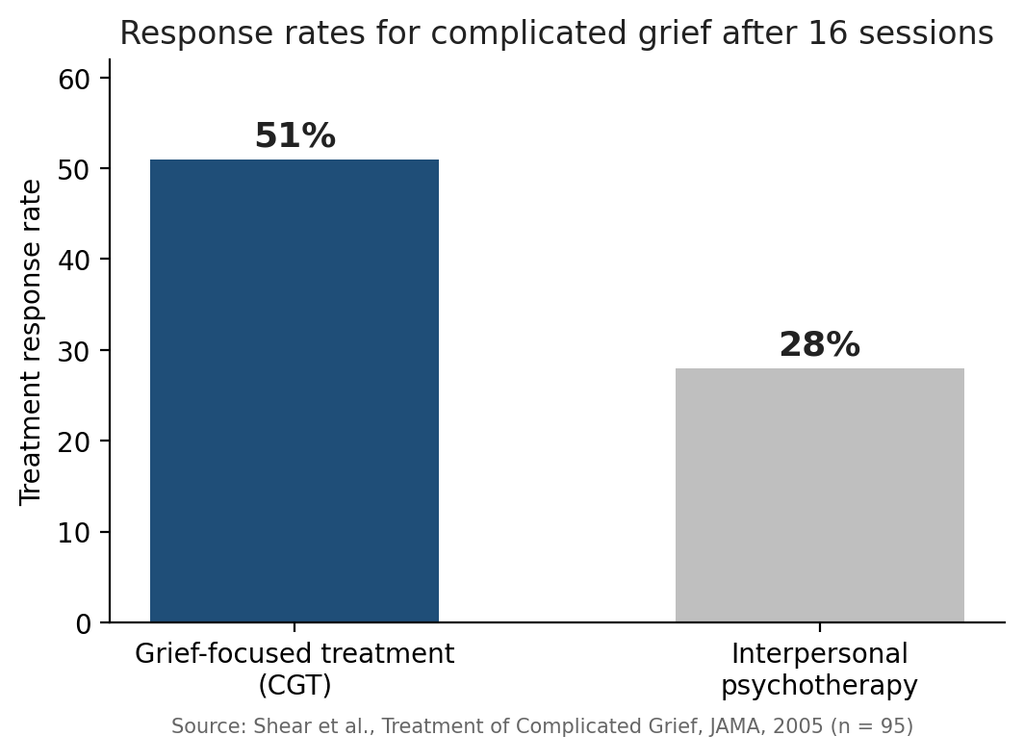
Figure 1. Grief-focused treatment nearly doubled the response rate for complicated grief.
So the type of grief work matters. If your grief has been intense for a long time, it’s fair to ask a counsellor how they approach prolonged or complicated grief specifically.
You may also have seen the claim that grief counselling can make normal grief worse. In 2007, Larson and Hoyt traced that claim in Professional Psychology: Research and Practice and found it had no real statistical or empirical basis.
Who benefits most from grief counselling?
The people who benefit most are those whose grief is intense, long-lasting, or tangled up with trauma. In 2017, a meta-analysis in the Journal of Affective Disorders estimated that 9.8% of bereaved adults develop prolonged grief disorder after non-violent losses. Rates tend to run higher after sudden or violent deaths.
You’re likely to get real value from counselling if:
- The death was sudden, traumatic, by suicide, or was the death of a child.
- A year on, the longing or pain is as sharp as it was in the first weeks.
- You avoid everything that reminds you of them, or you can’t think about anything else.
- Work, parenting, eating or sleep still haven’t come back.
- Your relationship with the person was complicated, and the unfinished parts keep circling.
- You’re holding the whole family together and nobody is holding you.
If it’s been a few weeks and you’re sad, tired and teary, that’s grief doing what grief does. Counselling can still help you feel less alone, but you’re not “behind.”
If you’re having thoughts of suicide, call or text 9-8-8 at any time, day or night.
What progress looks like when grief counselling is working
Progress in grief counselling rarely looks like feeling happy again. It shows up in smaller, concrete ways, and often unevenly:
- You can say their name, or tell the story of the death, without shutting down.
- Sleep starts coming back, even if it’s patchy.
- Waves still hit, but they pass sooner.
- You visit a place or open a box you’d been avoiding.
- Guilt gets quieter, or at least fairer.
- You enjoy something for a moment and don’t feel disloyal for it.
Diwali, Vaisakhi, Eid, Christmas and anniversaries can still knock you sideways years later. That doesn’t mean counselling failed. We wrote about this in muted grief during the holidays.
Why talking to family isn’t always enough
Family support matters, but it has limits when everyone is grieving the same person. Siblings protect parents. Parents protect children. Spouses take turns being the strong one. Each person stays quiet so they don’t upset anyone, and the grief goes underground.
In many South Asian families there’s another layer. Grief is expected at the funeral and then put away. Men especially can get the message, spoken or not, to go back to work and look after everyone. A counsellor sits outside that system. You can say the thing you can’t say at home, in English, Punjabi, Hindi, Urdu or Gujarati. If you’re the one carrying everyone, read the mental load of being the strong one.
What if grief counselling isn’t helping?
Give it a few sessions, then be honest about it. If nothing feels different after a month or two, tell your counsellor directly. These are the usual fixes:
- A different fit. The relationship with your counsellor matters a lot. Switching counsellors is normal and nobody takes it personally.
- A more targeted approach. For prolonged grief, grief-specific methods beat general therapy in the JAMA trial above.
- Checking for depression or trauma. Sometimes grief sits on top of a depressive episode or PTSD that needs its own treatment, and possibly a talk with your doctor about medication.
- Different timing. Some people book while they’re still in shock. Pausing and coming back later is fine.
Grief counselling in New Westminster and online across BC
If you’d like to know what sessions involve week to week, start with what bereavement counselling is. When you’re ready, our counsellors offer grief and loss counselling in New Westminster and online anywhere in BC, with evening and weekend appointments and a free 15-minute virtual consultation.
Frequently asked questions
How many grief counselling sessions will I need?
It depends on the loss and what you’re dealing with. Some people need a few sessions to get through a hard stretch. The grief-focused treatment in the 2005 JAMA trial ran 16 sessions over about 19 weeks, which gives a rough idea of what focused work on prolonged grief can involve.
Can grief counselling make grief worse?
Sessions can feel harder before they feel easier, because you’re facing things you’ve been avoiding. That’s different from making grief worse. A 2007 review in Professional Psychology: Research and Practice found no solid evidence that grief counselling harms people going through normal grief.
Does grief counselling help with guilt?
Yes. Guilt is one of the most common things people work on. A counsellor helps you look at what you actually knew and could control at the time, and separate that from hindsight. Guilt rarely vanishes completely, but it usually becomes quieter and fairer.
Is grief counselling different after a sudden or violent death?
Often, yes. A sudden or violent death can bring trauma symptoms like intrusive images, nightmares or feeling constantly on edge. Counsellors usually work on the trauma first so you can grieve the person. In BC, family members of people harmed by violent crime may qualify for funded counselling through CVAP.
Sources
- Currier J., Neimeyer R. and Berman J., The Effectiveness of Psychotherapeutic Interventions for Bereaved Persons: A Comprehensive Quantitative Review, Psychological Bulletin, 2008, retrieved 2026-10-19, https://digitalcommons.memphis.edu/facpubs/8714
- Shear K. et al., Treatment of Complicated Grief: A Randomized Controlled Trial, JAMA, 2005, retrieved 2026-10-19, https://pubmed.ncbi.nlm.nih.gov/15928281/
- Larson D. and Hoyt W., What has become of grief counseling? An evaluation of the empirical foundations of the new pessimism, Professional Psychology: Research and Practice, 2007, retrieved 2026-10-19, https://scholarcommons.scu.edu/cpsych/11
- Lundorff M. et al., Prevalence of prolonged grief disorder in adult bereavement: A systematic review and meta-analysis, Journal of Affective Disorders, 2017, retrieved 2026-10-19, https://pubmed.ncbi.nlm.nih.gov/28167398/
- 9-8-8 Suicide Crisis Helpline (Canada), https://988.ca