You’ve decided to get help for your mental health. Then you hit the next question: who do you actually book with? A counsellor, a psychologist, a psychiatrist? In British Columbia the titles sound similar, but the training, cost, and what each person can do are quite different.
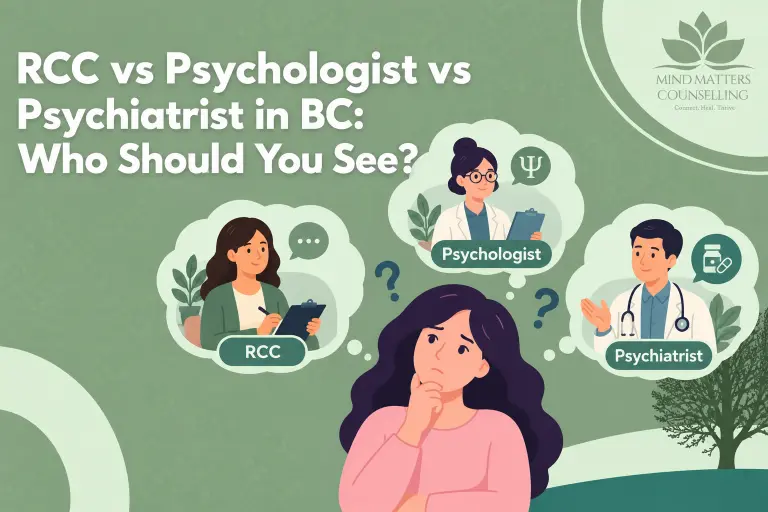
Here’s the simple version. A registered clinical counsellor (RCC) provides talk therapy. A psychologist provides therapy and can also do formal assessments and diagnosis. A psychiatrist is a medical doctor who can diagnose and prescribe medication. Most people looking for help with anxiety, relationships, grief, or stress start with an RCC. Below, we explain why, and when one of the others makes more sense.
| Key Takeaways RCCs hold a master’s degree and focus on therapy. According to BCACC, the RCC designation covers more than 90% of clinical counsellors in BC. Psychologists hold a doctoral degree and can assess and diagnose, but can’t prescribe. Psychiatrists are physicians. They’re covered by MSP with a referral, while counsellors and psychologists usually aren’t. Clinical counselling in BC becomes a provincially regulated profession starting November 29, 2027. |
What is a registered clinical counsellor (RCC)?
A registered clinical counsellor is a therapist registered with the BC Association of Clinical Counsellors (BCACC). To earn the RCC designation, a counsellor needs a master’s degree in counselling or a closely related field, supervised clinical experience, and ongoing professional development. BCACC says the RCC designation covers more than 90% of clinical counsellors in BC.
RCCs help with a long list of everyday and serious concerns, including anxiety, depression, relationship problems, grief, trauma, life transitions, and work stress. Their main tool is psychotherapy: structured, evidence-based conversation using approaches like CBT, emotionally focused therapy, and trauma-informed care. If you’re curious how two of those approaches compare, see our post on EFT vs CBT.
One detail surprises many people. Right now, the words “counsellor” and “therapist” aren’t legally protected titles in BC, so in theory anyone can use them. That’s changing. The BC Ministry of Health has announced that psychotherapy will be regulated under the Health Professions and Occupations Act by the College of Health and Care Professionals of BC, starting November 29, 2027. Until then, the RCC designation is the clearest sign that a counsellor has met formal training and ethics standards. You can check any counsellor’s status on BCACC’s public RCC register.
For a broader explanation of the process itself, see our page on what counselling is and how it works.
What does a psychologist do?
A registered psychologist in BC holds a doctoral degree in psychology and is regulated by the College of Health and Care Professionals of BC. Psychologists provide therapy too, but their training goes deeper into psychological testing, assessment, and diagnosis.
You’d usually see a psychologist when you need a formal assessment. Common examples include an adult ADHD or learning disability assessment, a psychoeducational assessment for a child, or a diagnostic report for school, work, or insurance purposes. Psychologists can diagnose mental health conditions, but they can’t prescribe medication in BC.
Psychologists typically cost more than counsellors. ICBC’s own fee schedule shows the gap: its standard covered fee for a psychologist session is $228, compared with $140 for a clinical counsellor session.
What does a psychiatrist do?
A psychiatrist is a medical doctor who completed medical school and then specialized in psychiatry through a multi-year residency. Psychiatrists diagnose mental illness, prescribe and manage medication, and treat more complex or severe conditions, such as bipolar disorder, psychosis, or depression that hasn’t responded to other treatment.
Because psychiatrists are physicians, their services are covered by MSP when you have a referral from your family doctor or a walk-in clinic. The trade-off is access. Wait times can be long, and many psychiatrists focus on assessment and medication rather than weekly therapy. It’s common for someone to see a psychiatrist for medication and an RCC for ongoing counselling at the same time.
RCC vs psychologist vs psychiatrist: side-by-side comparison
| Question | RCC | Psychologist | Psychiatrist |
| Education | Master’s degree plus supervised practice | Doctoral degree | Medical degree plus psychiatry residency |
| Main focus | Talk therapy | Therapy, testing, and diagnosis | Diagnosis and medication |
| Can diagnose? | Not usually in BC | Yes | Yes |
| Can prescribe? | No | No | Yes |
| MSP coverage? | No | No | Yes, with a referral |
| Typical wait | Often shorter | Varies by clinic | Often longer, through referral |
| Best for | Anxiety, relationships, grief, trauma, stress | Formal assessments and diagnosis | Severe symptoms, medication needs |
How much does each option cost in BC?
MSP covers psychiatrists with a referral, but it doesn’t cover RCCs or registered psychologists. That said, private counselling often costs less than people expect once other coverage is factored in.
Many extended health plans through work or school include coverage for RCCs, psychologists, or both. Check your plan wording carefully, because some only list one profession. There are also public programs that pay for counselling in specific situations. After a car crash, ICBC’s Enhanced Care coverage pre-approves 12 clinical counselling sessions within the first 12 weeks, whoever was at fault, which our ICBC counselling page explains. Victims of crime may qualify for counselling through the Crime Victim Assistance Program, covered on our CVAP counselling page.
You can see our current session fees on our pricing page.
Which one should you see first?
For most people, an RCC is the right first step. Start there if you’re dealing with stress, anxiety, low mood, grief, burnout, relationship conflict, or the aftermath of a hard experience, and you want someone to talk to regularly.
Consider a psychologist when you need a formal diagnosis or assessment, such as an adult ADHD assessment or a report for school accommodations.
See your family doctor and ask about a psychiatrist when symptoms are severe, when you think medication might help, or when you’ve tried therapy and things aren’t improving. And if you’re ever thinking about harming yourself, call or text 9-8-8, Canada’s suicide crisis helpline, or go to your nearest emergency department.
The good news is that you don’t need to get this exactly right on day one. A good counsellor will tell you if you’d benefit from adding a psychologist or a psychiatrist to your care.
If you’re looking for a registered clinical counsellor in New Westminster, Mind Matters Counselling offers individual counselling in person and online across BC. Not sure what to expect? Our post on your first counselling session walks you through it.
Frequently Asked Questions
Is an RCC the same as a therapist?
An RCC is a type of therapist, but not every therapist is an RCC. In BC, “therapist” isn’t a protected title yet, so the RCC designation from BCACC is the clearer marker of training and accountability until provincial regulation starts in November 2027.
Can a counsellor diagnose depression or anxiety in BC?
RCCs can recognize symptoms and talk with you about what they see, but formal diagnosis is usually done by a physician, psychiatrist, or psychologist. Many people work with a counsellor without needing a formal diagnosis at all.
Do I need a referral to see a counsellor?
No. You can book directly with an RCC or a psychologist. You only need a referral to see a psychiatrist through MSP. Some extended health plans ask for a doctor’s note, so check your policy before your first session.
Is online counselling as effective as in-person?
For many people, yes. Online sessions use the same approaches as in-person work, and they remove travel time, which makes it easier to stay consistent. What matters most is feeling comfortable with your counsellor. Many BC counsellors, including ours, offer both options.
Sources
- BC Association of Clinical Counsellors (BCACC), “Protection of the Public,” bcacc.ca.
- College of Health and Care Professionals of BC, “BC Ministry of Health public consultation: proposed new restricted activity for psychotherapy,” July 10, 2026, chcpbc.org.
- ICBC, “Medical care and treatment,” pre-approved treatments and standard fees, icbc.com.