After betrayal, distance, or life stressors it can feel impossible to rebuild trust and reconnect with your partner. Whether you find yourself needing couples counselling for cheating or wanting to deepen emotional connection through couples therapy, intentional practices can lead to positive shifts in your relationship. The following couple exercises aren’t miracle workers but are research-backed tools used in evidence-based practices such as Emotionally Focused Therapy and Gottman Method Couples Counselling.
Here are seven of my favorite couple therapy exercises to help you and your partner feel more vulnerable with each other, experience empathy, and reconnect. Relationship therapists swear by these exercises to help couples break out of disconnected states and into secure attachment. Residents of Burnaby seeking couple counselling or an individual in need of relationship counseling can start here and take these exercises home to practice outside of therapy.
Why Trust and Connection Matter in Couples Mental Health Therapy
Trust is the bedrock of any successful relationship. It’s the root system that allows a relationship to stand tall in the face of adversity. When trust is undermined, say, through cheating, fighting or general drift, things like anxiety and resentment set in. Research out of the Journal of Marital and Family Therapy found that couples who went through purposeful trust-rebuilding exercises experienced a 70% greater satisfaction in their relationships.
Similar concepts apply to connection. Couples who stay bonded stay connected through small positive moments day in and day out. On the contrary, when we begin taking our partner for granted we feel resentful. Couples therapists call these missed opportunities “bids for connection.” They can be as simple as your partner smiling at you or asking you a question. Connection needs maintenance, just like trust. Fortunately, there are exercises that can build your connection muscles too. And like with trust, your relationship can benefit if you just commit to them (hello, relationship counselling for one person).
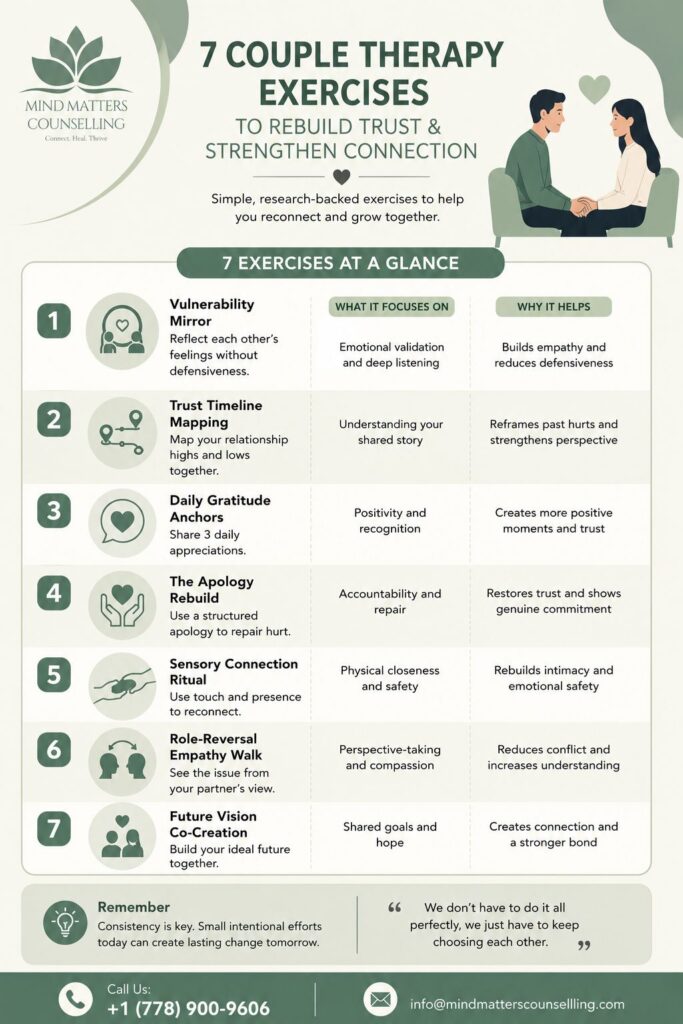
Exercise 1: The Vulnerability Mirror – Reflecting Pain Without Defensiveness
This exercise draws from EFT, encouraging partners to mirror each other’s deepest hurts to validate emotions.
- Sit facing each other in a quiet space, holding hands if comfortable.
- Partner A shares a specific pain point (e.g., “I felt abandoned when you stayed late at work without calling”).
- Partner B mirrors back: “It sounds like you felt abandoned…” without defending or fixing.
- Switch roles after 5 minutes; repeat daily for a week.
Why it works: Mirroring disarms defensiveness, rebuilding trust by showing “I hear you.” Research indicates it reduces conflict by 40% in couples counselling sessions.
Exercise 2: Trust Timeline Mapping – Charting Your Shared History
Visualize your relationship’s highs and lows to reframe betrayals as growth opportunities, ideal for couples counseling for cheating.
Steps to Create Your Timeline:
- Gather supplies: Paper, markers, and a timeline template (straight line from “First Met” to “Today”).
- Mark milestones: Positive (wedding, trips) and negative (arguments, infidelity) events with colors—green for joy, red for pain.
- Discuss narratives: For each red mark, share “What I learned” and “How we’ve grown.” Avoid blame.
- End with future goals: Add a forward extension with shared dreams.
Do this together weekly. Couples report deeper empathy, turning scars into strengths.
Exercise 3: Daily Gratitude Anchors – Small Wins for Big Trust
Inspired by Gottman’s 5:1 ratio (five positive interactions per negative), this combats negativity bias.
- Each evening, share three specific gratitudes: “I appreciate how you made coffee this morning.”
- Write them in a shared journal, reading past entries monthly.
- Tie to trust: “This shows me you’re reliable, rebuilding my faith after past letdowns.”
Exercise 4: The Apology Rebuild – Structured Repair Attempts
After couples counseling for cheating, apologies often fall flat. This exercise structures them for impact.
Key Components of an Effective Apology:
- Acknowledge the hurt: “I see how my actions made you feel unsafe.”
- Take responsibility: No “buts”—own it fully.
- Express remorse: “I’m truly sorry for the pain I caused.”
- Offer amends: “Here’s how I’ll make it right, like checking in daily.”
- Request forgiveness: “Can you find space to forgive over time?”
Practice with past issues, then real-time conflicts. Therapists note it accelerates trust restoration.
Exercise 5: Sensory Connection Ritual – Reawakening Physical Intimacy
Trust rebuilds through non-sexual touch, vital in relationship counselling for one person where one partner leads.
- Dim lights, play soft music; sit back-to-back.
- Partner A places hands on B’s shoulders, massaging slowly while describing sensations: “Your skin feels warm and safe.”
- Switch; focus on breath syncing.
- Progress to eye-gazing: Stare silently for 4 minutes, then share feelings.
This counters disconnection, with studies showing 30% intimacy gains.
Exercise 6: Role-Reversal Empathy Walk – Understanding the Other Side
Switch perspectives to dissolve “me vs. you” thinking.
- Pick a recurring issue (e.g., household chores).
- Each writes a script from the other’s viewpoint: “As my partner, I feel overwhelmed because…”
- Role-play it aloud, staying in character.
- Debrief: “What surprised me?” Repeat bi-weekly.
Great for couples counselling in Burnaby, it builds compassion, reducing fights by 50% per clinical trials.
Exercise 7: Future Vision Co-Creation – Dreaming Beyond the Past
End with hope: Collaboratively design your ideal future.
- Brainstorm categories: Daily life, adventures, conflict resolution.
- Vision Board Basics:
- Cut magazine images or draw symbols for dreams (e.g., beach vacation for reconnection).
- Paste on a board; add affirmations like “We choose trust daily.”
- Review monthly, acting on one goal.
This shifts focus from pain to possibility, solidifying gains from couples mental health therapy.
Integrating Exercises into Your Routine: Tips for Lasting Change
Keep it consistent. Every day try for at least 20 minutes. Keep a record in an app that both of you can access. If you need help, therapy can help you get even more out of these exercises. Registered Clinical Counsellors (RCC) at Mind Matters Counselling have experience with couples counselling that provides a safe, confidential, non-judgmental space to work through struggles and get back on track. Couples can work with us to customize these exercises to suit your needs.
Practice self-care along with these too! Journal by yourself, go for a run or meditation. The American Psychological Association has done studies that show routines like this promote healthy relationships built on trust that will last.
Myths About Couple Therapy Exercises Debunked
Myth 1: “They fix everything overnight.”
Reality: Consistency (3-6 months) yields results; pair with therapy.
Myth 2: “Both must want it.”
Reality: Relationship counselling for one person sparks change.
Myth 3: “Too touchy-feely for tough issues.”
Reality: Backed by RCTs for couples counseling for cheating in relationships.
Myth 4: “Just talk—no structure needed.”
Reality: Steps ensure progress.
How Mind Matters Counselling Helps Guide Your Journey
At Mind Matters Counselling, couples mental health therapy can help you learn to overcome life’s obstacles. Our RCC trained therapists foster a safe space to heal trust issues, build skills to cope with challenges and restore your emotional balance. Need couples counseling for cheating? or just don’t feel connected to your partner anymore? We can guide you on your individual journey and naturally include work like this in your sessions. Come see how we can help couples in Burnaby and beyond.
Common Challenges and How to Overcome Them
Resistance is normal, one partner may hesitate.
- If only one is committed: Start solo exercises, inviting gently (relationship counselling for one person works!).
- Old wounds resurface: Pause, breathe, resume later.
- No progress? Seek therapy—80% of couples improve with guidance.
Patience yields profound shifts.
Conclusion: Your Path to a Stronger, More Connected Partnership
Trust and connection take bravery, effort, and kindness to restore. But the benefits are worth it: intimacy that goes deeper, relationships that can weather the ups and downs, and happiness that lasts. Each of these seven exercises, the vulnerability mirror to Nonviolent Communication, the Hope & Destiny Safari to Appreciative Inquiry, provides a simple, research-based action that anyone can take on their own or together.
Begin with one. Implement it. Track your progress. Celebrate your victories. All couples experience disconnects. The only difference between them and secure couples is repair. If you still find yourself struggling with the relationship, consider couples mental health counselling like Mind Matters Counselling can offer you a safe space to flourish.
You’ve got this. Reach out and build the relationship you deserve.
FAQs
1. What is couples counselling, and who needs it?
Couples counselling is therapy for partners to improve communication and resolve conflicts. It’s ideal for anyone feeling disconnected, post-infidelity, or stressed.
2. How does couples’ mental health therapy differ from regular talk therapy?
Couples mental health therapy focuses on relational dynamics, attachment, and shared emotional health, unlike individual therapy’s personal focus.
3. Is couples counseling for cheating effective?
Yes, structured approaches like these exercises help 65-75% of couples rebuild trust, per studies, with professional support boosting success.
4. Can relationship counselling for one person make a difference?
Absolutely, one partner’s changes often inspire the other, creating ripple effects without requiring mutual buy-in initially.
5. Where to find couples counselling in Burnaby?
Local options like Mind Matters Counselling provide expert RCC-led sessions; check with us for confidential couples counselling support.