Getting married is exciting, but what happens after the honeymoon when two unique people with different lifestyles, habits, preferences, and STUFF all come together in one household? Moving in with your spouse is certainly more than a logistical challenge, it’s an emotional, psychological, and relational transition that will impact the rest of your lives together. Whether you’re moving into a sparkling new place together or combining two full lives into one home, moving in with your spouse is a unique process that can catch many couples off guard.
Studies have found that the transition couples make during the first few months of living together has lasting effects on their relationship. Everything from household cleanliness to finances to boundaries can impact your marriage when you first move in with one another. The good news is that by approaching the transition with the right mindsets and preparation, moving in with your spouse can be one of the best times of your marriage.
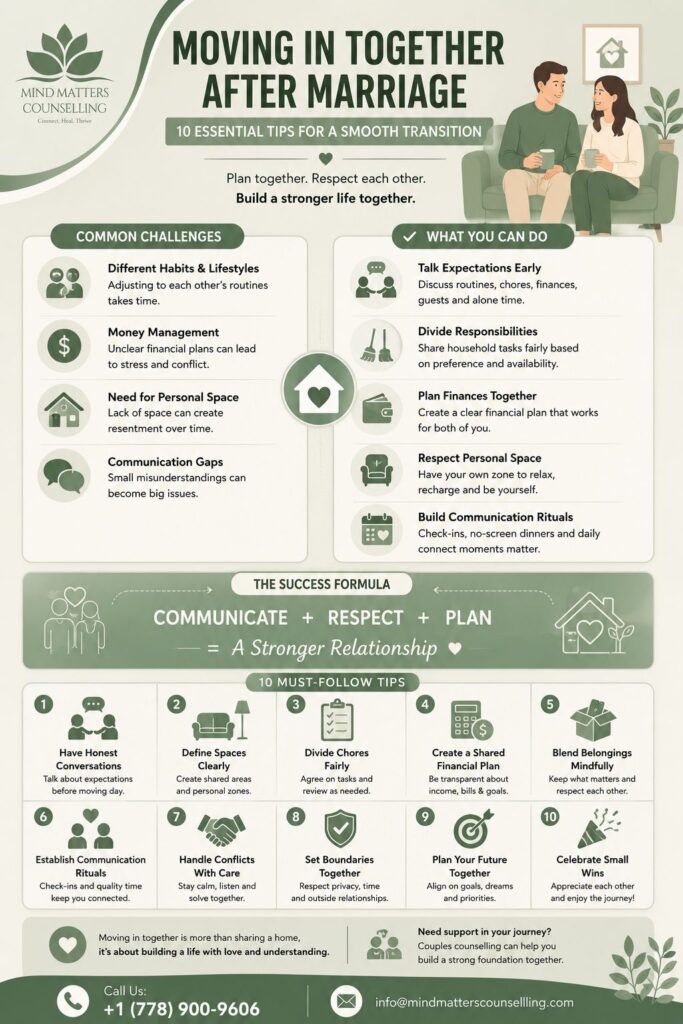
Top 10 Essential Tips for Moving in Together After Marriage
1. Have Honest Conversations Before Moving Day
Prior to moving into your first place together, sit down together and have a few really tough conversations. Many couples spend too much time daydreaming about paint colours and not enough time talking about the things that will matter most. Topics to discuss before the moving truck arrives: expectations about morning routines, household chores, finances, guests and alone time.
Ask each other: Do you like to rush out of bed in the morning or take your time? Who pays which bills? How cluttered is too cluttered for your roommates? They may seem insignificant but these are the details couples fight about down the road. Couples counselling therapy is a great idea before you start living with your partner. Couples counselling can help you both identify expectations you didn’t know you had.
2. Define Shared Spaces and Personal Zones
One of the most overlooked aspects of cohabitation is the need for individual space. Even in the happiest marriages, people need time and territory to decompress, pursue hobbies, or simply be alone with their thoughts. Without defined personal zones, one or both partners may start to feel suffocated or resentful.
- When setting up your new home together, consider the following:
- Designate a reading nook, home office, or hobby corner that belongs to each person.
- Respect closed doors, they signal a need for alone time, not rejection.
- Shared spaces like the living room and kitchen should reflect both personalities equally.
- Discuss how guests will be invited and how often, to preserve shared comfort.
- Agree on quiet hours and personal time routines from the beginning.
3. Divide Household Responsibilities Fairly
One of the fastest ways to build resentment in a marriage is through an imbalanced division of household chores. Research from the American Psychological Association found that perceived unfairness in domestic labour is one of the leading contributors to marital dissatisfaction. The key word here is ‘perceived’ what feels fair varies from person to person.
Rather than assuming roles based on gender or tradition, have a frank discussion about who does what and why. Some couples divide tasks based on preference, others based on schedule or skill. The method matters less than the mutual agreement. Write it down if it helps. Review and adjust as your life changes.
4. Create a Shared Financial Plan
Money is one of the top causes of conflict among married couples, and moving in together brings finances into sharp focus. Suddenly, rent, groceries, utilities, and household costs are shared realities. Establishing a clear financial structure early prevents misunderstanding and inequity.
Consider addressing the following financial areas together:
- Joint account vs. separate accounts vs. a hybrid approach, which works best for both of you?
- Who is responsible for which bills and when are they paid?
- How will large purchases be decided and what is the spending threshold before consulting each other?
- How will you handle savings, emergencies, and long-term goals?
- Is one partner carrying more debt, and how will that affect shared finances?
If financial discussions trigger tension or old wounds, especially if one partner has experienced financial betrayal before relationship counselling for one person or couples counselling therapy can help create a safe space for these conversations.
5. Blend Your Belongings Mindfully
Moving in together means combining two households. You’ll have two sets of furniture, dishes, decorations, and everything else in between. This blending process is practical and sentimental. Items have histories attached to them and it’s important to navigate keeping, tossing, and replacing with care and compromise.
Don’t decide on your own what to keep and what not to. Go room to room together and make decisions as a couple. If your S.O. has an item that is precious to them, keep it even if it doesn’t match your style. Find ways to mesh your backgrounds and stories throughout your home to make each of you feel at home.
6. Establish Communication Rituals
Living together creates the illusion of constant connection, but proximity does not equal communication. Many couples move in together and actually start talking less meaningfully because they assume they are already ‘in touch.’ Creating deliberate communication rituals keeps your relationship emotionally alive and prevents small issues from becoming silent, unresolved resentments.
Healthy communication rituals to consider include:
- A weekly ‘check-in’ conversation where each partner shares how they are feeling, not just logistically, but emotionally.
- A no-screens dinner routine at least a few nights per week.
- A morning or evening ritual, even five minutes that anchors your connection daily.
- An agreed-upon approach to handling arguments: taking breaks when escalating, using ‘I’ statements, and returning to discussions once calm.
- Regular appreciation expressions, naming specific things you value about your partner.
7. Respect Different Rhythms and Habits
You can love someone with all your heart and soul and still realize you’re a morning person who married someone who lives for midnight, or you keep things neat and tidy while your partner lives comfortably inside chaos. Everyone has different habits, peak times of energy, and rhythms. It’s not you two being incompatible, it’s you two being humans.
Try not to focus on changing one another. Maybe your partner who stays up late will try not to slam cabinets after midnight. Maybe you let your partner make their home office their ‘organized clutter spot.’ Learn to accept and respect each other’s idiosyncrasies instead of trying to ‘correct’ them.
8. Maintain Your Individual Identities
One of the best things you can do for your relationship when moving in together is work to maintain your sense of self. It’s easy enough — particularly when you’re first moving in together and everything is still new — to want to be around your partner all the time. But the longer you spend losing yourself in a relationship, the more chance you run of becoming enmeshed, losing your spark, and feeling unfulfilled.
Make sure to support each other in seeing friends, having hobbies, and spending time alone. The more you continue to build yourself as an individual, the more you have to bring to the relationship. Two complete people make a much healthier couple than two people who have lost themselves in one another.
9. Plan for Conflict, Because It Will Come
Even if you’re compatible, conflict is inevitable when living with someone. The question is not if you’ll disagree but how you’ll handle yourself when you do. Many couples embark on cohabitation without a game plan for when conflict arises and are quickly caught off guard, lacking the tools to survive the fight.
Come to an understanding before conflict hits: No name-calling, no leaving during an argument without explicitly stating when you will return, no dredging up past mistakes unrelated to the argument at hand. If you find yourself stuck in similar arguments over and over again–running into the same issue with no resolution–you might be encountering a systemic problem that can best be worked through with a therapist.
10. Celebrate the Milestones, Big and Small
Moving in together is a significant milestone, and it deserves ongoing celebration. Do not let the busyness of setting up a home cause you to forget the joy of what you have built together. Mark your first month in the new space. Cook a special dinner when the last box is unpacked. Create new traditions that are uniquely yours.
Intentional moments of celebration strengthen your emotional bond and remind you both why you chose each other. In the middle of debates about grocery lists and chore schedules, these moments of joy are what keep your connection alive.
How Mind Matters Counselling Can Support You Through This Transition
Moving in together, even under the best circumstances can stir up unexpected emotions, old patterns, and relationship dynamics that are hard to navigate alone. That is where professional support can make a profound difference.
Mind Matters Counselling is a team of Registered Clinical Counsellors (RCC) based in British Columbia, offering a safe, confidential, and non-judgmental space to process what you are going through. Whether you are navigating the emotional weight of merging households, struggling with communication breakdowns, or working through deeper relational wounds, their counsellors provide the skills and support needed to restore emotional balance and build a healthier partnership.
Mind Matters Counselling offers support for:
- Couples counselling therapy to improve communication, resolve conflict, and deepen emotional intimacy.
- Couples counseling for cheating and rebuilding trust after infidelity or betrayal.
- Relationship counselling for one person, because sometimes only one partner is ready to seek help, and that is a valid and powerful starting point.
- Individual therapy to address personal patterns, anxiety, or past trauma that may be impacting your relationship.
- Pre-marital and post-marital counselling for couples entering major life transitions.
Final Thoughts
Getting married and moving into your forever home together is easily one of the most exhilarating, life changing events you will ever experience. Every day you wake up next to your partner you are choosing them. Not just in the big, sweeping gestures of love. But in the little every day decisions that come with living with another human being. The partners that survive the transition of moving in together the easiest are not the ones that don’t fight. They’re the ones who communicate with purpose, respect each other and their needs, and ask for help when they need it.
Refer back to these 10 tips as a guideline throughout every stage of your life together. And if you do find yourself needing help, remember that asking for professional help is not admitting that there is something wrong with your relationship. Quite the opposite, you’re taking steps to protect it.
Your home is where your story begins. Build it with intention.
Frequently Asked Questions
1. What is couples counselling therapy and how does it help newlyweds moving in together?
Couples counselling therapy is a form of psychotherapy that helps partners improve communication, resolve conflict, and strengthen their emotional bond. For newlyweds moving in together, it provides a structured space to address expectations, household dynamics, and relational patterns before they become entrenched problems.
2. Can couples counseling for cheating help us rebuild trust while living together?
Yes. Rebuilding trust after infidelity is one of the most challenging journeys a couple can take, especially when sharing a home. Couples counseling for cheating is specifically designed to help both partners process the breach of trust, understand what led to it, and create a path toward healing.
3. What is relationship counselling for one person, and is it effective?
Relationship counselling for one person, sometimes called individual therapy with a relational focus, helps one partner explore their own patterns, triggers, and communication styles as they relate to the relationship. It is absolutely effective.
4. How do I find a professional counsellor in New Westminster, BC?
If you are looking for a professional counsellor in New Westminster, BC, start by searching for Registered Clinical Counsellors (RCCs) in your area. RCCs are regulated professionals with graduate-level training and supervised clinical experience.
5. When is the right time to start couples therapy before or after moving in together?
Both timings can be beneficial, and ideally, couples should not wait for a crisis to seek support. Starting therapy before moving in together allows you to surface and address potential friction points in a supported environment.