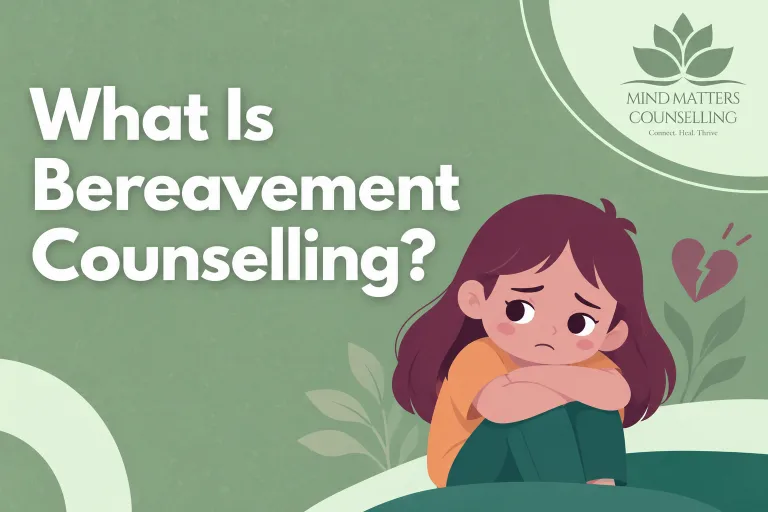
Bereavement counselling is one-on-one support from a trained counsellor after someone close to you dies. It gives you a regular, private place to talk about the person, the death and everything that’s changed since, and to work through feelings that are hard to say out loud at home. You don’t need a diagnosis to book it.
Most people who search this aren’t shopping for therapy. They’re trying to work out whether what they feel is normal, and whether talking to a stranger would change anything. This guide covers what bereavement counselling is, what actually happens in the room, and who tends to get the most from it.
| Key Takeaways Bereavement counselling is grief counselling after a death. The two terms mean almost the same thing. Sessions cover the death itself, the relationship, guilt or anger, and how daily life has changed. A 2017 meta-analysis in the Journal of Affective Disorders put prolonged grief at about 1 in 10 bereaved adults. You don’t have to wait for grief to feel “stuck” before you start. |
What is bereavement counselling?
Bereavement counselling is talk therapy focused on the death of a person. A counsellor helps you understand your grief reactions, say what you’ve been carrying, and slowly rebuild a life that includes the loss. It can be one-on-one, with family members together, or in a group, either in person or online.
“Bereavement” describes the situation: someone has died. “Grief” describes what you feel and do about it. So bereavement counselling is named after the event, and grief counselling after the response. Day to day, counsellors use the two terms interchangeably.
It isn’t a way to speed grief up or to get you to move on from the person. Good bereavement counselling works on the idea that your bond with them continues in a different form. For a lot of people, the relief comes from being allowed to keep talking about them, not from being asked to stop.
Is bereavement counselling the same as grief counselling?
Mostly, yes. Kaiser Permanente’s health library says grief counselling is also called bereavement counselling, and notes that “bereavement” is usually used only when the loss is a death. The difference only matters when your loss isn’t a death.
| Term | What loss it covers | Usual focus |
| Bereavement counselling | The death of a person | Mourning, guilt, memories, life after the death |
| Grief counselling | Any loss, including a death | Emotional reactions to the loss |
| Grief and loss counselling | Death plus other losses, such as divorce, pregnancy loss, illness, job loss or a pet | The full range of losses people grieve |
If your loss isn’t a death (a separation, a miscarriage, a diagnosis that turned your life over), you’re not in the wrong place. Counsellors who offer grief and loss counselling in New Westminster work with all of these. Some of those losses barely get acknowledged by the people around you, which we cover in our piece on disenfranchised grief.
What happens in a bereavement counselling session?
The first session is mostly listening. Your counsellor will ask who died, how and when, and what your relationship was like. They’ll ask how you’re sleeping, eating and working, and who you have around you. You don’t have to share anything before you’re ready.
After that, sessions move between a few kinds of work. Kaiser Permanente’s overview lists learning what grief normally looks like, expressing feelings openly, and building a new sense of self after the loss. In real sessions, that tends to look like this:
- Telling the story of the death. Often more than once. Each telling usually carries a little less shock.
- Talking about the relationship as it really was. Difficult parts included. Love and resentment can sit side by side.
- Working on guilt. “I should have called.” “I should have noticed.” A counsellor helps separate what you could have known then from what you know now.
- Handling practical changes. Living alone, money, parenting solo, suddenly being the head of the family.
- Finding ways to stay connected. Rituals, letters, keeping certain traditions, deciding what to do with their things.
Counsellors draw on different approaches. On our team that includes person-centred therapy, CBT for thought loops that keep you stuck, emotion-focused work, and trauma-informed care when a death was sudden or violent. Nobody will hand you a worksheet in week one. The pace follows you.
Who is bereavement counselling for?
Anyone who has lost someone can use it, but not everyone needs it. Most people grieve hard and then slowly find their footing with family, friends and community around them. In 2017, Lundorff and colleagues pooled 14 studies in the Journal of Affective Disorders and found that 9.8% of adults developed prolonged grief disorder after non-violent losses. That’s roughly 1 in 10.
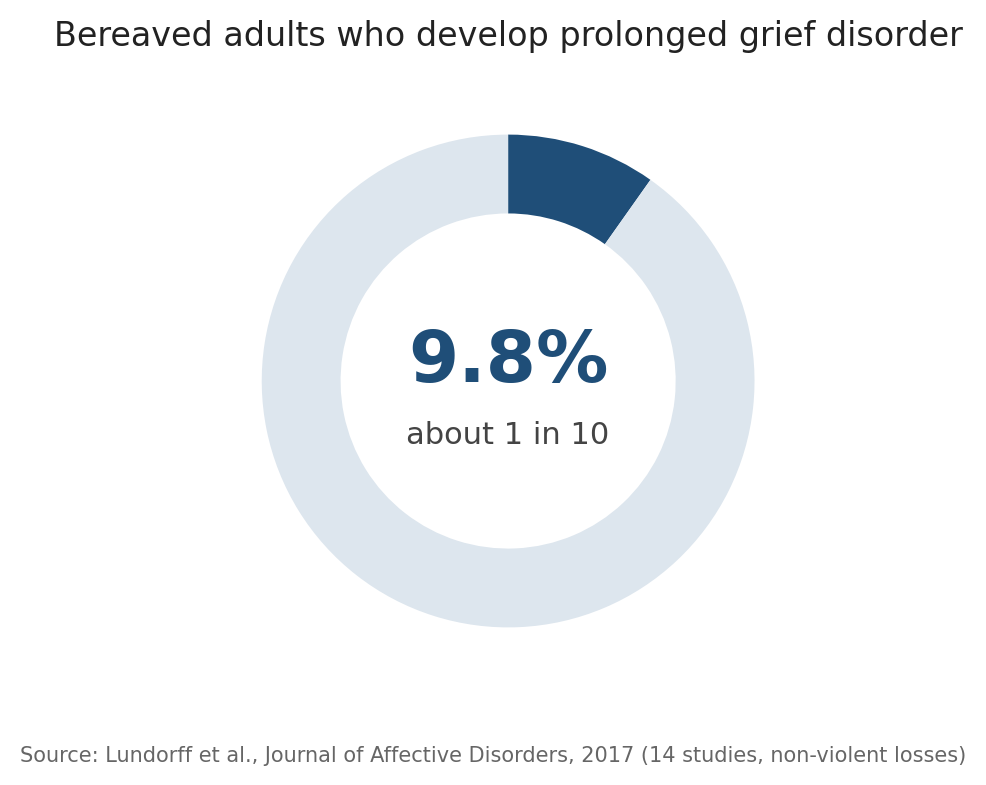
Figure 1. About 1 in 10 bereaved adults develop prolonged grief disorder.
It’s worth booking a session if any of these sound familiar:
- You can’t stop replaying how they died, or you avoid anything that reminds you of them.
- Guilt, or anger at yourself, the doctors or the person who died, isn’t easing.
- Months after the funeral, you still can’t function at work or at home.
- It feels like part of you died too, or life has no point without them.
- People expect you to be “over it” by now, so you’ve gone quiet.
- The death was sudden, violent, by suicide, or was the death of a child.
If you’re having thoughts of ending your life, don’t wait for a counselling appointment. Call or text 9-8-8, Canada’s suicide crisis helpline, at any time.
When the visitors leave and the house goes quiet
Grief often lands hardest after the rituals are over. In many South Asian families, the first weeks after a death are full: prayers at home, a Bhog or 13th-day ceremony, relatives sleeping over, food arriving every day. There’s barely time to feel anything. Then everyone flies home and the house goes silent.
That second or third month is a common point for people to reach out for support. It’s also common for one person, often the eldest son or daughter, to hold everything together for everyone else and quietly fall apart later. If that’s you, our post on the mental load of being the strong one is worth reading.
Language matters here too. Some feelings only come out properly in Punjabi, Hindi or Urdu, in the words your parent actually used. Our counsellors work in English, Hindi, Punjabi, Urdu and Gujarati, so you don’t have to translate your grief before you can talk about it.
When should you start bereavement counselling?
There’s no wrong time. Some people book in the first few weeks because they can’t sleep or function. Others wait a year, until an anniversary or a birthday knocks them flat. Both are normal.
The American Psychiatric Association added prolonged grief disorder to the DSM-5-TR in 2022. For adults, it can only be diagnosed once at least 12 months have passed since the death, or 6 months for children and teens. That rule exists to stop normal grief being labelled a disorder. It isn’t a waiting period for help, and you don’t need a diagnosis to see a counsellor.
A sensible rule of thumb: if grief is making it hard to get through your days, or you’re carrying it alone, now is a good time. If you’d like to know what counselling can realistically change, our follow-up post on how grief counselling helps goes through the research.
Getting support in New Westminster or online
Our Registered Clinical Counsellors and Canadian Certified Counsellors see clients at 550 6th Street in New Westminster and online anywhere in BC, with evening and weekend times. If you’re not sure counselling is right for you yet, start with a free 15-minute virtual consultation. You can read more about our grief and loss counselling in New Westminster or meet the counsellors.
Frequently asked questions
How long does bereavement counselling last?
There’s no set number of sessions. Some people come for a handful of sessions around a hard stretch, like the first few months or an anniversary. Others with prolonged or traumatic grief work for several months. Your counsellor will check in regularly on whether sessions are still useful, and you decide when to stop.
Do I need a doctor’s referral for bereavement counselling in BC?
No. You can book directly with a Registered Clinical Counsellor or Canadian Certified Counsellor. If you plan to claim through extended health benefits, check your plan first. Most BC plans cover RCCs or CCCs, but limits and rules differ. Our pricing page lists current session fees.
Can bereavement counselling be done online?
Yes. Online sessions work the same way as in-person ones, with the same counsellor and the same privacy. Many grieving people prefer it because they can talk from home and don’t have to hold it together on the drive back. We offer secure virtual sessions anywhere in British Columbia.
Can children get bereavement counselling?
Yes. Children grieve differently from adults. They can seem fine one minute and be back to playing the next, then struggle months later. Some of our counsellors work with children from age 5 and with teens, and parents are usually involved in planning how sessions will work.
Does CVAP cover counselling if someone died because of a crime?
In BC, the Crime Victim Assistance Program can fund counselling for immediate family members after a violent crime. Once a claim is approved, we bill CVAP directly. Our CVAP counselling page explains eligibility and how to get started.
Sources
- Kaiser Permanente, Grief Counseling (Health Encyclopedia), retrieved 2026-10-19, https://healthy.kaiserpermanente.org/health-wellness/health-encyclopedia/he.aa129215
- Lundorff M. et al., Prevalence of prolonged grief disorder in adult bereavement: A systematic review and meta-analysis, Journal of Affective Disorders, 2017, retrieved 2026-10-19, https://pubmed.ncbi.nlm.nih.gov/28167398/
- Prigerson H. et al., Validation of the new DSM-5-TR criteria for prolonged grief disorder, World Psychiatry, retrieved 2026-10-19, https://pmc.ncbi.nlm.nih.gov/articles/PMC7801836
- 9-8-8 Suicide Crisis Helpline (Canada), https://988.ca