When most people think about grief, they think about losing a loved one.
They think about funerals, sympathy cards, and people gathering around to offer support.
But not all grief is recognized.
Not all grief receives understanding.
Not all grief is acknowledged by others.
And yet, it hurts just the same.
This is known as disenfranchised grief, a type of grief that is often overlooked, minimized, or misunderstood by society, family members, friends, or even ourselves.
At Mind Matters Counselling, we often work with individuals who are carrying profound losses that no one seems to recognize. They come to therapy feeling confused about why they’re struggling so much because, on the surface, it may seem like they “should be over it” or that their loss “doesn’t count.”
But grief doesn’t work that way.
What Is Disenfranchised Grief?
Disenfranchised grief occurs when a loss is not openly acknowledged, socially validated, or publicly mourned.
In other words, something important has been lost, but the people around you may not fully understand why it hurts so much.
You may hear things like:
- “At least it wasn’t worse.”
- “Everything happens for a reason.”
- “You need to move on.”
- “Why are you still upset about that?”
- “It wasn’t even a real relationship.”
These responses can leave people feeling isolated and ashamed of their grief.
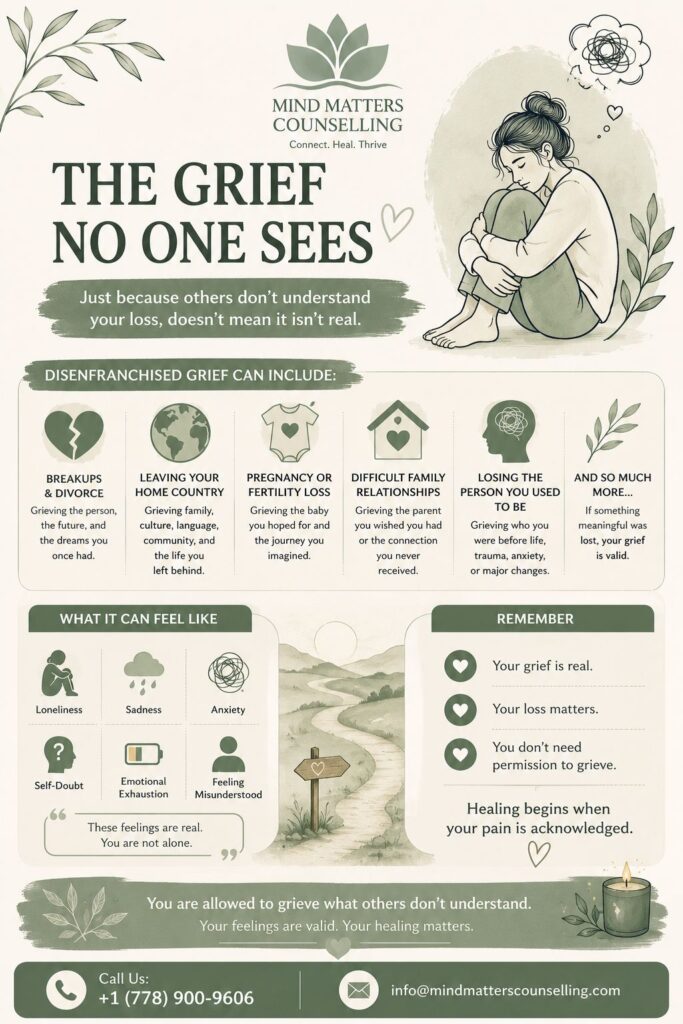
Examples of Disenfranchised Grief
Many life experiences can trigger grief, even when they don’t involve death.
The End of a Relationship
A breakup, divorce, situationship, or engagement that didn’t work out can create deep grief.
You aren’t only grieving the person.
You’re grieving:
- future plans
- shared dreams
- emotional safety
- the life you imagined
Yet people often expect you to “just move on.”
Infertility, Pregnancy Loss, or Postpartum Losses
Many individuals grieve pregnancies that ended unexpectedly, fertility struggles, or the version of parenthood they imagined.
These losses can feel incredibly lonely because others may not fully understand their significance.
Immigration and Leaving Home
As an immigrant, you may grieve:
- family members left behind
- traditions
- language
- community
- familiarity
- a sense of belonging
Many immigrants carry grief while simultaneously being told they should feel grateful for the opportunities they’ve gained.
The result?
A complicated mix of gratitude and sadness.
Both can exist at the same time.
Losing a Parent Who Is Still Alive
Sometimes grief shows up in relationships that are physically present but emotionally unavailable.
You may grieve:
- the parent you wish you had
- emotional connection that never existed
- unmet childhood needs
- the relationship you hoped would change
This grief is often invisible to others.
Grieving the Version of Yourself You Used to Be
Sometimes grief isn’t about losing a person.
It’s about losing yourself.
You may grieve:
- who you were before trauma
- who you were before anxiety
- who you were before illness
- who you were before becoming a caregiver
- who you were before life changed
Many people don’t realize this is grief.
But it absolutely is.
Why Disenfranchised Grief Feels So Complicated
When grief is recognized, people often receive support.
When grief is unrecognized, people often question themselves.
You may find yourself wondering:
“Why am I still so affected by this?”
“Maybe I’m being dramatic.”
“Other people have it worse.”
“I should be over this by now.”
This self-judgment often creates a second layer of pain.
Not only are you grieving the loss itself, but you’re also carrying the burden of feeling misunderstood.
The Impact of Disenfranchised Grief on Mental Health
Unprocessed grief can sometimes show up as:
- anxiety
- depression
- irritability
- emotional numbness
- difficulty concentrating
- exhaustion
- loneliness
- relationship struggles
- feelings of emptiness
Many people come to therapy believing they have anxiety or burnout, only to discover that grief is sitting quietly underneath it all.
Grief Doesn’t Need Permission to Be Real
One of the most powerful things people hear in therapy is:
“Your grief makes sense.”
You do not need society’s permission to grieve.
You do not need a funeral, a diagnosis, or public validation for your pain to matter.
If something meaningful was lost, grief is a natural response.
How Counselling Can Help with Disenfranchised Grief
At Mind Matters Counselling, we provide a compassionate space for individuals experiencing grief and loss, life transitions, relationship challenges, and emotional overwhelm.
Therapy can help you:
- process complex emotions
- make sense of your loss
- reduce shame around grief
- honour what was lost
- navigate major life transitions
- reconnect with yourself after loss
- find meaning and healing without forcing yourself to “move on”
Our approach recognizes that grief is not something to fix.
It is something to witness, understand, and carry differently over time.
You Are Allowed to Grieve What Others Don’t Understand
Whether you’re grieving a relationship, a dream, a version of yourself, a family dynamic, a pregnancy, your homeland, or something that feels difficult to explain, your grief is valid.
Loss does not become real only when others recognize it.
Sometimes the heaviest grief is the grief that nobody sees.
And sometimes healing begins when someone finally says:
“Of course this hurts.”
If you’re struggling with grief, loss, life transitions, or emotional overwhelm, Mind Matters Counselling is here to help.
Contact Mind Matters Counselling today and give yourself permission to process the losses that deserve to be acknowledged.
Frequently Asked Questions
What is disenfranchised grief?
Disenfranchised grief is grief that is not openly recognized, validated, or supported by others. It often occurs after losses that society may not view as significant, even though they are deeply painful.
Can you grieve someone who is still alive?
Yes. Many people experience grief related to emotionally unavailable parents, estranged family members, changing relationships, or loved ones affected by illness or addiction.
Is it normal to grieve after moving to another country?
Absolutely. Immigration often involves grieving family, culture, traditions, language, identity, and a sense of familiarity. This type of grief is very common among immigrants.
How do I know if I’m experiencing grief or depression?
Grief and depression can share similar symptoms. A therapist can help you understand what you’re experiencing and provide support tailored to your situation.
Can therapy help with grief that happened years ago?
Yes. Unprocessed grief can remain with us for years. Therapy can provide a safe space to explore and heal losses that still feel present today.