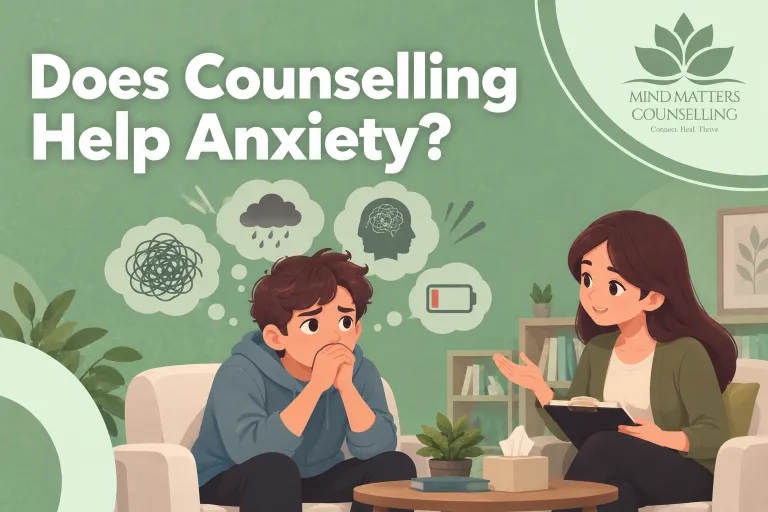
Yes. Counselling helps most people with anxiety, and the evidence is strongest for structured approaches like cognitive behavioural therapy (CBT). In a 2018 meta-analysis of placebo-controlled trials, people who had CBT were about three times as likely to respond as people who got a placebo. Many keep their gains after sessions end.
That’s the short answer. The longer one depends on what kind of anxiety you have, what the counselling actually involves, and what you want to change. That’s what this post covers.
Key Takeaways
- In 2022, 5.2% of Canadians aged 15 and older met the criteria for generalized anxiety disorder, double the 2012 rate (Statistics Canada).
- CBT roughly tripled the odds of responding compared with placebo in a 2018 meta-analysis.
- Gains generally hold for at least 12 months after counselling ends.
- Many people do well with counselling alone. Some do best with counselling plus medication.
Does counselling help anxiety?
Yes, for most types of anxiety. In 2018, Carpenter and colleagues pooled randomized placebo-controlled trials of CBT in the journal Depression and Anxiety. They found moderate effects on anxiety symptoms and an odds ratio of 2.97 for responding to CBT compared with placebo. CBT also eased depression and improved quality of life, though less strongly.
“Counselling” covers a lot of ground. Some of it is mostly supportive listening, which feels good but on its own isn’t the strongest treatment for an anxiety disorder. The approaches with the most research behind them are active ones: CBT, exposure-based work, and skills from DBT and ACT. A good anxiety counsellor pairs a warm, safe relationship with those structured tools.
The need is growing. In 2023, Statistics Canada reported that generalized anxiety disorder among Canadians aged 15 and older doubled from 2.6% in 2012 to 5.2% in 2022. Among young women aged 15 to 24, it tripled, from 3.8% to 11.9%.
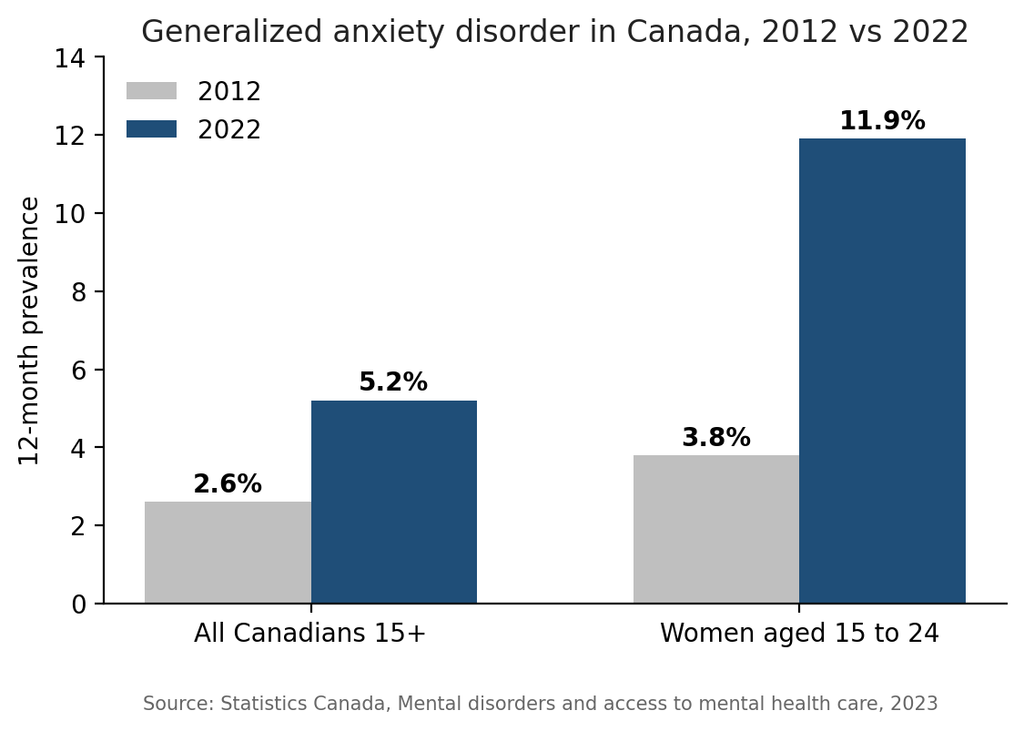
Figure 1. Generalized anxiety disorder has doubled in Canada over ten years, and tripled among young women.
Which types of anxiety respond best to counselling?
The 2018 Depression and Anxiety meta-analysis found large effects for generalized anxiety disorder, OCD and acute stress disorder. Effects were small to moderate for PTSD, social anxiety and panic disorder. Smaller doesn’t mean useless. It usually means progress takes longer or needs more exposure-based work.
| Type of anxiety | What counselling usually focuses on | Effect in the 2018 meta-analysis |
| Generalized anxiety disorder | Worry habits, intolerance of uncertainty, physical tension | Large |
| OCD | Exposure and response prevention (ERP) | Large |
| Acute stress after a frightening event | Processing the event, calming the nervous system | Large |
| Social anxiety | Facing feared situations, harsh self-talk | Small to moderate |
| Panic disorder | Fear of body sensations, avoidance | Small to moderate |
| PTSD | Trauma processing | Small to moderate |
Not sure whether you’re having panic attacks or something else? Our guide to panic attack vs anxiety attack explains the difference.
How long does counselling take to help anxiety?
Most structured anxiety treatment is short-term. The trials in the 2018 meta-analysis averaged about 11 CBT sessions. On our anxiety counselling page, our counsellors note that many clients start to notice improvement within 4 to 8 weeks of consistent sessions.
Change tends to show up in a rough order:
- You understand your anxiety better. The racing heart or the 3 a.m. spiral makes more sense, so it’s a bit less frightening.
- You pick up a few tools that actually work for you, like grounding, slowing your breath, or catching a worry before it snowballs.
- You start doing things you’d been avoiding: the highway drive, speaking up in a meeting, the phone call you’ve put off for weeks.
- Worry takes up less of the day, and when it spikes, it settles faster.
Long-standing anxiety, or anxiety mixed with depression or trauma, usually takes longer. If you’re the person who looks fine at work and falls apart at home, read our post on high-functioning anxiety and depression.
Do the benefits last after counselling ends?
Generally, yes. In 2020, van Dis and colleagues published a meta-analysis in JAMA Psychiatry covering 69 randomized trials and 4,118 people. CBT for anxiety-related disorders was linked to better outcomes than comparison conditions for up to 12 months after treatment ended. In the studies that tracked relapse, rates were between 0% and 14%.
Past 12 months, the evidence thins out. Effects were still small to medium for generalized anxiety and social anxiety, and large for PTSD, but few studies followed people that long. In plain terms, the skills you learn tend to stick. A few booster sessions during a stressful year are normal, not a sign that it didn’t work.
That’s also why many people like having counselling in the mix even if they take medication. The skills stay yours after the sessions stop.
Counselling, medication, or both?
Counselling is the most common help Canadians with anxiety actually get. Statistics Canada’s 2022 Mental Health and Access to Care Survey found that people who met criteria for a mood, anxiety or substance use disorder were more likely to have received counselling (43.8%) than medication (36.5%).
For mild to moderate anxiety, counselling on its own often works. For severe anxiety, anxiety that keeps you from leaving the house, or anxiety with significant depression, combining counselling with medication is common. That decision belongs with your family doctor or a psychiatrist, because counsellors in BC don’t prescribe. If you’re unsure who does what, see RCC vs psychologist vs psychiatrist.
What if counselling hasn’t helped your anxiety before?
Lots of people tried counselling once, found it was mostly talking, and decided it doesn’t work for them. Before you write it off, look back at that experience with four questions:
- Was it anxiety-specific? General supportive counselling is different from CBT, exposure work or ERP.
- Did you practise between sessions? Most of the change in anxiety happens during the week, not in the hour.
- Did it stop too early? The first few sessions are often assessment and getting to know you.
- Was the fit right? If you didn’t feel safe with the counsellor, steering away from hard topics made sense.
Being able to talk in your own language can matter more than people expect. Anxiety often speaks in the voice you grew up with. Our counsellors offer sessions in English, Hindi, Punjabi, Urdu and Gujarati.
Anxiety counselling in New Westminster and online
If anxiety is shaping your days, our counsellors offer anxiety counselling in New Westminster and secure online sessions anywhere in BC, with evening and weekend times. You can start with a free 15-minute virtual consultation. If you want the CBT side in more depth first, read what CBT for anxiety involves.
Frequently asked questions
How many counselling sessions do most people need for anxiety?
Structured anxiety treatment is often fairly short. Trials of CBT for anxiety averaged about 11 sessions in a 2018 meta-analysis. In real life, some people need fewer and some need more, especially when anxiety overlaps with depression, trauma or ADHD. Your counsellor should review progress with you regularly.
Is anxiety counselling covered by extended health insurance in BC?
Most extended health plans in BC cover sessions with a Registered Clinical Counsellor (RCC) or a Canadian Certified Counsellor (CCC), usually up to a yearly limit. Plans vary, so check your coverage before your first session. Our pricing page lists current fees.
What’s the difference between counselling and therapy for anxiety?
In BC the two words are used almost interchangeably. What matters more is the approach: whether your counsellor uses methods with evidence behind them for anxiety, such as CBT or exposure work, and whether you feel comfortable working with them.
Can I get anxiety counselling in Punjabi, Hindi or Urdu?
Yes. Our team offers counselling in English, Hindi, Punjabi, Urdu and Gujarati, in person in New Westminster or online across BC. Many clients find it easier to describe anxiety in the language they think and worry in.
Could it be ADHD rather than anxiety?
Both can show up as restlessness, poor focus and racing thoughts, and they often occur together. A counsellor can help you untangle the two. Our guide to neurodivergence, ADHD, autism and anxiety explains how they overlap.
Sources
- Statistics Canada, Mental disorders and access to mental health care (Insights on Canadian Society), 2023, retrieved 2026-10-19, https://www150.statcan.gc.ca/n1/pub/75-006-x/2023001/article/00011-eng.htm
- Statistics Canada, Mental health of Canadians: it matters (counselling 43.8% vs medication 36.5%), retrieved 2026-10-19, https://www.statcan.gc.ca/o1/en/plus/4691-mental-health-canadians-it-matters
- Carpenter J. et al., Cognitive behavioral therapy for anxiety and related disorders: A meta-analysis of randomized placebo-controlled trials, Depression and Anxiety, 2018, retrieved 2026-10-19, https://pubmed.ncbi.nlm.nih.gov/29451967/
- Neurotorium, Anxiety disorders treatment principles: cognitive behavioural therapy (summary of Carpenter et al. 2018, mean of 11 sessions), retrieved 2026-10-19, https://neurotorium.org/slidedeck/anxiety-disorders-treatment-principles/slide/7-cognitive-behavioural-therapy/
- van Dis E. et al., Long-term Outcomes of Cognitive Behavioral Therapy for Anxiety-Related Disorders: A Systematic Review and Meta-analysis, JAMA Psychiatry, 2020, retrieved 2026-10-19, https://pmc.ncbi.nlm.nih.gov/articles/PMC6902232