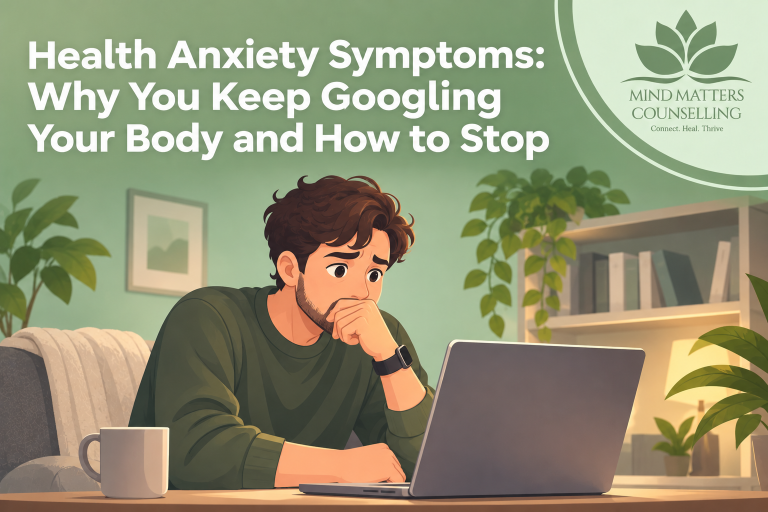
The most common health anxiety symptoms are constant worry that you have, or will get, a serious illness, along with frequent body checking, searching symptoms online, seeking reassurance from doctors or family, and feeling only brief relief after a normal test result. Normal body sensations, like a skipped heartbeat or a headache, get read as signs of danger. The worry then creates more physical symptoms, which feeds the fear.
If you have ever spent midnight reading about a rare disease because of a twinge in your side, you are not alone, and you are not “crazy.” Health anxiety is a recognized, treatable form of anxiety.
What are health anxiety symptoms?
Health anxiety used to be called hypochondria. Today, clinicians usually describe it under two diagnoses in the DSM-5-TR:
- Illness anxiety disorder: strong fear of having or getting a serious illness, with few or mild physical symptoms, lasting at least six months.
- Somatic symptom disorder: real physical symptoms that cause a lot of distress, with excessive thoughts, feelings or time spent on them.
You don’t need a diagnosis to get help. What matters is how much the worry costs you.
Common health anxiety symptoms in the mind and body
Thoughts and feelings
- Worrying about one illness after another, like cancer, MS, heart disease or ALS.
- Feeling sure something was missed, even after normal tests.
- Fear that triggers when you hear about someone else’s illness.
- Dread before appointments, or avoiding doctors altogether.
Behaviours
- Checking your body: pulse, lumps, moles, skin, throat, stool.
- Searching symptoms online for hours. This is sometimes called cyberchondria.
- Asking your partner, friends or family “does this look normal to you?”
- Booking many appointments, or avoiding medical care out of fear.
Physical sensations
Anxiety itself causes real body symptoms: tight chest, racing heart, dizziness, tingling, stomach upset, muscle tension and fatigue. People with health anxiety then read these anxiety symptoms as more evidence of illness. If you also get sudden surges of fear, our post on panic attacks vs anxiety attacks may help you tell them apart.
Why Googling and reassurance make it worse
This is the part that surprises people. Checking feels like it should help. In the short term, it does. A clear search result or a doctor saying “you’re fine” brings relief.
But the relief fades within hours or days, and the brain learns a rule: “I only feel safe after I check.” So the urge comes back stronger. Search engines also tend to show the scariest possibilities, which keeps the alarm going.
The health anxiety loop usually runs like this:
- You notice a body sensation.
- You feel a spike of fear: “What if it’s serious?”
- You check, search or ask someone.
- You feel brief relief, or you find something scarier.
- You pay even closer attention to your body, so you notice more sensations.
- The loop starts again.
Breaking the loop means slowly cutting back on checking and reassurance, not adding more of it.
Health anxiety or a real health concern?
This is a fair question, and the answer is not “ignore your body.” Health anxiety treatment never asks you to skip medical care. A good balance looks like:
- See your family doctor for new, persistent or worsening symptoms, and follow their advice.
- Agree on a plan with your doctor, like regular check ups, instead of booking urgent visits each time worry spikes.
- Go to emergency care for true emergencies, like chest pain with shortness of breath, signs of stroke or severe bleeding.
If your doctor has checked a symptom, given you a plan, and you still can’t stop worrying about it, that is the point where anxiety, not illness, is likely driving.
What causes health anxiety?
There is rarely one cause. Common contributors include:
- A serious illness, or the death of a loved one from illness.
- Your own past health scare.
- Growing up with a parent who worried a lot about health.
- General anxiety or OCD traits.
- Stress, burnout and poor sleep, which make body sensations louder.
- Heavy news and social media exposure to health stories.
Our guide to anxiety and stress explains how stress primes the body for worry.
How to cope with health anxiety symptoms
These are the same tools I teach clients. They work best when you practise them for several weeks.
- Track your checking. For one week, write down each time you check, search or ask. Awareness alone lowers it for many people.
- Cut back slowly. If you search ten times a day, aim for seven, then five. Going cold turkey often backfires.
- Use a worry window. Give health worries 15 minutes at a set time each day. Outside that time, note the worry and postpone it.
- Ride the urge. When the urge to check rises, wait 10 minutes. Urges peak and fall like a wave.
- Shift attention outward. Body scanning makes sensations louder. Name five things you can see and hear.
- Limit health content. Mute or unfollow accounts that trigger you.
- Ask for reassurance once. Then let your partner gently decline to repeat it. Agree on this together in a calm moment.
How counselling helps health anxiety
Cognitive behavioural therapy is the best supported treatment. In a large UK randomized trial, CBT for health anxiety led to much greater reductions in health anxiety than standard care, with benefits that lasted (Tyrer and colleagues, The Lancet, 2014). It helps you spot catastrophic thoughts, test them, and reduce the checking that keeps fear alive. You can learn more in our post on CBT for anxiety, and in does counselling help anxiety.
At Mind Matters Counselling, we offer anxiety counselling in person in New Westminster and online, with sessions in English, Hindi, Punjabi and Urdu. Call 236-868-6851 for a free 15 minute consultation.
Frequently asked questions
What are the first signs of health anxiety?
Early signs include checking your body often, searching symptoms online, needing reassurance after normal results, and worrying about illness for most of the day.
Can health anxiety cause real physical symptoms?
Yes. Anxiety can cause chest tightness, racing heart, dizziness, tingling, nausea and fatigue. These symptoms are real, even though anxiety is causing them.
Is health anxiety the same as hypochondria?
Hypochondria is the older term. Clinicians now use illness anxiety disorder or somatic symptom disorder, depending on whether physical symptoms are present.
How do I stop googling my symptoms?
Track how often you search, cut back gradually, delay each urge by 10 minutes, and replace searching with a call to your doctor for new or worsening symptoms.
Can health anxiety be cured?
Many people recover fully or reduce it to a manageable level with CBT. Old worries may return during stress, but the skills you learn keep working.
Sources
- American Psychiatric Association (2022). DSM-5-TR: Illness Anxiety Disorder and Somatic Symptom Disorder.
- Tyrer, P., Cooper, S., Salkovskis, P., et al. (2014). Clinical and cost-effectiveness of cognitive behaviour therapy for health anxiety in medical patients: a multicentre randomised controlled trial. The Lancet, 383(9913).
- Starcevic, V., and Berle, D. (2013). Cyberchondria: towards a better understanding of excessive health-related Internet use. Expert Review of Neurotherapeutics, 13(2).
About the author: Navreen Kaur is a Registered Clinical Counsellor (RCC) with the BC Association of Clinical Counsellors and the founder of Mind Matters Counselling in New Westminster. She uses CBT and mindfulness based approaches to help clients with anxiety and stress. Read Navreen’s full profile.