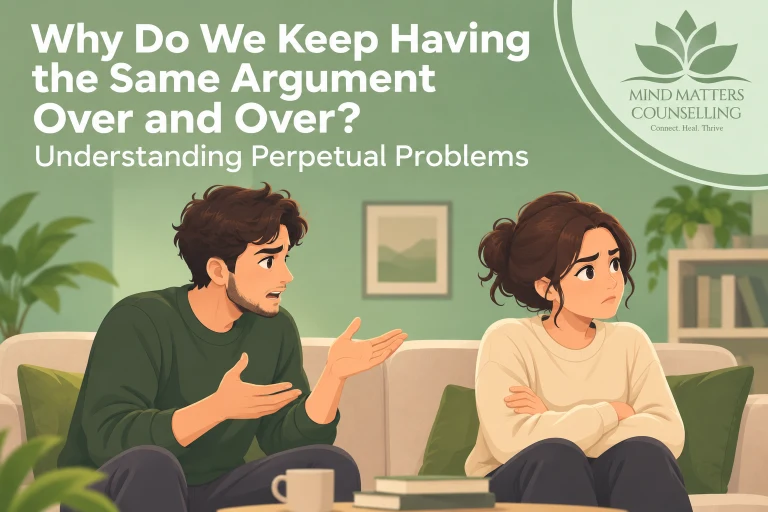
If you and your partner keep having the same argument over and over, you are probably dealing with what relationship researcher Dr. John Gottman calls a perpetual problem. These are disagreements rooted in personality, values or deep needs, and his research found that about 69% of couple conflicts fall into this group. The goal is not to make the argument disappear. It is to talk about it in a way that stops hurting you both.
That number surprises people. It also tends to bring relief. Happy couples have unresolved differences too. They just handle them differently.
Why do we keep having the same argument over and over?
Repeat arguments usually come back for one of three reasons:
- The topic is a stand in for something bigger. The fight about dishes is really about feeling respected. The fight about his mother is really about feeling chosen.
- The issue is built into who you each are. One of you is a planner and one is spontaneous. One saves and one spends. Those traits are not going away.
- The way you argue keeps it unresolved. Harsh openings, defensiveness and shutting down stop either of you from being heard, so the same argument comes back next week.
Solvable problems vs perpetual problems
Gottman separates conflict into two types. Knowing which one you are in changes how you approach it.
| Solvable problems | Perpetual problems |
|---|---|
| Tied to a situation | Tied to personality, values or needs |
| Can be fixed with a plan or compromise | Will come up again in some form |
| Example: who drives the kids on Tuesdays | Example: how close to be with extended family |
| Goal: agree on a solution | Goal: understand each other and manage it |
Common perpetual issues I see in couples across the Lower Mainland include money habits, chores and fairness, sex and affection, time with in-laws, parenting styles, religion, and how much financial support goes to family back home. If boundaries with in-laws are your recurring theme, our post on why setting boundaries with in-laws feels so wrong goes deeper.
Signs your argument has turned into gridlock
A perpetual problem is fine to live with. Gridlock is when it starts to damage the relationship. Signs include:
- You feel rejected by your partner whenever the topic comes up.
- You talk about it often, but nothing moves.
- Each of you digs in harder over time.
- Humour and affection disappear during these talks.
- You start to see your partner as selfish or as the enemy.
- Contempt, criticism, defensiveness or stonewalling show up. These are the Gottman Four Horsemen, and they predict trouble if they stay.
What is underneath the fight?
Gottman found that gridlocked conflicts almost always hide a dream: a hope, value or story about life that matters deeply to one partner. Until that dream is understood, compromise feels like losing part of yourself.
For example:
- Wanting to save every dollar might connect to growing up with financial stress and wanting your kids to feel secure.
- Wanting to send money to parents might connect to duty, gratitude and being a good son or daughter.
- Wanting more alone time might connect to needing to feel like your own person.
- Wanting more family visits might connect to fear of losing culture or language for your children.
Both partners usually have a dream in the conflict. Neither dream is wrong.
How to stop the same argument over and over from taking over your relationship
1. Start softly
Gottman’s research found that the first three minutes of a conflict conversation largely predict how it will end. Start with “I” and a need, not “you” and a complaint.
- Instead of: “You never help with anything around here.”
- Try: “I’m exhausted tonight. Could you handle the kids’ bedtime?”
2. Get curious about the dream
Take turns. One talks, one only listens and asks questions like:
- “What does this mean to you?”
- “Is there a story from your past behind this?”
- “What’s your deepest fear if we don’t do it your way?”
- “What would your ideal look like?”
The listener does not argue or fix. The goal is understanding, not agreement.
3. Find your core and your flexible areas
Each of you writes down what you absolutely need on this issue, which should be short, and where you can bend, which should be longer. Then look for a temporary deal you can both live with for a set time, like three months, and review it.
4. Take a real break when flooded
If your heart is racing and you can’t think clearly, you are flooded. Gottman recommends a break of at least 20 minutes, doing something calming, not rehearsing your next point. Agree on when you will come back.
5. Repair, even mid-fight
Small repair attempts keep fights from spiralling: “I’m getting defensive, let me try again,” a touch on the arm, or even a bit of shared humour.
6. Notice your cycle
Many repeat arguments follow a chase and withdraw dance. If one of you pushes and the other shuts down, read our post on the anxious avoidant relationship.
What a better version of the same argument sounds like
Here is a short example of a couple working on a money conflict:
Priya: I get anxious when we eat out a lot. Can we talk about the budget this weekend?
Arjun: Okay. I’ll be honest, eating out is how I relax after work. What makes you anxious about it?
Priya: My parents argued about money constantly. When we spend freely, I feel that fear again.
Arjun: I didn’t know it went that deep. What if we keep Fridays for eating out and cook the rest of the week?
The topic is still there. But they leave the talk feeling closer, not further apart. That is the real win. For more structured practice, see our couple therapy exercises to rebuild trust and connection.
When couples counselling helps
It is worth getting help if the same argument over and over now includes contempt, if you feel lonely in the relationship, or if you have tried these steps and still end up in the same place. A counsellor can slow the conversation down, help each of you hear the dream under the other’s position, and coach you through new ways of talking.
At Mind Matters Counselling, I use the Gottman Method and Emotionally Focused Therapy with couples, in person in New Westminster and online. I also offer sessions in Hindi, Punjabi and Urdu, which helps when family and culture are part of the conflict. Learn more about couples counselling or call 236-868-6851 for a free 15 minute consultation.
Frequently asked questions
Is it normal for couples to have the same fight repeatedly?
Yes. Gottman’s research found about 69% of relationship conflicts are perpetual, meaning they come back. What matters is whether you can discuss them with respect and humour.
What is a perpetual problem in a relationship?
It is a disagreement rooted in lasting differences in personality, values or needs. It cannot be solved once, but it can be managed in a way that keeps both partners feeling respected.
How do you break a cycle of arguing?
Start conversations gently, take turns listening for the deeper need, take 20 minute breaks when flooded, and repair quickly. Couples counselling can help if the pattern is entrenched.
Should we break up if we keep fighting about the same thing?
Not necessarily. Recurring fights are common in healthy relationships. It becomes a bigger concern when there is contempt, abuse, or a core value neither partner can live with.
What is gridlock in a relationship?
Gridlock is when a perpetual problem stops moving and both partners feel hurt, rejected and entrenched every time it comes up.
Sources
- Gottman, J. M., and Silver, N. (2015). The Seven Principles for Making Marriage Work (revised edition). Harmony Books.
- Gottman, J. M. (1994). What Predicts Divorce? The Relationship Between Marital Processes and Marital Outcomes. Lawrence Erlbaum.
About the author: Navreen Kaur is a Registered Clinical Counsellor (RCC) with the BC Association of Clinical Counsellors and the founder of Mind Matters Counselling in New Westminster. She works with couples using the Gottman Method and EFT. Read Navreen’s full profile.