Have you ever caught yourself repeatedly replaying a conversation in your head with your partner, asking someone you care about dozens of times whether or not they still love you, or panicking after they took too long to respond to your text message? You may have found yourself questioning whether something more was going on underneath the surface. OCD and anxious attachment often occur together. Learn why here and start understanding how to feel secure in your relationships AND yourself.
We dive into what science and therapy have revealed to us about OCD and anxious attachment; who is most at risk, and what support looks like.
What Is OCD, Really?
Obsessive-Compulsive Disorder is often reduced in pop culture to “being tidy” or “liking things a certain way.” In reality, OCD is a mental health condition built around two core components:
- Obsessions — intrusive, unwanted thoughts, images, or urges that create intense anxiety or discomfort
- Compulsions — repetitive mental or physical behaviours performed to neutralize that anxiety or prevent a feared outcome
Fear of contamination and checking behaviours may be some of the more well-known forms OCD takes, but it can also attach itself to relationships. This less commonly known form is sometimes called Relationship OCD (ROCD). Relationship OCD is characterised by obsessive doubts about your partner, relationship or feelings towards them – and subsequent compulsions to seek reassurance, review or compare.
What Is Anxious Attachment?
Attachment style refers to the patterns we develop, usually in early childhood, for how we relate to closeness, dependency, and separation in relationships. Someone with an anxious attachment style often:
- Craves closeness but fears it won’t be reciprocated
- Feels heightened distress during conflict or distance from a partner
- Seeks frequent reassurance and validation
- Interprets small changes in tone or availability as signs of rejection
- Struggles to feel settled even when the relationship is objectively stable
Attachment style is not a diagnosis, it’s a way you show up in relationships. When it manifests with something like OCD, the two can feed off each other in frustrating ways.
So, Can OCD Cause Anxious Attachment?
The honest answer is: it’s complicated, and the relationship likely runs in more than one direction.
- OCD can mimic and amplify anxious attachment behaviours. The reassurance-seeking loop common in ROCD looks almost identical to anxious attachment behaviour, checking in repeatedly, needing verbal confirmation of love, or scanning a partner’s face for signs of distance.
- Anxious attachment can make OCD symptoms worse. If someone already fears abandonment or feels unworthy of stable love, intrusive doubts about a relationship find fertile ground to take root and repeat.
- Both may share an underlying root: intolerance of uncertainty. People with OCD often struggle to sit with “not knowing,” and people with anxious attachment often struggle to sit with relational ambiguity. When these two overlap, the drive for certainty in love can become constant and draining.
- Early experiences can shape both. Inconsistent caregiving, high-control environments, or unpredictable emotional availability in childhood are associated with both anxious attachment and increased vulnerability to anxiety-based conditions like OCD.
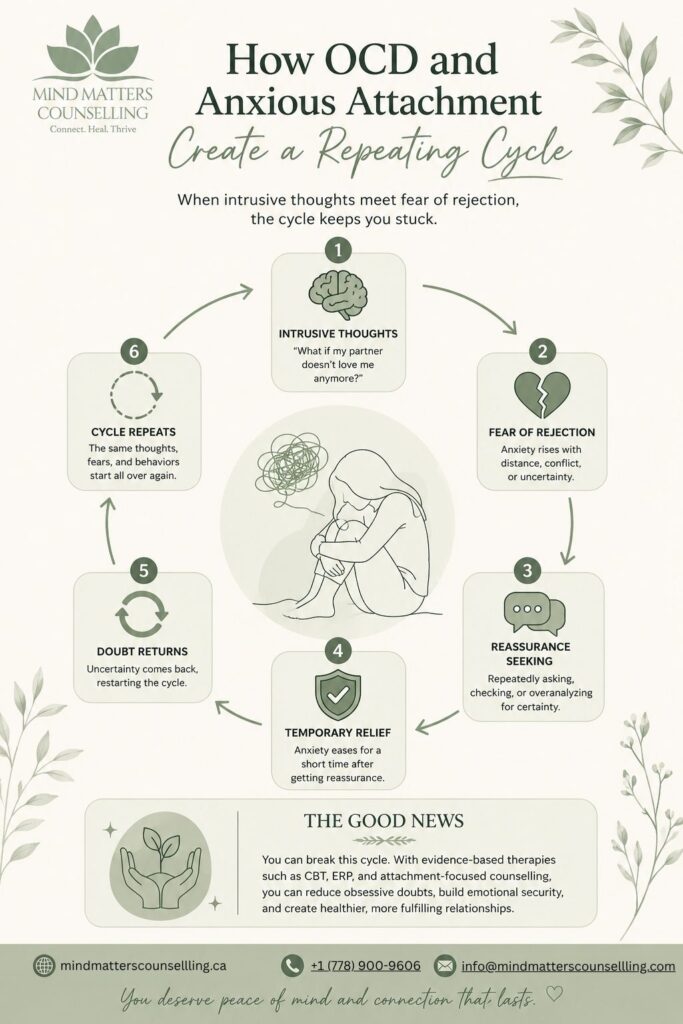
Instead of OCD “causing” anxious attachment or vice versa, OCD and anxious attachment behaviors maintain each other; doubt prompts checking behaviors, which give temporary relief, then the relief wears off and the cycle repeats itself.
Anxious Attachment in Women: Is There a Pattern?
Research and clinical observation both suggest that anxious attachment in women is a particularly common presentation, though it is by no means exclusive to women. A few contributing factors are often discussed:
- Socialization that emphasizes emotional attunement and relational responsibility can heighten sensitivity to a partner’s moods or perceived withdrawal
- Women are statistically more likely to be diagnosed with anxiety-related conditions, which can compound attachment-related fears
- Life transitions — such as new motherhood, career change, or relationship milestones, can intensify attachment anxiety at specific points in time
- Past relational wounds, including experiences of inconsistency or emotional unavailability from caregivers or partners, often surface strongly during adult romantic relationships
Recognizing this pattern isn’t about assigning blame or generalizing everyone’s experience, it’s about understanding that anxious attachment in women is a well-documented and treatable pattern, not a personal failing.
Signs of Burnout and Anxiety to Watch For
Obsessive doubting coupled with anxious attachment can slowly erode you. Burnout can occur because OCD symptoms are often expressed as “I’m just a worrier” or “I care too much.” Signs you may be experiencing burnout and anxiety:
- Persistent fatigue, even after adequate sleep, from constant mental vigilance
- Difficulty concentrating at work or in daily tasks due to intrusive relationship-focused thoughts
- Irritability or emotional flooding during minor relational disagreements
- Avoidance of social situations to prevent triggering doubts or comparisons
- A sense of never feeling “enough” reassurance helps briefly but never lasts
- Physical symptoms such as tension headaches, stomach upset, or a racing heart during moments of relational uncertainty
If several of these resonate, it may be worth exploring the pattern with a professional rather than trying to manage it alone indefinitely.
How Individual Counselling and Anxiety Counselling Can Help
The good news is that both OCD-related patterns and anxious attachment respond well to therapeutic support. A few approaches commonly used include:
- Cognitive Behavioural Therapy (CBT), which helps identify and gently challenge the thought patterns that fuel compulsive checking or reassurance-seeking
- Exposure and Response Prevention (ERP), a specialized approach for OCD that helps reduce the urge to perform compulsions in response to intrusive doubts
- Attachment-focused therapy, which explores the origins of relational fear and builds new, more secure ways of relating
- Mindfulness-based strategies, which support tolerance of uncertainty rather than the urgent need to resolve it
- Individual counselling, offering a steady, one-on-one space to unpack these patterns without judgment and at a pace that feels manageable
Anxiety counselling in particular can help someone separate “what is actually happening in the relationship” from “what my anxiety is telling me is happening” a distinction that is often the turning point in breaking the cycle.
How Mind Matters Counselling Can Help You Navigate This
Recognizing the link between OCD and anxious attachment is just one part of the battle. Actually working through it is another…which is why support can make all the difference.
At Mind Matters Counsellling, our team of Registered Clinical Counsellors (RCCs) provide a safe, confidential, and non-judgmental space to unpack whatever it is you’re struggling with (persistent doubts about your relationship, anxious attachment tendencies, burnout from shouldering both, etc.). Instead of pushing past solutions, we focus on understanding your own cycles and learning practical coping skills to help you feel more emotionally balanced in your relationships and with yourself.
Interested in individual counselling to process OCD-related issues? Or maybe anxiety counselling to better understand persistent attachment patterns? Either way, having a knowledgeable and empathetic partner by your side can help the process feel much less daunting. Mind Matters Counselling is built around providing compassionate guidance at your pace and without judgment.
Conclusion
OCD and anxious attachment are separate experiences, but they also frequently occur together, each reinforcing the other through cycles of uncertainty, seeking reassurance, and brief periods of relief that lead to more uncertainty. Realising that they might occur together is not about diagnosing yourself or your relationship as “damaged” or “broken”; it can help you understand why you may find yourself stuck in these cycles so that you can learn to break them.
You can absolutely move past obsessive doubt with professional support (individual counselling, anxiety counselling, therapy, or a blend of therapies). You can learn to feel more secure in yourself and your relationships. If you’re noticing these cycles in your life, reaching out to a registered counsellor can be a helpful and actionable first step.
Frequently Asked Questions
1. Is Relationship OCD (ROCD) the same as anxious attachment?
No. ROCD is a subtype of OCD involving intrusive doubts about a relationship, while anxious attachment is a relational pattern rooted in fear of abandonment. They can look similar and often overlap, but they are not the same thing.
2. Can someone have anxious attachment without having OCD?
Yes. Anxious attachment is a relational style that can exist entirely on its own, without any diagnosable condition like OCD present.
3. Does anxious attachment mean the relationship itself is unhealthy?
Not necessarily. Anxious attachment often reflects internal patterns and past experiences more than the current relationship’s actual health, though ongoing therapy can help clarify this distinction.
4. What is the first step if I recognize these patterns in myself?
Speaking with a registered counsellor is often the most effective first step, as they can help assess whether OCD, anxious attachment, or both are contributing to what you’re experiencing.
5. Can these patterns actually change over time?
Yes. With the right support, such as individual counselling or anxiety counselling, both OCD-related behaviours and anxious attachment patterns can shift toward greater security and calm.