If you go quiet when a partner wants to talk about feelings, or feel a small wave of relief when plans get cancelled, you may have an avoidant attachment style. It is one of the main adult attachment patterns psychologists describe, and it is common. In a 1997 US national survey, Mickelson, Kessler and Shaver found roughly one in four adults described themselves this way.
Avoidant does not mean cold, and it does not mean you cannot love. It usually means you learned early that leaning on people did not work, so you got very good at not needing to. Below are the signs, where the pattern starts, how it plays out with a partner, and what actually changes it.
Quick answer: An avoidant attachment style is a pattern where a person protects themselves from rejection by keeping emotional distance, valuing independence and shutting down when closeness feels like too much. It forms in childhood, shows up most in romantic relationships, and can change with awareness, safe relationships and therapy.
What is an avoidant attachment style?
An avoidant attachment style is a way of relating to people where closeness feels risky, so the person manages that risk by staying self-reliant and pulling back when someone gets too near. It sits inside attachment theory, first developed by British psychiatrist John Bowlby and tested by Mary Ainsworth through her “Strange Situation” studies with infants and caregivers.
In the 1980s, researchers Cindy Hazan and Phillip Shaver showed that the same patterns appear in adult romantic relationships. Today most clinicians talk about four styles: secure, anxious, avoidant and disorganized (also called fearful-avoidant).
One thing worth saying early: this is a pattern, not a diagnosis. You will not find “avoidant attachment” in the DSM. It is also different from avoidant personality disorder, which is a clinical condition centred on social fear and feelings of inadequacy.
What are the signs of avoidant attachment?
The clearest sign is a strong pull toward distance at the exact moment a relationship asks for more closeness. Other common signs:
- You feel most comfortable when you rely on no one and no one relies on you.
- Conversations about feelings make you want to change the subject, joke, or leave the room.
- You start noticing a partner’s flaws once things get serious.
- You keep parts of your life separate, like friends, money or plans.
- When stressed, you go quiet and handle it alone, even when help is offered.
- You miss people more when they are gone than when they are with you.
- Being called “distant” or “hard to read” is a familiar complaint.
Researchers Mario Mikulincer and Phillip Shaver call these “deactivating strategies.” The attachment system gets switched down so the person does not have to feel the need for someone. It works in the short term. Over time it leaves people lonely inside relationships that look fine from the outside.
Dismissive-avoidant vs fearful-avoidant: what is the difference?
Both avoid closeness, but for different reasons. In 1991, Kim Bartholomew and Leonard Horowitz split avoidance into two types based on how a person sees themselves and others.
| Dismissive-avoidant | Fearful-avoidant | |
|---|---|---|
| View of self | Positive (“I’m fine on my own”) | Negative (“I’m not enough”) |
| View of others | Unreliable or intrusive | Wanted but dangerous |
| Core feeling about closeness | “I don’t need it” | “I want it, and it scares me” |
| Typical behaviour | Calm distance, self-sufficiency | Push and pull, hot and cold |
| Common in | People raised with emotional neglect | People raised with fear or inconsistency |
When most articles say “avoidant,” they mean dismissive-avoidant. Fearful-avoidant overlaps heavily with what clinicians call disorganized attachment style, which has its own patterns and needs a different kind of care.
What causes an avoidant attachment style?
An avoidant attachment style usually develops when a child’s emotional needs were met with distance, discomfort or disapproval, so the child learned that showing need made things worse. The parent was often physically present and responsible. What was missing was emotional attunement.
In practice, that can look like:
- Crying being met with “you’re fine” or being sent to your room.
- Praise for independence and coping alone, and little comfort when upset.
- A parent who was overwhelmed, depressed or emotionally shut down themselves.
- A family culture where feelings simply were not discussed.
That last point comes up often in our New Westminster practice, especially with clients from families where duty and self-control were valued over emotional talk. Nobody did anything “wrong” in an obvious way. The child just learned the rule: handle it yourself.
Later experiences matter too. A painful breakup, betrayal or a controlling relationship can push an adult who was fairly secure toward avoidance.
How does avoidant attachment show up in relationships?
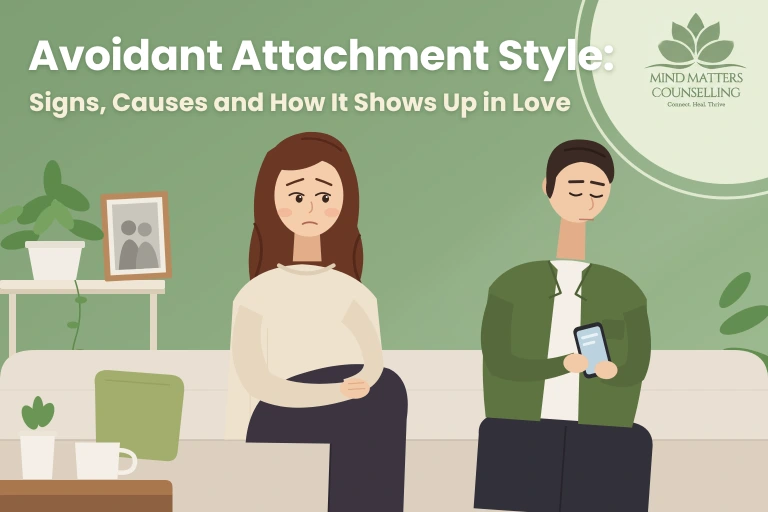
In relationships, avoidant attachment usually shows up as a cycle: the closer things get, the more the avoidant partner withdraws, and the more their partner reaches, the more trapped they feel.
This is most intense when an avoidant partner is with someone who has anxious attachment. Here is a typical Sunday-night version we hear in couples sessions:
She says, “You’ve been on your phone all weekend. Are we okay?” He hears criticism and a demand, says “We’re fine,” and gets quieter. She hears dismissal and pushes harder. He leaves the room to calm down. She feels abandoned. Both people end the night feeling misunderstood, and neither one is the villain.
The avoidant partner usually is not trying to punish anyone. Their body is flooded and withdrawal is the only regulation tool they learned. If the anxious side of this dynamic sounds familiar, our piece on how anxious attachment shows up in men covers the other half of the cycle.
Left alone, the withdrawal can harden into stonewalling, one of Gottman’s Four Horsemen and among the strongest predictors of a relationship ending.
Is it avoidance, or do you just need space?
Needing space is healthy. Avoidance is when space becomes the only response to closeness. A quick way to tell the difference:
| Healthy need for space | Avoidant withdrawal |
|---|---|
| You say what you need and when you’ll be back | You disappear without explaining |
| You return feeling more connected | You return hoping the topic is dropped |
| It happens at random times | It happens right after closeness or conflict |
| Your partner feels secure | Your partner feels anxious or shut out |
If most of your answers sit in the right column, that is worth paying attention to. It is not a character flaw. It is a learned habit, and learned habits can be relearned.
Can avoidant attachment change?
Yes. Attachment styles are fairly stable, but they are not fixed. Researchers use the term “earned secure attachment” for adults who started with an insecure pattern and became secure through later relationships, reflection and often therapy.
Change usually comes from a few things working together:
- Naming the pattern in the moment. “I’m shutting down right now” is a big step for someone who used to just leave.
- Staying a little longer than is comfortable. Not forcing intimacy, but tolerating it in small doses.
- Learning what your body does. Avoidant people often notice tension, numbness or irritation before they notice any emotion.
- A safe relationship. A partner, friend or therapist who stays steady when you pull back gives your nervous system new evidence.
Progress tends to feel awkward before it feels natural. Many clients say the first sign of change was simply noticing the urge to pull away, then choosing a different move.
How counselling helps with avoidant attachment
Counselling helps by giving you a relationship where closeness is safe to practise, and tools to understand what happens inside you when someone gets close.
With individual clients, counsellors often use approaches like emotionally focused individual therapy, which works directly with the feelings underneath withdrawal. Early sessions are rarely about deep emotion. They are about building trust at your pace, because pushing an avoidant client to “open up” tends to backfire.
For couples, therapy slows the pursue-and-withdraw cycle down so each person can see the fear behind the other’s behaviour. The avoidant partner learns to say “I need twenty minutes, then I’ll come back.” The anxious partner learns that the pause is not abandonment.
If you recognise yourself or your relationship here, our Registered Clinical Counsellors offer individual counselling and couples counselling in New Westminster, in person and online across BC. Get in touch to book a session or ask a question first.
Frequently asked questions
Can someone with an avoidant attachment style fall in love?
Yes. People with an avoidant attachment style feel love deeply. They tend to show it through actions, like fixing things or showing up, more than through words or emotional talk, and they may feel the most love when there is some distance.
Do avoidants come back after pulling away?
Often, yes. Many avoidant people return once they feel calmer and less pressured. Whether the relationship improves depends on whether the pattern gets talked about, not on how many times they return.
Is avoidant attachment the same as avoidant personality disorder?
No. Avoidant attachment is a relationship pattern, not a mental health diagnosis. Avoidant personality disorder is a clinical condition marked by intense fear of rejection and social inhibition across most areas of life.
What triggers an avoidant person?
Common triggers include pressure to talk about feelings, criticism, a partner’s strong emotions, conversations about commitment, and feeling that their independence is being limited.
How long does it take to change an avoidant attachment style?
There is no fixed timeline. Many people notice real shifts within several months of consistent therapy, though deeper change is gradual and builds through repeated safe experiences of closeness.
References
- Bowlby, J. (1969). Attachment and Loss, Vol. 1: Attachment.
- Ainsworth, M. et al. (1978). Patterns of Attachment.
- Hazan, C. and Shaver, P. (1987). Journal of Personality and Social Psychology.
- Bartholomew, K. and Horowitz, L. (1991). Journal of Personality and Social Psychology.
- Mickelson, K., Kessler, R. and Shaver, P. (1997). Journal of Personality and Social Psychology.
- Mikulincer, M. and Shaver, P. (2007). Attachment in Adulthood.