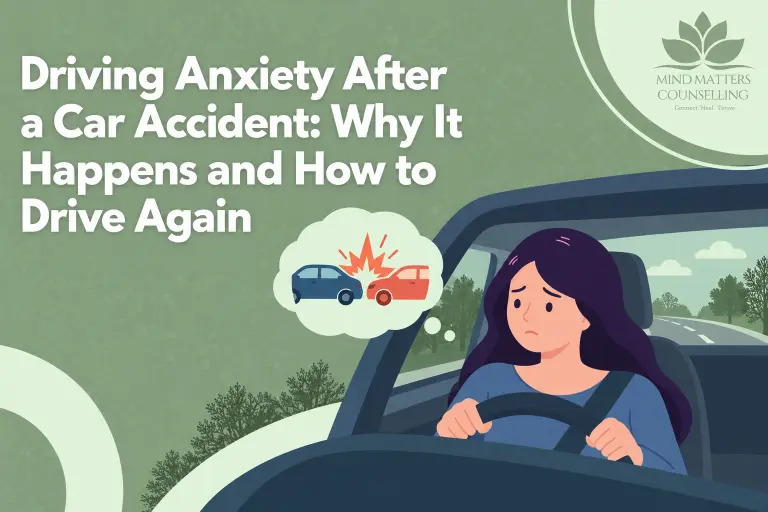
Your body healed weeks ago. The car is fixed. But the moment you sit in the driver’s seat, your hands sweat and your heart starts racing. Maybe you’ve started taking longer routes to avoid the intersection where it happened, or you flinch every time someone brakes in front of you.
Driving anxiety after a car accident is one of the most common emotional effects of a crash, and it often shows up even after a minor fender bender. The good news is that it usually responds well to the right support. Here’s why it happens, how to tell when it’s more than normal nerves, and how to get back behind the wheel step by step.
| Key Takeaways Fear of driving or riding in a car is one of the most common reactions after a crash, often more common than PTSD. The fear is driven by your brain’s threat system, and avoiding driving usually makes it stronger over time. Gradual, planned exposure is the most effective way back to confident driving. In BC, ICBC pre-approves 12 clinical counselling sessions in the first 12 weeks after a crash, regardless of fault. |
Why do people get anxious about driving after a crash?
After a crash, your brain’s threat system learns to link driving with danger. Cars, intersections, rain, or even the sound of brakes can set off the same fight-or-flight response you felt during the accident. That’s a protective reaction, but it often stays switched on long after the real danger has passed.
This is common. A well-known study of road accident victims at the John Radcliffe Hospital in Oxford, led by Richard Mayou and published in the BMJ in 1993, found that phobic travel anxiety, as a driver or a passenger, was more common than PTSD and often disabling. A smaller 2009 study of 150 crash survivors in Serbia found that 65% reported travel anxiety at least two years later, and 9% had stopped driving altogether.
The severity of the crash doesn’t always predict the severity of the fear. People who had a minor collision sometimes struggle more than people with serious injuries, especially if the crash felt sudden and out of their control, or if they had a frightening “what if” moment just before impact.
Driving fear also tends to grow through avoidance. Each time you skip a drive, your brain gets a quick hit of relief, and it files that away as proof that driving was dangerous. The next trip feels a little harder.
Signs of driving anxiety after an accident
Driving anxiety can look different from person to person. Some people can’t drive at all, while others drive but feel tense the entire time. Common signs include:
- Racing heart, sweaty palms, or shaky hands when you get in the car
- Avoiding highways, bridges, certain intersections, or driving at night
- Gripping the wheel, braking too early, or driving well below the speed limit
- Feeling panicked as a passenger, or constantly “co-driving” from the passenger seat
- Replaying the crash when you see similar cars or weather
- Asking others to drive you, even when it’s inconvenient
- Trouble sleeping before a planned drive
The fear of being a passenger is easy to miss. Many people assume they’re fine because they’ve started driving again, while they quietly dread every time someone else is behind the wheel.
Is it driving anxiety or PTSD?
Driving anxiety focuses mainly on cars and travel. PTSD is broader. It affects many parts of daily life and includes symptoms like flashbacks, nightmares, feeling constantly on guard, and emotional numbness that last for more than a month after the event.
PTSD after a crash isn’t rare. A recent meta-analysis published in Health Promotion Perspectives estimated that about 20% of road traffic accident survivors develop PTSD. Signs that your reaction may be closer to PTSD include:
- Intrusive memories or flashbacks you can’t control
- Nightmares about the crash
- Being easily startled, jumpy, or always scanning for danger
- Feeling detached from people around you
- Irritability or anger that feels new
- Symptoms lasting longer than a month and affecting work or relationships
If several of these sound familiar, it’s worth talking to a counsellor or your doctor. PTSD responds well to trauma-focused treatment, and you don’t need to wait until things get worse to ask for help. Seasons can make this harder, too. Our post on car accident recovery and winter anxiety explains why dark, icy months often bring symptoms back.
How to drive again after a car accident
The most effective way to get comfortable driving again is gradual exposure. You build a ladder of driving situations, from easiest to hardest, and work up one step at a time. You move to the next step only when the current one feels manageable, not when the anxiety is gone completely.
A sample ladder might look like this:
- Sit in the parked car with the engine off for five minutes
- Start the engine and stay parked, breathing slowly
- Drive around an empty parking lot
- Drive a short route on quiet residential streets
- Drive a familiar route at a quiet time of day
- Drive in light traffic, then moderate traffic
- Drive past or through the area where the crash happened
- Drive on the highway, at night, or in rain
A few things help each step go better. Practise slow breathing before you start, with a longer exhale than inhale. Bring a calm passenger in the early stages if that helps, then try the same step alone. Repeat each step several times, because one good drive doesn’t rewire a fear response. Expect some anxiety. The aim is to show your brain that you can feel nervous and still drive safely.
Keep a short record of each drive and how anxious you felt from 0 to 10. Many people are surprised to see the numbers drop after a few repeats, even when it didn’t feel that way in the moment.
How counselling helps with driving fear
Counselling gives structure to this process and helps with the parts that are hard to fix alone, like flashbacks, guilt about the crash, or anxiety that has spread beyond driving.
Cognitive behavioural therapy is one of the most widely used approaches. It combines planned exposure with work on the thoughts that keep fear going, such as “I can’t trust other drivers” or “if I get anxious, I’ll lose control.” You can learn more in our guide to cognitive behavioural therapy for anxiety. When the fear is part of a wider trauma response, trauma-focused therapy helps the memory of the crash feel less raw.
In BC, cost doesn’t have to be a barrier. Under ICBC’s Enhanced Care coverage, anyone injured in a crash has 12 pre-approved clinical counselling sessions within the first 12 weeks, regardless of who was at fault. More sessions can be approved after that through your recovery specialist. Our post on how ICBC counselling supports recovery after a car accident explains how the process works.
At Mind Matters Counselling, we provide ICBC counselling for drivers, passengers, cyclists, and pedestrians in New Westminster and online across BC. If the fear of driving is limiting your work, family life, or independence, a free 15-minute consultation is a simple place to start.
Frequently Asked Questions
Is it normal to be scared to drive after a minor car accident?
Yes. Even small collisions can trigger strong fear, especially if the crash was sudden or you felt out of control. For many people, the anxiety eases within a few weeks. If it lasts longer or keeps you from driving, counselling can help.
How long does driving anxiety last after an accident?
It varies. Some people feel normal within weeks, while others struggle for months or years, especially if they avoid driving. Avoidance tends to keep the fear going, so gradual practice and early support usually shorten recovery time.
Should I force myself to drive right away?
Pushing straight into the hardest drive often backfires. A gradual approach works better: start with easy steps, repeat them until they feel manageable, then move up. Make sure you’re physically cleared to drive and that any injuries won’t affect your control of the car.
Does ICBC cover counselling for driving anxiety?
Under Enhanced Care, ICBC pre-approves 12 clinical counselling sessions in the first 12 weeks after a crash, no matter who was at fault. If you need more sessions or the 12 weeks have passed, your counsellor can work with your ICBC recovery specialist to request approval.
Sources
- Mayou, R., Bryant, B. and Duthie, R., “Psychiatric consequences of road traffic accidents,” BMJ, 1993.
- Dickov, A. et al., “Psychiatric consequences of stress after a vehicle accident,” Psychiatria Danubina, 2009.
- Meta-analysis of PTSD prevalence among road traffic accident survivors, Health Promotion Perspectives.
- ICBC, “Medical care and treatment,” icbc.com.