ADHD counselling for children and teens in New Westminster, Burnaby, Surrey & the Lower Mainland
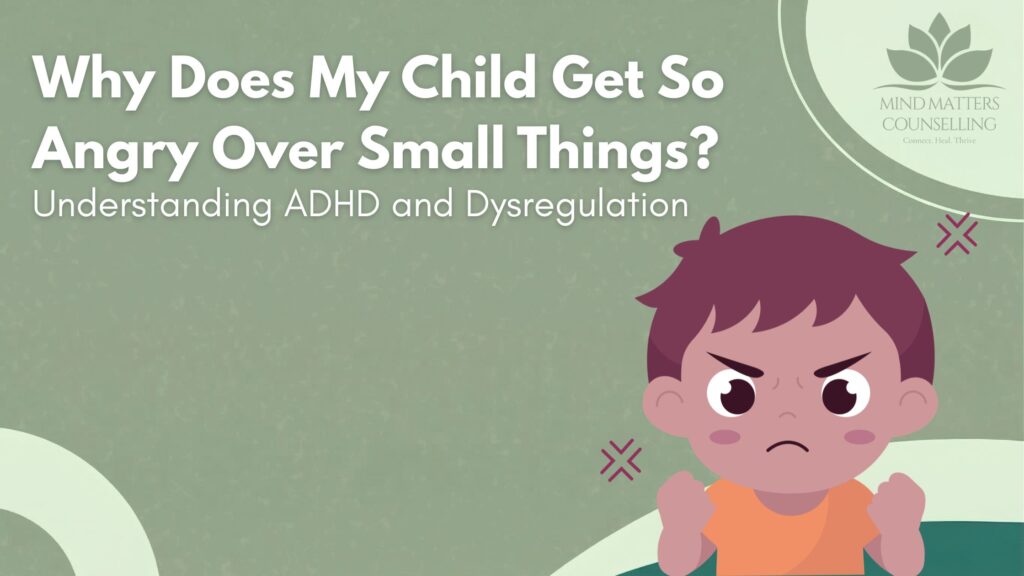
Your child loses their favourite pencil and suddenly they’re crying.
You ask them to put their shoes on, and they become frustrated.
You remind them about homework, and they snap:
“I don’t want to!”
A small disagreement turns into a huge argument.
Five minutes later, they may be completely calm and wondering why everyone is still upset.
If this sounds familiar, you may have found yourself asking:
“Why does everything become such a big deal?”
“Why can’t my child just calm down?”
“Why are they so sensitive?”
“Are they being defiant?”
“Am I being too strict—or not strict enough?”
When a child has ADHD, intense emotional reactions can sometimes be connected to emotional dysregulation and difficulties with executive functioning.
This does not mean every emotional outburst is caused by ADHD. Children can become angry for many reasons. But when intense reactions happen frequently, seem disproportionate to the situation, or are difficult for your child to recover from, it can be helpful to look underneath the behaviour rather than focusing only on the behaviour itself.
At Mind Matters Counselling, we support children, teens, and families navigating ADHD, anxiety, emotional regulation, autism, neurodivergence, and behavioural challenges in New Westminster, Burnaby, Surrey, and surrounding Lower Mainland communities.
When a Small Problem Feels Like a Very Big Problem
Imagine your child has been looking forward to playing outside.
You tell them:
“Not right now. We have to leave in ten minutes.”
They immediately become upset.
You might think:
“It’s only ten minutes. Why are they reacting like this?”
But your child may not be experiencing the situation as simply:
“I can’t play outside right now.”
Their brain may be dealing with several things at once:
- disappointment
- difficulty shifting attention
- frustration
- loss of control
- difficulty transitioning
- difficulty regulating the emotional response
The result can be an emotional reaction that seems much bigger than the original event.
From the outside, it can look like overreacting.
From the child’s perspective, the emotion may genuinely feel overwhelming.
What Is Emotional Dysregulation?
Emotional regulation is our ability to notice, understand, manage, and recover from emotional experiences.
Everyone becomes angry, frustrated, disappointed, or overwhelmed.
The difference is often what happens next.
A child who is able to regulate might become frustrated and eventually say:
“I’m upset because I wanted to keep playing.”
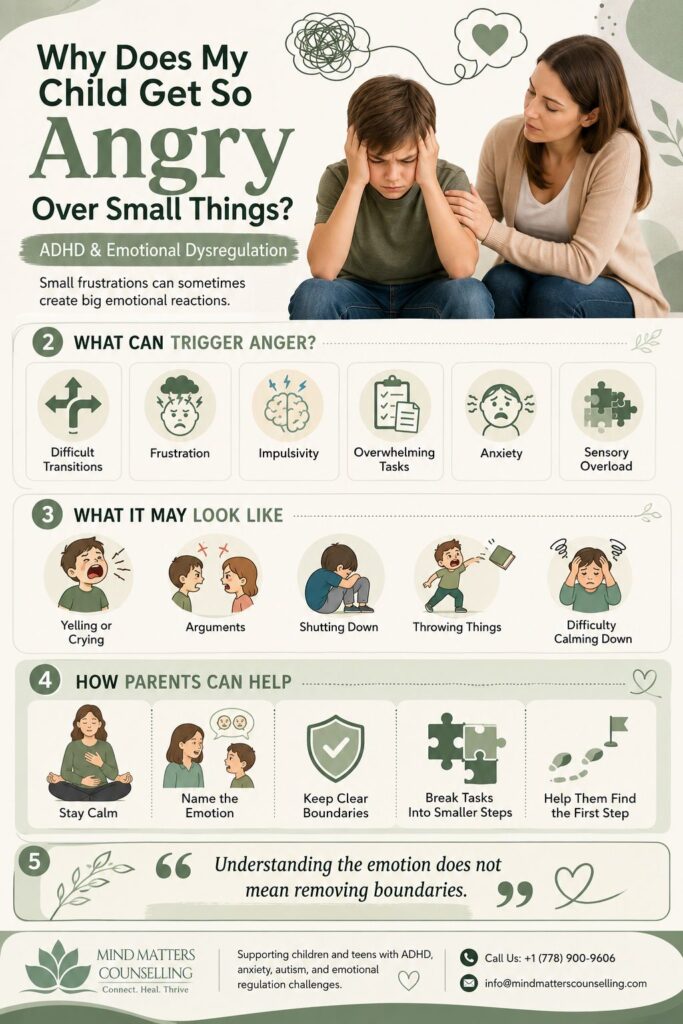
A child experiencing emotional dysregulation may:
- yell
- cry
- slam doors
- throw objects
- argue
- become physically agitated
- say things they later regret
- shut down
- struggle to communicate what they need
The difficulty isn’t necessarily the emotion itself.
The difficulty can be the intensity, speed, and recovery from the emotion.
Is Emotional Dysregulation a Symptom of ADHD?
Emotional dysregulation is not one of the formal diagnostic criteria for ADHD, but difficulties with emotional regulation are commonly reported among people with ADHD and are an important clinical consideration.
ADHD affects more than attention.
Children with ADHD can also experience challenges involving:
- impulse control
- working memory
- planning
- organization
- shifting attention
- managing frustration
- delaying gratification
- transitioning between activities
These executive functioning differences can make emotional situations harder to navigate.
For example, your child may know:
“I shouldn’t yell when I’m angry.”
But knowing what to do and being able to access that skill in the middle of intense emotion are two different things.
Read More: What is Emotionally Focused Individual Therapy?
“But They Know Better.”
This is one of the most frustrating parts for parents.
You may have explained the expectation many times.
Your child may even be able to explain it back to you.
They know:
- yelling isn’t okay
- hitting isn’t okay
- throwing things isn’t okay
- homework needs to get done
- they need to get ready
- they need to listen
So why does it keep happening?
Because knowledge and regulation are not the same thing.
A child can understand a rule when they are calm and still struggle to use that knowledge when overwhelmed.
This is why simply repeating:
“You know better.”
may not teach the skill you actually want them to develop.
The question becomes:
What skill is missing in that moment?
What Looks Like Defiance May Sometimes Be Overwhelm
Not every act of defiance is emotional dysregulation.
Children can refuse things because they don’t want to do them.
They can test limits.
They can push boundaries.
They can be angry because they are unhappy with a parent’s decision.
But sometimes behaviour that looks like defiance is actually a child who has become overwhelmed.
Consider the difference.
“I don’t want to do my homework.”
This could be a refusal.
But it could also be:
“I don’t know where to start, and I’m embarrassed that I don’t know how to do it.”
“Leave me alone!”
This could be disrespectful.
But it could also mean:
“I’m overwhelmed and I don’t know how to explain what I’m feeling.”
“I hate you!”
This can be hurtful to hear.
But in some situations, it may be an impulsive expression of:
“I’m extremely angry right now and I don’t know what to do with this feeling.”
Understanding the behaviour doesn’t mean excusing harmful behaviour.
It means trying to understand what is underneath it so you can respond more effectively.
Why Does My Child Get Angry Over Small Things?
There may be several things happening at once.
1. Frustration Tolerance May Be Lower
Children with ADHD may become frustrated quickly when something feels difficult, boring, unfair, or unpredictable.
A small obstacle can feel like a major roadblock.
2. Transitions Can Be Difficult
Going from:
- screen time to homework
- playtime to dinner
- home to school
- school to an appointment
- one activity to another
requires a child to stop one thing and shift their attention to another.
For some children with ADHD, that transition is harder than adults realize.
3. Impulsivity Can Affect Emotional Reactions
The emotional response may happen before the child has time to pause.
They become angry.
They react.
Then they think.
Adults often have more ability to create that pause.
Children are still developing it.
4. Executive Functioning Challenges Can Create Frustration
Imagine knowing you need to clean your room but having no idea where to start.
Or knowing you have homework but being unable to organize the steps.
Or remembering that you need to get ready but becoming distracted repeatedly.
The child may hear:
“You’re not even trying.”
But internally, they may be experiencing:
“I don’t know how to get started.”
Repeated experiences of struggling can eventually create frustration and shame.
The Connection Between ADHD, Anxiety, and Anger
Sometimes what looks like anger is actually anxiety.
A child who is worried about:
- making mistakes
- school
- friendships
- disappointing parents
- being judged
- failing
- not understanding something
may express that anxiety through irritability or anger.
For some children, saying:
“I’m scared I won’t be good enough.”
is much harder than saying:
“I don’t care!”
This is why it can be helpful to consider both ADHD and anxiety when a child’s emotional reactions are intense.
Why After-School Meltdowns Can Happen
Some children appear to hold themselves together throughout the school day.
They follow instructions.
They manage social interactions.
They concentrate as much as they can.
They navigate noise, transitions, expectations, and academic demands.
Then they get home.
And everything falls apart.
Parents may wonder:
“Why can my child behave at school but not at home?”
This does not necessarily mean your child is choosing to misbehave at home.
Home may simply be where they finally feel safe enough to release the emotional tension they have been holding throughout the day.
This can be particularly relevant for children who are working hard to manage ADHD, anxiety, or autistic traits in structured environments.
ADHD and Autism: When Emotional Overload Looks Like Behaviour
Children on the autism spectrum can also experience significant emotional overwhelm, although the underlying reasons may differ from those experienced by children with ADHD.
For an autistic child, an emotional outburst or shutdown may be connected to:
- sensory overload
- unexpected changes
- communication difficulties
- social exhaustion
- difficulty understanding what is happening
- feeling overwhelmed by noise, lights, textures, or environments
A child’s behaviour is communication, but it is important not to assume that every meltdown has the same cause.
Understanding the individual child matters.
At Mind Matters, our approach to neurodivergent children aims to understand what the behaviour is communicating, rather than simply trying to make the child appear more compliant.
What Parents Often Try and Why It Doesn’t Always Work
When a child repeatedly becomes angry, parents understandably try to stop the behaviour.
They may use:
- consequences
- rewards
- lectures
- taking away screens
- repeated reminders
- threats
- time-outs
Sometimes these strategies are appropriate.
But if the underlying problem is emotional regulation, simply increasing consequences may not teach the child the missing skill.
A child who doesn’t know how to regulate frustration needs more than:
“Don’t get angry.”
They need to learn:
“What do I do when I start getting angry?”
What Can Parents Do When Their Child Is Melting Down?
The goal isn’t to eliminate every difficult emotion.
The goal is to help your child gradually develop the ability to recognize and manage those emotions.
Start by Regulating Yourself
Your child’s nervous system responds to yours.
If both of you are escalating, trying to reason through the entire situation may not work.
Use a calm voice.
Reduce unnecessary stimulation.
Keep your words short.
Name What You See
Instead of immediately correcting:
“Stop acting like this.”
Try:
“You’re really frustrated right now.”
Or:
“This feels really hard right now.”
Naming the emotion doesn’t mean agreeing with inappropriate behaviour.
It communicates:
“I can see what you’re experiencing.”
Separate the Emotion From the Behaviour
You can validate the feeling while maintaining the boundary.
For example:
“It’s okay to be angry. It’s not okay to hit.”
This teaches your child that emotions are acceptable while certain behaviours still have limits.
Help Them Find the First Step
If the problem is homework:
Instead of:
“Go finish your homework.”
Try:
“Let’s figure out the first question together.”
If getting ready is the problem:
“Let’s start with your socks.”
Breaking tasks into smaller steps can reduce the executive-functioning demand.
What Does ADHD Counselling for Children Actually Look Like?
Counselling isn’t simply a place where a child is told to behave better.
Therapy can provide children with practical tools to understand themselves.
Depending on the child’s age and needs, counselling may focus on:
- emotional identification
- emotional regulation
- frustration tolerance
- coping skills
- impulse control
- problem-solving
- communication
- self-esteem
- anxiety management
- executive functioning strategies
- social skills
- understanding neurodivergence
Children often need these skills taught in ways that make sense for them.
That might involve:
- games
- drawing
- storytelling
- creative activities
- role-playing
- visual tools
- practical exercises
The goal is to help children understand:
“This is what happens inside me when I become overwhelmed, and these are the things I can do.”
Therapy Isn’t Only for the Child
Parents often come to counselling saying:
“My child needs help.”
Sometimes the child does need support.
But parents need support too.
Parenting a child with ADHD, anxiety, or autism can be exhausting.
You may constantly wonder:
- Am I being too strict?
- Am I being too lenient?
- Should I give consequences?
- Should I ignore it?
- Why does nothing seem to work?
- How do I help without making things worse?
Parent counselling or family counselling can help you understand your child’s behaviour while also giving you practical strategies for responding differently.
Sometimes changing the interaction between parent and child can make a significant difference.
When Should I Consider ADHD or Child Counselling?
You don’t have to wait for your child’s behaviour to become severe.
Consider seeking support if your child’s emotional reactions are:
- frequent
- intense
- difficult to recover from
- affecting friendships
- affecting school
- creating significant family conflict
- affecting their self-esteem
- causing anxiety
- creating constant stress at home
Counselling can also be helpful if you simply feel stuck as a parent.
You don’t need to have everything figured out before reaching out.
Child and Teen Counselling in New Westminster, Burnaby & Surrey
At Mind Matters Counselling, we work with children, teens, and families experiencing ADHD, anxiety, autism, emotional regulation difficulties, self-esteem concerns, and relationship challenges.
Our goal is not to make neurodivergent children fit into a narrow idea of how they “should” behave.
Instead, we work toward helping children understand themselves, develop practical coping skills, communicate their needs, and build confidence.
We provide child and teen counselling for families in New Westminster, Burnaby, Surrey, and surrounding Lower Mainland communities, with both in-person and online options depending on the service and therapist.
Your Child Isn’t Giving You a Hard Time. They May Be Having a Hard Time.
Sometimes the behaviour is frustrating.
Sometimes it is exhausting.
Sometimes you may genuinely not know what to do next.
But behind the anger may be a child who is struggling with a skill they haven’t learned yet.
A child who doesn’t know how to manage disappointment.
A child who can’t find the words for anxiety.
A child whose executive functioning makes everyday tasks harder.
A child who is overwhelmed by sensory or social demands.
Or simply a child who needs help understanding what is happening inside them.
Understanding doesn’t mean removing boundaries.
It means approaching the behaviour with curiosity as well as limits.
If your child’s anger, frustration, anxiety, or emotional outbursts are becoming difficult to manage, you don’t have to figure it out alone.
At Mind Matters Counselling, we provide child and teen counselling for ADHD, anxiety, autism, emotional regulation, self-esteem, and related concerns in New Westminster, Burnaby, Surrey, and throughout the Lower Mainland.
Book a session with Mind Matters Counselling to learn more about how we can support your child and your family.
Frequently Asked Questions
Is anger a symptom of ADHD in children?
Anger itself is not a formal diagnostic criterion for ADHD. However, many children with ADHD experience difficulties with emotional regulation, impulsivity, frustration tolerance, and executive functioning, which can contribute to intense emotional reactions.
Why does my child with ADHD get angry over small things?
A child with ADHD may have difficulty shifting attention, managing frustration, tolerating delays, or regulating intense emotions. What seems small to an adult can feel much bigger to a child who is already overwhelmed.
How can I help my ADHD child regulate their emotions?
Start by helping your child identify emotions, reduce stimulation when they are overwhelmed, maintain clear boundaries, break difficult tasks into smaller steps, and practice coping strategies when they are calm—not only during a meltdown.
Is my child being defiant or emotionally overwhelmed?
It can be difficult to tell. Some behaviour is intentional refusal, while other behaviour may be connected to anxiety, ADHD-related executive functioning difficulties, sensory overload, or emotional dysregulation. Looking at what happens before, during, and after the behaviour can provide useful information.
Can anxiety cause anger in children?
Yes. Some children express anxiety through irritability, frustration, avoidance, or anger rather than saying that they feel worried or afraid.
Can counselling help a child with ADHD?
Counselling can help children develop skills related to emotional regulation, coping, communication, self-esteem, frustration tolerance, problem-solving, and anxiety management. Parent and family involvement may also be helpful.
Does Mind Matters Counselling work with autistic children?
Mind Matters Counselling provides support for children and teens with autism and other forms of neurodivergence. Therapy is tailored to the child’s individual communication style, needs, strengths, and goals.
When should I seek counselling for my child’s anger?
Consider seeking professional support when emotional outbursts are frequent, intense, difficult to manage, affecting school or friendships, creating significant family conflict, or contributing to anxiety or low self-esteem.