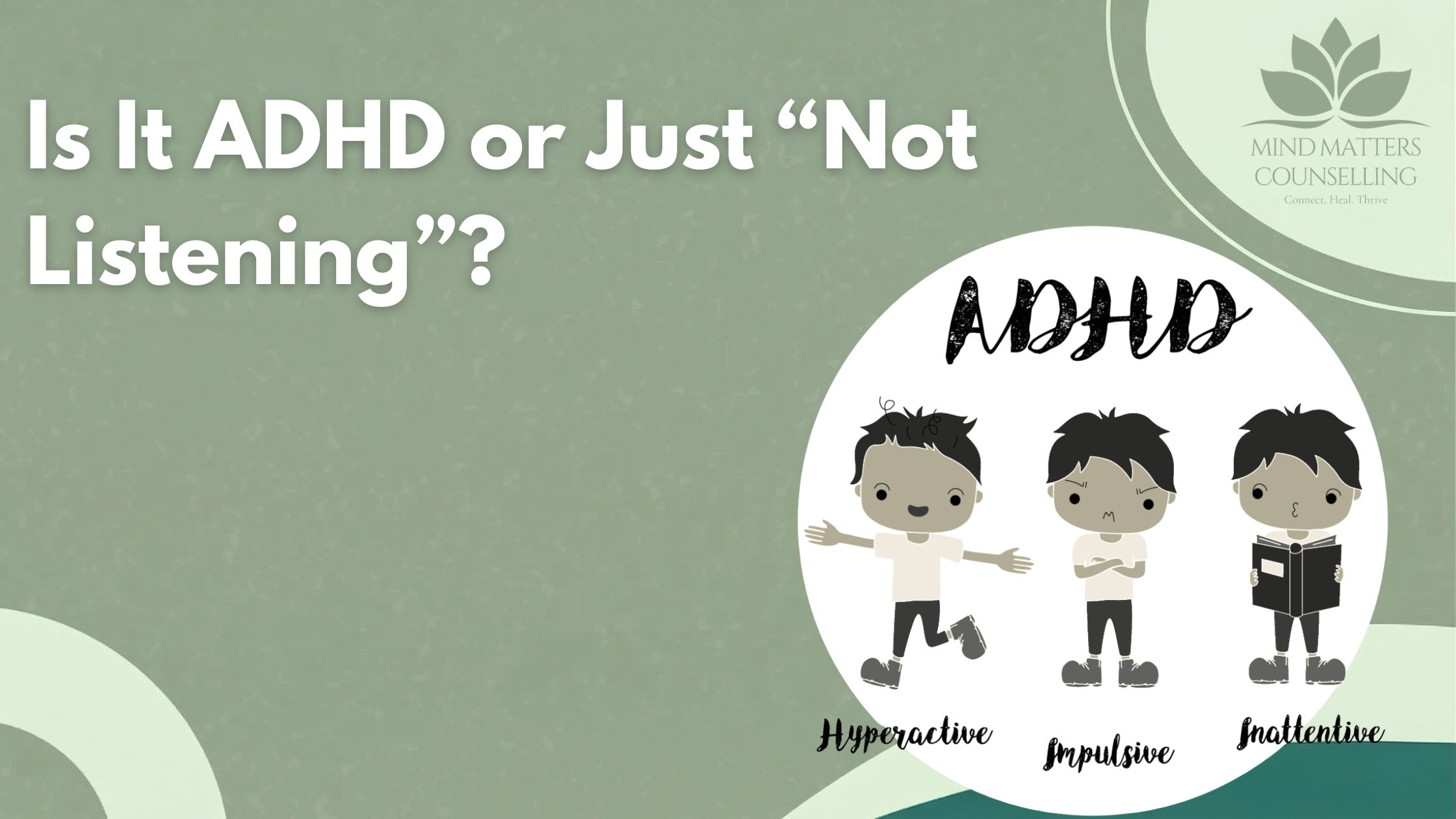
When you’re a parent of an ADHD child it can be difficult to decide if they are just distracted or if something more is going on. Neurodivergent children are not hard kids, they simply operate differently.
At home you may have found the perfect balance with your kids. But what about at school? You may hear things like
- “I know they can do this work, they just don’t try.”
- “Your child should try harder.”
- “They never listen to me.”
This isn’t limited to school things either. You may even catch yourself having to nitpick your child about things at home like
- Difficulty finishing homework
- Emotional meltdowns
- Trouble following simple instructions
- complex directions
- forgetting things
- problem with routines
- anger over small issues
Many parents in New Westminster, Burnaby, Surrey, and nearby areas wonder:
“Is my child just being lazy?”
But often, these can actually be signs of ADHD in children and teens.
At Mind Matters Counselling, we help families understand ADHD with compassion and not judgment. Many children with ADHD benefit from executive functioning support to improve time management, organization, task completion, and planning skills.
ADHD Symptoms in Children Are Often Misunderstood
ADHD is not “hyperactivity” or “procrastinating”. ADHD kids can be smart, creative, sensitive, and competent but they see, feel, and do things differently because their brains work differently.
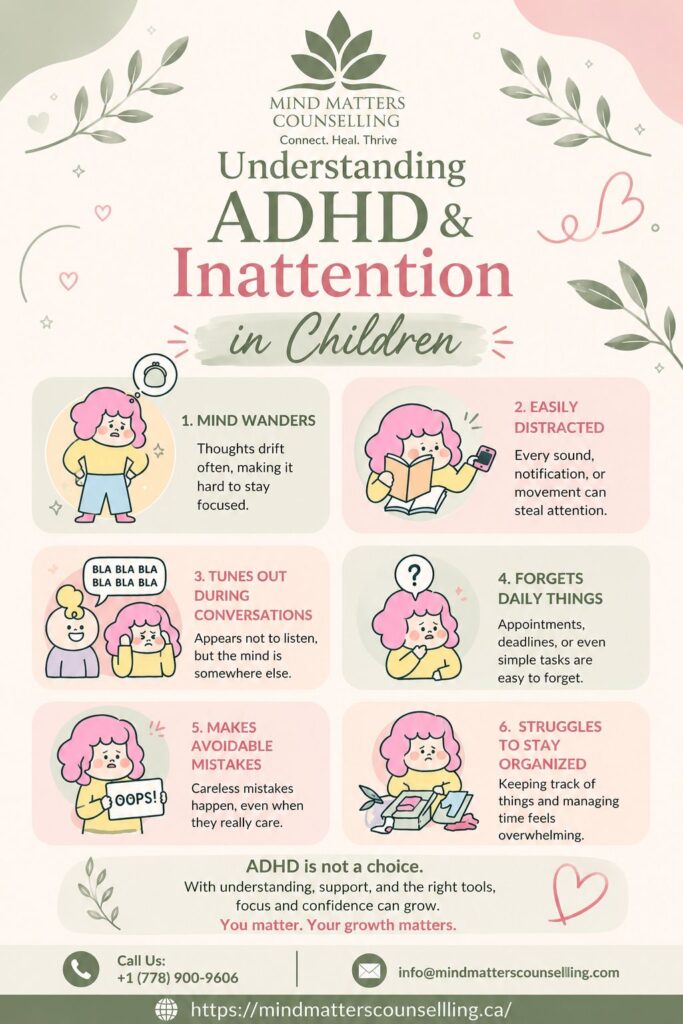
Some symptoms of ADHD that kids may have are:
- difficulty paying attention
- being forgetful
- quick to anger/emotional explosions
- difficulty finishing homework
- constantly losing things
- avoiding things that they have to focus on
- acting without thinking
- unable to sit still
- zoning out/daydreaming often
- problems with transition
Others have anxiety and learn how to “hide it” because they feel like they are always behind, misunderstood, or judged by others around them.
ADHD Research and Statistics Parents Should Know
Attention Deficit Hyperactivity Disorder (ADHD) is a commonly diagnosed neurodevelopmental disorder in children and adolescents. Reports by the Center for Disease Control and Prevention show that there are millions of children globally affected by ADHD. ADHD symptoms often persist into adulthood.
Research also shows that ADHD affects far more than attention and focus. Children with ADHD are more likely to experience:
- anxiety and emotional overwhelm
- low self esteem
- academic stress and school related frustration
- difficulty with peer relationships
- challenges with emotional regulation and executive functioning
Research has also shown that children who receive early emotional and behavioural support learn healthy coping skills, gain self confidence and experience improved social and academic functioning. Therefore early intervention and providing kids and teens with ADHD with compassion is crucial.
ADHD in Teens Can Look Different
As children grow older, ADHD often becomes less obvious because by the time they turn 13 years old, their ADHD symptoms don’t show up as what they did when they were a child. Teen ADHD counselling can help adolescents manage school stress, emotional overwhelm, low self esteem, and executive functioning difficulties.
For many teens, ADHD may show up as:
- Denying to perform a task instead of procrastination
- low motivation instead of being distracted
- messy rooms and backpacks instead of forgetfulness
- low self-esteem instead of confusion
- shutting down when stressed instead of tantrums
Some other common symptoms are emotional overwhelm, difficulty managing school pressure like completing assignments and anxiety around deadlines
Many teens hear labels like:
“lazy”
“careless”
“not trying hard enough”
But underneath, they may actually be struggling with executive functioning and emotional regulation.
Why Children with ADHD Struggle Emotionally
Children with ADHD struggle are often corrected more than other children.
Over time, this can affect their confidence. Many kids begin believing:
- “I’m bad.”
- “I can’t do anything right.”
- “Everyone else is better than me.”
This is why ADHD support is not just about behaviour but it’s about emotional well-being too. Some families benefit from child behavioural therapy when children struggle with emotional outbursts, impulsive behaviour, anxiety, or difficulty following routines.
What Children with ADHD Often Need to Hear
Kids with ADHD receive corrections all day long – at school and at home. Even with good intentions, parents can use phrases that make kids feel ashamed, misunderstood, or defeated.
Rather than bombard your child with negativity, remember that kids with ADHD thrive most when they feel emotionally safe, validated, and supported.
Instead of Saying:
- “Why can’t you just focus?”
- “You never listen.”
- “You’re being lazy.”
- “You should know better.”
- “How did you forget that again?”
Try Saying:
- “I can see this feels difficult for you.”
- “Let’s figure this out together.”
- “You’re trying, even if it feels hard right now.”
- “Mistakes happen, we can work through this.”
- “I’m here to support you.”
Tiny tweaks to what we say can have a big impact on our children’s self-esteem. When kids feel heard instead of criticized, they gain confidence, feel emotionally safe and develop healthier ways to cope. They also experience less conflict in the household which improves the trust between parents and children.
How Child ADHD Therapy Can Help
Mind Matters Counselling offers child ADHD therapy in New Westminster, Burnaby, Surrey and surrounding areas. We provide ADHD therapy for children to help improve emotional regulation, focus, confidence, and daily routines both at home and at school.
We work to help kids and teens feel heard and develop skills to function effectively at home and school.
Children can benefit from therapy by learning how to:
- regulate emotions
- cope with frustration and feeling overwhelmed
- increase focus and organizational skills
- learn positive ways to cope
- enhance self-esteem
- manage anxiety related to academics and peer pressure
Parents are also provided with tools to understand your child better and minimize conflict.
ADHD, Anxiety, and Neurodivergence Therapy in Burnaby, Surrey, and New Westminster
Children with ADHD frequently present with anxiety, sensory sensitivity, or other neurodivergent qualities. Often these children display OCD like behaviours. Mind Matters Counselling embraces each unique child by offering empathetic, client focused therapy that views the child through a multi-dimensional lens. Our approach to neurodivergent child therapy focuses on understanding each child’s unique emotional, sensory, and behavioural needs with compassion and care.
Here we believe children thrive when they feel heard, emotionally safe, and supported.
When Should Parents Seek Help for ADHD?
It may help to speak with a therapist if your child:
- struggles emotionally at home or school
- constantly forgets or loses things
- becomes overwhelmed easily
- has difficulty focusing or completing tasks
- experiences anxiety or low confidence
- frequently argues or shuts down
- feels “behind” compared to peers
Early support can help children build confidence before struggles begin affecting self-esteem and relationships.
Child and Teen Counselling Near You
Need ADHD counselling in Burnaby, New Westminster or Surrey? Mind Matters Counselling can help.
Children, teens and families who struggle with ADHD, anxiety, dysregulation and neurodivergence receive empathy and practical assistance here. Parents often seek ADHD treatment support when their child begins struggling academically, emotionally, or socially.
Contact Mind Matters Counsellling today to help your child gain confidence, competence, and understanding.
FAQ‘s
Does my child need an ADHD diagnosis before starting therapy?
No. A formal diagnosis is not always required to begin counselling. Many parents seek therapy when they notice emotional, behavioural, or focus-related struggles in their child, even before an official assessment is completed.
Can therapy help with emotional outbursts and meltdowns?
Absolutely. Therapy can help children understand their emotions, build emotional regulation skills, and learn healthier coping strategies when they feel overwhelmed, frustrated, or overstimulated.
What type of therapy works best for children with ADHD?
Different children benefit from different approaches. At Mind Matters Counselling, therapy for ADHD for children may include Cognitive Behavioural Therapy (CBT), emotional regulation strategies through art therapy, attachment-based play therapy, and parent guidance tailored to the child’s unique needs.
How can counselling help children with ADHD?
Counselling can help children with ADHD improve emotional regulation, build coping skills, strengthen confidence, manage anxiety, and develop strategies for focus and organization. Therapy also helps parents better understand their child’s emotional and behavioural needs.