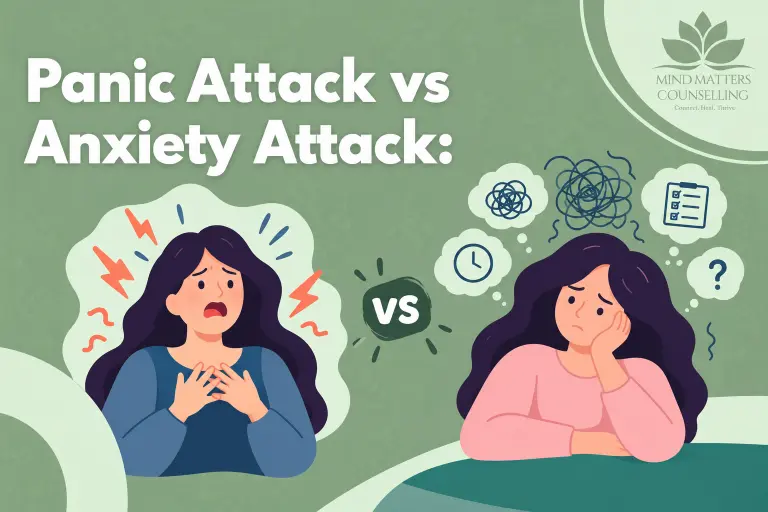
Your heart is pounding, your chest feels tight, and you can’t get a full breath. Is this a panic attack or an anxiety attack? People use the two terms as if they mean the same thing. They don’t, and knowing the difference changes how you respond in the moment.
The short version: a panic attack hits suddenly and peaks within minutes. What most people call an anxiety attack builds more slowly, usually around a specific worry, and can hang around for hours. This guide walks through the signs of each, how to calm your body when one starts, and when it’s time to get support. If you want the bigger picture first, our post on the difference between anxiety and stress is a good starting point.
| Key Takeaways A panic attack is a sudden surge of intense fear that peaks within minutes. It’s a recognized clinical term in the DSM-5.” Anxiety attack” isn’t a clinical term. People use it for anxiety that builds gradually around a stressor. Panic attacks are common. WHO World Mental Health Survey data found about 13% of people have one at some point in life. Both respond well to treatment, especially cognitive behavioural therapy. |
What is a panic attack?
A panic attack is an abrupt surge of intense fear or discomfort that reaches its peak within minutes. The DSM-5, the manual clinicians use for diagnosis, lists 13 possible symptoms. A panic attack involves four or more of them, and it can happen even when you feel calm beforehand.
The symptoms include:
- Pounding or racing heart
- Sweating, trembling, or shaking
- Shortness of breath or a smothering feeling
- A choking sensation
- Chest pain or tightness
- Nausea or stomach upset
- Dizziness or feeling faint
- Chills or hot flushes
- Numbness or tingling
- Feeling unreal or detached from yourself
- Fear of losing control or “going crazy”
- Fear of dying
Panic attacks can be expected, meaning they’re tied to a known trigger like flying or a crowded mall, or unexpected, coming out of nowhere. The unexpected ones are often the most frightening, because there’s nothing obvious to blame.
They’re also more common than most people think. A 2016 study by de Jonge and colleagues, using World Health Organization survey data from more than 140,000 adults across 25 countries, found that about 13.2% of people experience at least one panic attack in their lifetime.
What is an anxiety attack?
“Anxiety attack” isn’t a diagnostic term. People usually mean a period of strong anxiety that builds over time in response to a stressor, like an exam, a hard conversation, money problems, or a health scare. It tends to be less sudden than panic, but it can last longer.
Common signs include restlessness, constant worry, muscle tension, irritability, a racing mind, trouble sleeping, and feeling on edge. You might also notice a tight chest or an upset stomach, though the physical symptoms are usually less intense than in a panic attack.
Because anxiety attacks grow slowly, many people don’t notice them until they’re already worn out. That’s especially true for people who stay busy and productive while anxious inside, which we cover in our post on high-functioning anxiety and depression.
Panic attack vs anxiety attack: the key differences
| Feature | Panic attack | Anxiety attack |
| Onset | Sudden, often without warning | Gradual, builds over minutes to hours |
| Peak | Within about 10 minutes | No clear peak |
| Trigger | Can be unexpected or tied to a trigger | Usually linked to a specific worry or stressor |
| Intensity | Very intense, often feels like a medical emergency | Mild to severe, more of a slow burn |
| How long it lasts | Usually 5 to 30 minutes | Can linger for hours or days |
| Clinical term? | Yes, defined in the DSM-5 | No, an everyday description |
One practical test: think about the speed. If you went from fine to terrified in a few minutes, that points to panic. If you’ve been feeling worse all afternoon as a deadline gets closer, that’s more like building anxiety.
The two can also overlap. Someone who’s been anxious for days can tip into a full panic attack, which is why the line between them sometimes feels blurry.
How do you stop a panic attack?
You can’t always stop a panic attack once it starts, but you can shorten it and make it less frightening. The goal isn’t to fight the feeling. Fighting tends to feed the fear of the symptoms, which is what keeps panic going.
These steps help many people:
- Name it. Tell yourself, “This is a panic attack. It’s uncomfortable, and it will pass.” Panic peaks and then fades.
- Lengthen your exhale. Breathe in for about four counts and out for six or more. A longer exhale tells your nervous system to slow down.
- Try 5-4-3-2-1 grounding. Name five things you see, four you can touch, three you hear, two you smell, and one you taste.
- Stay where you are if you safely can. Leaving teaches your brain that the place was dangerous, which can make the next attack more likely there.
- Loosen your grip on your body. Unclench your jaw, drop your shoulders, and plant your feet.
For anxiety that builds slowly, the best tools work earlier. Movement, writing down the worry, cutting back on caffeine, and talking to someone before the pressure peaks all help.
A safety note: chest pain, trouble breathing, and numbness can also be signs of heart or other medical problems. If it’s your first episode, if the symptoms feel different from usual, or if you’re unsure, call 911 or go to the nearest emergency department.
When does panic become panic disorder?
Having one panic attack doesn’t mean you have panic disorder. Panic disorder is diagnosed when someone has repeated unexpected panic attacks, followed by at least a month of persistent worry about having more, or changes in behaviour to avoid them.
That avoidance is the part to watch. People start skipping the gym because a racing heart feels like the start of an attack. They stop driving on the highway, or avoid places where escape feels hard. Over time, life gets smaller. If you notice that happening, it’s a good sign to get support.
How does therapy help with panic and anxiety?
Cognitive behavioural therapy (CBT) is one of the most studied treatments for both panic attacks and ongoing anxiety. It helps you spot the thoughts that turn a normal body sensation into a catastrophe, like “my heart is racing, so I must be having a heart attack,” and replace them with more accurate ones.
CBT for panic often includes interoceptive exposure. That means gently bringing on harmless sensations, such as spinning in a chair to feel dizzy, so your brain learns those feelings aren’t dangerous. It sounds strange, but it works well for many people. You can read more in our guide to cognitive behavioural therapy for anxiety.
At Mind Matters Counselling, our counsellors provide anxiety counselling, including panic attack therapy, in New Westminster and online across BC. If panic or ongoing anxiety is starting to shape your choices, a free 15-minute consultation is an easy first step.
Frequently Asked Questions
Can an anxiety attack turn into a panic attack?
Yes. When anxiety builds for hours or days, the body’s stress response stays switched on. A small extra trigger, like a sudden noise or a racing thought, can tip that built-up tension into a full panic attack that peaks within minutes.
How long does a panic attack last?
Most panic attacks peak within about 10 minutes and ease off within half an hour. Some people feel shaky, tired, or on edge for hours afterward. If symptoms last much longer, or feel different from usual, check in with a doctor.
Can you have a panic attack in your sleep?
Yes. Nocturnal panic attacks wake people suddenly with a racing heart, sweating, or shortness of breath, without a nightmare causing them. They’re less common than daytime attacks, but they respond to the same treatments, including CBT.
Do panic attacks mean something is wrong with my heart?
Usually not, but the symptoms can overlap with heart problems. A doctor should check any first episode of chest pain or breathing trouble. Once medical causes are ruled out, counselling can help you stop fearing the sensations themselves.
Sources
- American Psychiatric Association, Diagnostic and Statistical Manual of Mental Disorders, Fifth Edition (DSM-5), criteria for panic attack and panic disorder.
- de Jonge, P. et al., “Cross-national epidemiology of panic disorder and panic attacks in the World Mental Health Surveys,” Depression and Anxiety, 2016.