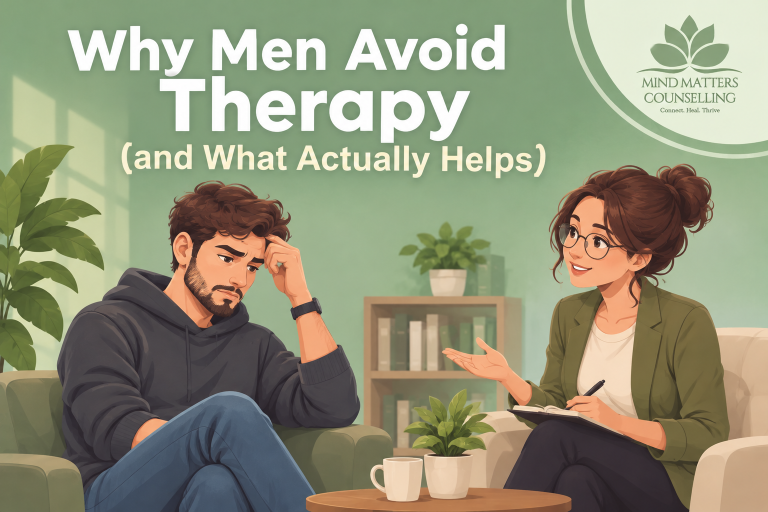
Most men who walk into our New Westminster office for the first time say some version of the same thing: “I should have done this years ago.” They waited through the sleepless nights, the short temper, the extra drinks, the relationship that kept getting colder. So why men don’t go to therapy sooner is a fair question, and the answer is rarely “they don’t care.”
The numbers make it urgent. According to the Mental Health Commission of Canada, men account for about three-quarters of suicides in Canada. Men and women experience mental illness at similar rates, but men are less likely to recognise it, talk about it, or get treatment.
This article covers the real barriers, what struggling often looks like in men, and what makes starting easier.
Why men don’t go to therapy: the real reasons
Why men don’t go to therapy usually comes down to a mix of what they were taught and practical uncertainty about what therapy involves. The most common reasons we hear:
- “I should be able to handle this myself.” Many men were raised to see self-reliance as strength and asking for help as failure.
- Not knowing what to say. If you’ve never talked about feelings, sitting across from a stranger and doing it feels impossible.
- Fear of being judged or “analysed.” Some men picture lying on a couch while someone digs into their childhood.
- Thinking it’s not serious enough. “I’m not depressed, I’m just stressed” is a common way to wave it off.
- Cultural and family expectations. In many families, including the South Asian families we work with often, men are expected to provide and hold everyone together. Admitting struggle can feel like letting the family down.
- Practical barriers. Cost, time off work, and confusion about who to see. Our guide to RCC vs psychologist vs psychiatrist clears up that last one.
None of these are signs of weakness. They are signs of what men have been taught to expect from themselves.
How struggling looks different in men
Men often struggle in ways that don’t look like the typical picture of depression or anxiety, which is why both they and the people around them miss it.
Instead of sadness, it may show up as:
- Anger, irritability or a short fuse over small things
- Working longer hours, or being unable to switch off
- Drinking more, gambling, or other ways of escaping
- Withdrawing from friends and family
- Physical complaints: headaches, back pain, stomach issues, poor sleep
- Feeling flat or emotionally numb
- Risk-taking, like driving fast
Relationships often reveal it first. A man who goes quiet during conflict, or needs constant reassurance, may be dealing with patterns we cover in anxious attachment in men. Long-term pressure to perform can also lead to emotional burnout in men.
What actually helps men start therapy
The most useful shift is seeing therapy as a practical tool for a specific problem, not an open-ended talk about feelings. What helps men get started:
- Start with a concrete goal. “I want to stop blowing up at my kids” or “I want to sleep through the night” is a perfectly good reason to book.
- Choose a structured approach. CBT and solution-focused therapy work on thoughts, habits and practical skills, which many men find a comfortable starting point.
- Try online sessions. Video counselling from your car or home office removes the waiting room, which matters more than people admit.
- Pick the counsellor who fits. Some men prefer a male counsellor, some don’t. Reading counsellor profiles first helps you choose.
- Check your benefits. Many workplace extended health plans cover sessions with a Registered Clinical Counsellor (RCC).
- Give it three sessions. The first one is mostly getting to know each other. Judge it after the third.
What happens in a first session
A first session is a conversation, not an interrogation. Nobody makes you cry, and you decide how much you share.
It usually covers what brought you in, a bit about your work, relationships, health and sleep, what you’d like to be different, and what you’ve already tried. The counsellor will explain how they work and what next sessions might look like. Most men leave surprised at how ordinary it felt.
For a fuller walkthrough, read what to expect in your first counselling session.
Our Registered Clinical Counsellors offer individual counselling in New Westminster and online across BC. Get in touch to ask questions before committing to anything.
How to encourage a man in your life to try therapy
Pushing usually backfires. What works better is lowering the stakes and connecting therapy to something he already cares about.
- Pick a calm moment, not the middle of an argument.
- Lead with what you’ve noticed, not a label. “You haven’t been sleeping and you seem wiped out” lands better than “I think you’re depressed.”
- Link it to his goals. Being a better dad, keeping his health, handling work stress.
- Make it easy. Offer to find a few counsellors or sit with him while he books.
- Suggest couples counselling if the issue is showing up in your relationship. Some men find it easier to start together.
- Drop it, then come back. One conversation rarely settles it.
A simple script: “I’ve noticed you’ve been carrying a lot lately. I’m not trying to fix you. I just think talking to someone could take some weight off. Would you be open to one session?”
If you’re worried about his safety, or he’s talking about not wanting to be here, call or text 9-8-8 any time.
Frequently asked questions
Is going to therapy a sign of weakness for men?
No. Going to therapy is a practical decision to deal with a problem, like seeing a physiotherapist for a bad knee. Many men find it takes more courage than handling things alone.
Why don’t men go to therapy as often as women?
The biggest reasons why men don’t go to therapy are pressure to be self-reliant, uncertainty about what therapy involves, fear of judgment, and struggles that show up as anger or stress rather than sadness, so they get missed.
Should men see a male therapist?
It depends on the person. Some men open up more easily with another man, others prefer a woman. The fit with the counsellor matters more than gender. You can see our full team of counsellors to compare.
Does therapy work for men who don’t like talking about feelings?
Yes. Structured approaches like CBT focus on thoughts, habits and practical skills, and many men start there before ever talking about emotions directly.
References
- Mental Health Commission of Canada. Mental Health and Suicide Prevention in Men: Evidence Brief.
- Public Health Agency of Canada. Suicide in Canada: Key Statistics.