She anxiously scrolls through her phone for the third time in ten minutes. Still no response. Her chest begins to feel tight. What if she did something wrong? Is he drifting away from her? She carefully studies their last conversation, searching for clues. The anxiety of waiting is torturous even though she logically understands that he is probably just busy.
Sound familiar? If so, you fit into a pattern called anxious attachment. And studies have shown time and time again that women experience anxious attachment more frequently than men. But why? The reason goes beyond just “women are prey to their emotions.” It’s far more complex than that. Our biology, childhood experiences, and societal norms intertwine to teach women subconscious rules about how to be in relationships.
Let’s dive in.
What Is Anxious Attachment?
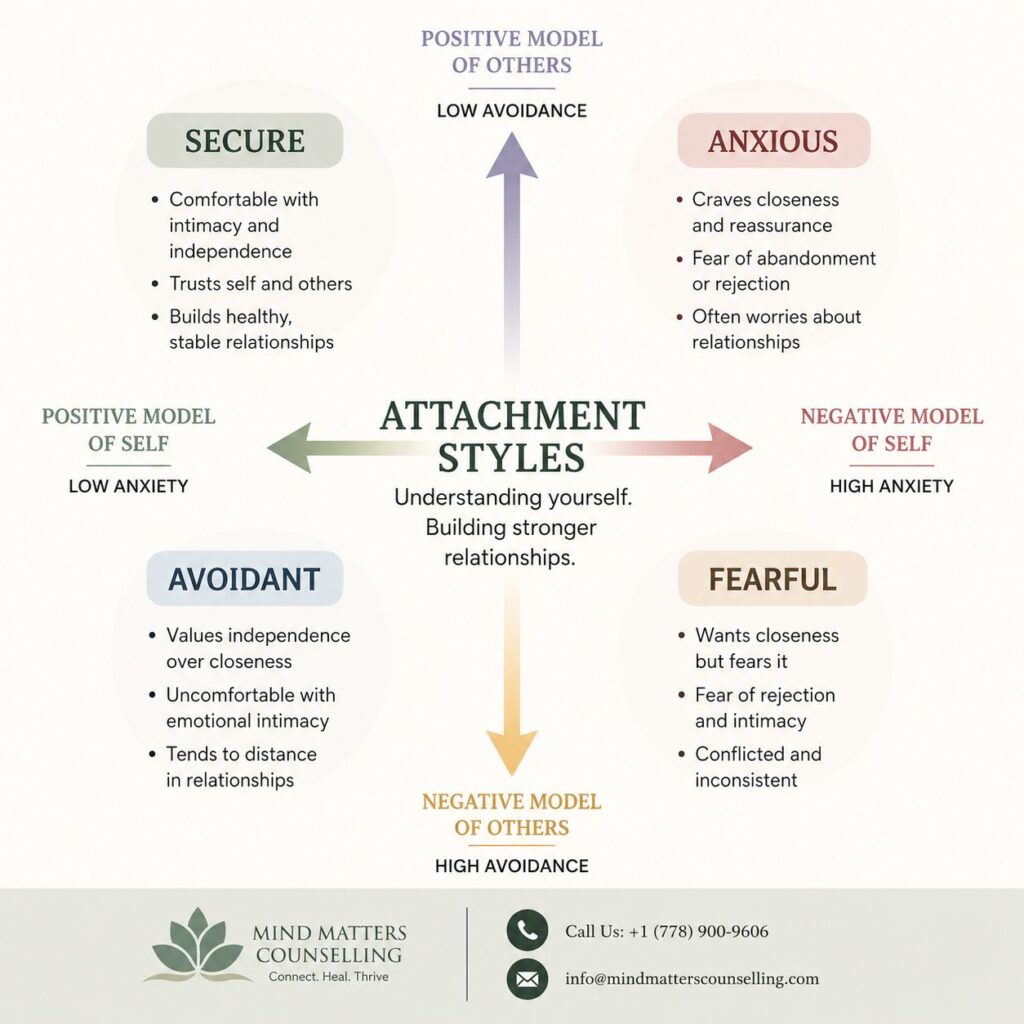
Someone with anxious attachment feels this fear of rejection on a consistent basis. Anxiety attachment is one of the four attachment styles developed by psychologist John Bowlby and later expanded upon by Mary Ainsworth. We develop this style of attachment when our caregivers were sometimes warm and nurturing but other times cold and unpredictable. When we don’t know if we are going to be loved, we fight harder to keep that love.
Growing up we become adults that need intimacy, are scared of our partners leaving us, and seek high amounts of reassurance from our partners. We may read too far into silence, think someone not looking at us means they’re rejecting us when they’re just focusing on something, or feel like our relationship is about to end when it’s completely fine.
The thing about anxious attachment in women though is that it’s not bad. Your anxious attachment style isn’t your fault. When we develop this style, our nervous system learned it needed to be on high alert to maintain connection with our loved ones. The problem is that it continues doing this when you no longer need to.
Why Women Develop Anxious Attachment More Often
1. Girls Are Taught to Prioritize Relationships
From an early age, girls receive messages that relationships are central to their identity and worth. They are praised for being nurturing, empathetic, and emotionally attuned. They are expected to keep the peace, manage others’ feelings, and stay close.
Boys, meanwhile, get different messages. Independence is valued. Emotional distance gets coded as strength. Crying gets discouraged. This socialization creates two very different nervous systems by the time these children become adults.
As one review in Entrepreneursherald.com noted, social conditioning that encourages women to be relational and emotionally expressive can amplify tendencies toward anxious attachment behaviors like excessive reassurance-seeking. Men with the same underlying anxiety often suppress it to fit cultural expectations of stoicism, which instead shows up as avoidance.
The wound may be the same. The way it gets expressed is shaped by what society permits.
2. Rumination Makes Anxious Thoughts Stickier
Women are more prone to rumination, the repetitive cycling of worrying thoughts, than men. Research published on ResearchGate found that women’s higher levels of attachment anxiety are linked to their greater tendency to ruminate, which makes it harder to regulate emotions and move past relationship worries.
When an anxiously attached person ruminates, small uncertainties get amplified. A delayed text becomes proof of abandonment. A quiet evening becomes evidence that something is wrong. The brain is not being irrational; it is doing what anxious attachment trained it to do: scan for signs of disconnection.
This is not a character weakness. It is a pattern that can change with the right support.
3. Evolutionary Pressures Left a Mark
Some researchers point to evolutionary psychology as part of the picture. Studies suggest that women evolved to prioritize relationship security because they historically faced higher stakes around partnership: pregnancy, childcare, and social support systems tied to a stable partner. Anxious attachment behaviors, like staying attuned to a partner’s moods and working to maintain the bond, may have offered a survival advantage in that context.
Men, meanwhile, evolved patterns that favored emotional distance and multiple connections, which shows up today as avoidant attachment tendencies.
This does not mean biology is destiny. It means the patterns we see today have deep roots, which is exactly why they can feel so automatic and so hard to change without intentional work.
4. Childhood Experiences Shape Attachment Differently by Gender
Girls and boys often receive different levels of emotional responsiveness from caregivers. Studies show that fathers in particular interact differently with sons and daughters, and that these differences shape how children develop their internal working models of relationships.
A child who learns early that closeness requires constant effort, that love might disappear if they stop monitoring it, develops the watchfulness of anxious attachment. And girls, who are more often encouraged to stay emotionally connected to their caregivers and to discuss feelings openly, may be more likely to internalize this vigilance as a relational strategy.
5. Trauma and Its Aftermath
Women experience trauma, particularly relational trauma like emotional abuse, sexual assault, and intimate partner violence, at higher rates than men. These experiences wire the nervous system toward hypervigilance in relationships. When love has been dangerous or unpredictable, the nervous system does not stop watching for danger just because the threat is gone.
Anxious attachment and trauma often intertwine, especially in women who have grown up in environments where their emotional needs were inconsistently met or where caregivers were a source of both comfort and fear.
How Anxious Attachment Shows Up in Relationships
Recognizing the signs can be the first step toward change. Here is what anxious attachment often looks like in adult relationships:
- Constant worry about whether your partner is losing interest
- Needing frequent reassurance that you are loved
- Feeling abandoned or rejected by small changes in your partner’s mood or behavior
- Difficulty trusting that the relationship is stable even when things are going well
- Becoming overly focused on the relationship to the point where other areas of life feel secondary
- Feeling intense anxiety when a partner needs space or time alone
None of these behaviors make someone “too much.” They make someone human, with a nervous system that learned to fight hard for connection.
The Anxious-Avoidant Dance
The most common dynamic is between an anxiously attached person and an avoidantly attached person. Sound familiar?
When the anxious partner senses distance, they move closer. When the avoidant partner feels crowded, they withdraw. One person chases and the other runs. The more someone goes after their partner, the farther the other person backs away. The more someone backs away, the more their partner pursues.
Everyone is doing what their attachment style has conditioned them to do. There is no villain in this story. However, if both parties are unaware of their pattern, it can seem hopeless.
This is where the magic starts to happen.
Can Anxious Attachment Change?
Yes. Our attachment styles can change. They are patterns that we learn, and learned patterns can be unlearned with the right experiences and support. Studies have found that therapy can help individuals develop what’s known as “earned secure attachment” or obtain the internal sense of security they didn’t get as a child through experiences rather than chance. This type of therapy often draws from attachment theory.
The process involves:
- Learning to recognize the nervous system’s triggers
- Building the capacity to self-soothe without always seeking external reassurance
- Developing a more stable, compassionate relationship with yourself
- Learning to communicate needs directly rather than through anxious behaviors
- Forming new relational experiences that teach the nervous system that connection can be safe and consistent
Therapists at Mind Matters Counsellling hold space with clients/patients, individuals and couples to explore these patterns non-judgmentally. Even if you are in the early stages of recognizing these behaviors in yourself or you’ve battled with them for years, healing and building a more secure attachment is possible.
Getting Support for Anxious Attachment in Women
If any of this resonated with you like reading your diary, pay attention. Anxiety is love when we suffer in silence. It will whisper to you that your needs are too much. It will tell you that people would leave you if they really knew who you were. It will convince you that the only way to maintain love is to never stop proving yourself.
It’s not true.
Seeing a therapist who specializes in attachment theory can help you unravel where these thoughts originated and learn new patterns that support you in healthy ways. Mind Matters Counselling provides individual therapy in New Westminster, BC with a team of Registered Clinical Counsellors who can provide you with a safe, confidential space to work on exactly these issues.
You can break the cycle of anxiety. You don’t have to live in that loop forever.
Frequently Asked Questions
Q1: What causes anxious attachment in women?
Anxious attachment in women typically develops from inconsistent early caregiving, where comfort and warmth were unpredictable. Social conditioning that ties women’s worth to relationships, higher rates of relational trauma, and a greater tendency toward rumination all make women more susceptible to developing this attachment style over time.
Q2: Is anxious attachment more common in women than men?
Yes. Multiple studies confirm that women score higher on attachment anxiety measures while men tend toward avoidant attachment. A 2022 study of nearly 5,000 university students found this pattern clearly, though researchers note the difference is real but not enormous in size.
Q3: Can anxious attachment be healed?
Yes, anxious attachment can shift meaningfully with the right support. Therapy rooted in attachment theory helps people build “earned secure attachment” by learning to self-soothe, communicate needs directly, and develop a more stable internal sense of self that does not depend entirely on a partner’s responses.
Q4: How does anxious attachment affect romantic relationships?
Anxious attachment in relationships often shows up as fear of abandonment, constant need for reassurance, and difficulty tolerating a partner’s need for space. It frequently creates a pursuit-withdrawal cycle, especially when paired with an avoidant partner, where both people’s patterns intensify each other’s distress.
Q5: How do I know if I have anxious attachment?
Common signs include chronic worry about your partner’s feelings toward you, needing frequent reassurance, interpreting normal distances as rejection, and feeling that relationships require constant effort to maintain. A counsellor or therapist can help you understand your attachment style and what drives it.