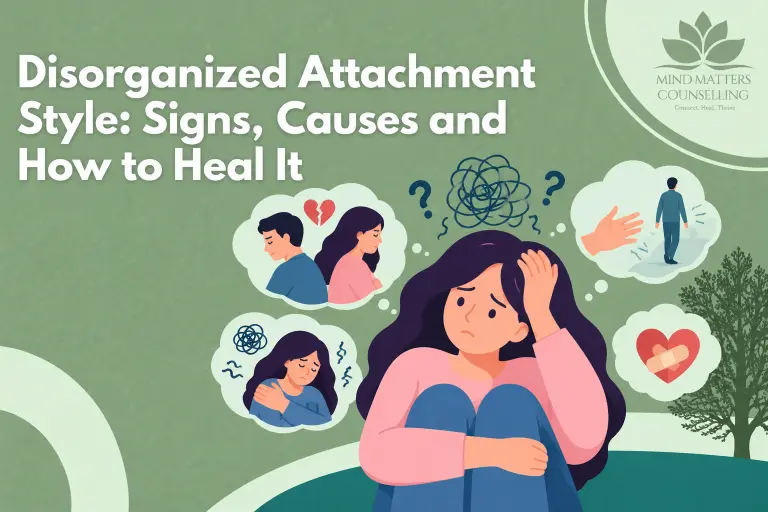
You want closeness. Then you get it, and something in you panics. You pull away, start a fight, or go completely quiet, and later you can’t fully explain why you did it. If that loop sounds familiar, you may be living with a disorganized attachment style.
Disorganized attachment is the least discussed of the attachment styles, yet it’s often the hardest one to live with. It combines the hunger for connection you see in anxious attachment with the urge to escape that shows up in avoidant attachment. Below, we cover what it is, where it comes from, how it shows up in adult relationships, and what healing really looks like.
| Key Takeaways Disorganized attachment means wanting closeness and fearing it at the same time. Researchers Mary Main and Judith Solomon first described it in infants in the 1980s. It’s linked to caregivers who were frightening, frightened, or unpredictable. In adults it often looks like push-pull relationships, sudden shutdowns, and trouble trusting calm. It can change. Attachment-focused therapy helps many adults build what researchers call earned security. |
What is disorganized attachment style?
Disorganized attachment is an insecure attachment pattern where a person both seeks and fears closeness with the people they depend on. It develops when a child’s source of comfort was also a source of fear, so the nervous system never settled on one clear strategy for feeling safe.
Attachment theory started with psychiatrist John Bowlby and psychologist Mary Ainsworth. Ainsworth’s research described three patterns in young children: secure, anxious (also called ambivalent), and avoidant. In the 1980s, Mary Main and Judith Solomon noticed a group of infants who didn’t fit any of them. These children would walk toward a parent and then freeze, turn away mid-approach, or look dazed. Main and Solomon named this pattern disorganized/disoriented.
How common is it? A 1999 meta-analysis led by Marinus van IJzendoorn found that roughly 15% of infants in typical middle-class samples showed disorganized attachment, with much higher rates in families facing serious stress or maltreatment.
In adults, many self-report models call the same pattern fearful-avoidant attachment. You’ll see both terms online. They describe the same basic conflict: “I need you” and “you’re not safe” firing at once.
What causes disorganized attachment?
The core cause is something attachment researchers call fright without solution. A child gets scared, and the person they would normally run to is either causing the fear or is too frightened or overwhelmed to help. The child is stuck with no good option.
Common roots include:
- A parent whose behaviour felt frightening, through anger, abuse, or wild mood swings
- A parent carrying their own unresolved trauma or grief, who sometimes seemed scared, frozen, or “not there”
- Substance use or untreated mental illness in the home
- Witnessing violence between adults
- Sudden loss of a caregiver or repeated long separations
It isn’t always obvious abuse. A loving parent who was struggling with their own unprocessed trauma can still be confusing and scary to a small child. That’s why so many adults with this pattern say, “My childhood wasn’t that bad,” and still recognize themselves in every sign below.
This isn’t about blaming parents. Most were passing on what they themselves received. Understanding the origin simply helps you stop treating the pattern as a personal defect.
Signs of disorganized attachment in adults
In adult relationships, disorganized attachment usually shows up as a hot-and-cold cycle. There’s intense closeness, then sudden withdrawal, often without a trigger the other person can see. Common signs include:
- You crave a partner’s attention, then feel smothered or suspicious once you have it
- Calm, stable relationships feel boring, or “too good to be true”
- You test partners to see whether they’ll leave
- Conflict sends you into shutdown, numbness, or panic instead of a conversation
- You find it hard to name what you’re feeling while it’s happening
- Deep down you expect the people you love to hurt you eventually
- Your reactions sometimes feel out of proportion afterward, and you feel ashamed of them
Partners often say they never know which version of you they’ll get. From the inside, it can feel like two alarms ringing at once: one telling you to hold on tight, the other telling you to run. These reactions aren’t character flaws. They’re survival strategies that made sense to a child with no safe option, still running in an adult body.
Some people with this pattern also lean hard into keeping everyone happy, because conflict feels dangerous. If that sounds like you, our post on how people end up becoming people pleasers explains the fawn response in more detail.
How is it different from anxious or avoidant attachment?
| Attachment style | Main move in relationships | Core fear |
| Anxious | Moves toward the partner, seeks reassurance | Being abandoned |
| Avoidant | Moves away, values independence | Losing freedom or being dependent |
| Disorganized (fearful-avoidant) | Moves toward and away, often in quick cycles | Both closeness and abandonment |
The difference matters because the support looks different. An anxiously attached person usually benefits from learning to self-soothe. Someone with disorganized attachment often needs to build basic safety first, in their body and in at least one steady relationship, before other skills stick.
Can disorganized attachment be healed?
Yes. Attachment styles aren’t a life sentence. Research using the Adult Attachment Interview, developed by Mary Main and colleagues, found adults who had difficult childhoods but now show secure patterns. Researchers call this earned security, and it usually comes from a steady relationship plus making sense of your own story.
One finding from that research stands out. What predicts security in adults isn’t how good or bad childhood was. It’s how coherently a person can talk about it. Someone who can describe painful experiences clearly, without being flooded by them or brushing them off, tends to relate more securely. That’s useful news, because coherence is something you can build.
What helps day to day
- Name the pattern as it happens. A simple “I’m in pull-away mode right now” creates a pause between the urge and the action.
- Notice your body first. The urge to run or cling usually shows up as tension, a racing heart, or numbness before it becomes a thought. Slow breathing and feeling your feet on the floor can bring you back.
- Explain the pattern in a calm moment. Tell a partner or close friend what tends to happen to you, before the next conflict, not in the middle of one.
- Go slower in new relationships. Intensity early on often feeds the cycle.
How therapy helps
For most people, the biggest shift happens inside a relationship that stays safe even when you push it away. A good counsellor offers exactly that. Over time, the therapy relationship becomes a place to practise trusting, disagreeing, and staying connected.
Approaches like emotionally focused individual therapy (EFIT) work directly with attachment fears, and trauma-informed work helps when the pattern grew out of frightening experiences. If the cycle is playing out with a partner, couples counselling can help both of you understand the push-pull instead of fighting about it.
When should you talk to a counsellor?
It’s worth reaching out if your relationships keep ending the same way, if shutdowns or panic are affecting your work or family life, or if there’s trauma in your past you’ve never really talked about. Another sign is noticing the pattern showing up in how you parent.
At Mind Matters Counselling, our counsellors offer individual counselling in New Westminster and online across BC, with a focus on attachment and trauma-informed care. You can book a free 15-minute consultation to see whether it feels like a good fit before committing to anything.
Frequently Asked Questions
Is disorganized attachment the same as fearful-avoidant attachment?
Mostly, yes. Disorganized attachment is the term researchers use for children, based on Main and Solomon’s work. Fearful-avoidant is the term many adult models use for the same push-pull pattern. Both describe wanting closeness while fearing it.
Is disorganized attachment a mental health diagnosis?
No. Attachment styles aren’t diagnoses in the DSM-5. They describe patterns in how people relate to others. Disorganized attachment does often appear alongside trauma, anxiety, or depression, which is why a counsellor will usually look at the whole picture.
Can two people with disorganized attachment have a healthy relationship?
They can, but it usually takes awareness and support. When both partners swing between closeness and distance, cycles can escalate quickly. Learning each other’s patterns, often with a couples counsellor, gives both people a way to slow things down.
How long does it take to heal disorganized attachment?
There’s no fixed timeline. Some people notice real change within months of consistent therapy, while deeper shifts can take a year or more. Progress is rarely a straight line, and setbacks during stress are normal rather than a sign of failure.
Sources
- Main, M. and Solomon, J., research on disorganized/disoriented infant attachment, 1986 and 1990.
- van IJzendoorn, M. H., Schuengel, C. and Bakermans-Kranenburg, M. J., “Disorganized attachment in early childhood: Meta-analysis of precursors, concomitants, and sequelae,” Development and Psychopathology, 1999.
- Main, M., Kaplan, N. and Cassidy, J., work on the Adult Attachment Interview and earned security.