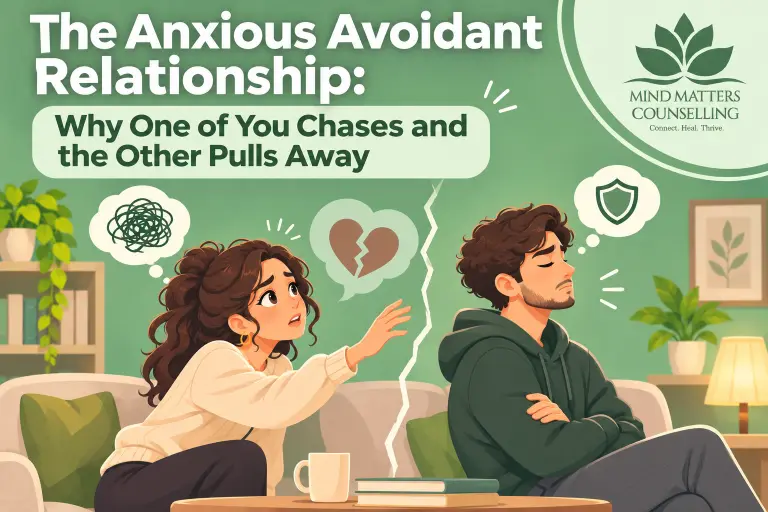
An anxious avoidant relationship is a pairing where one partner copes with stress by reaching for closeness and the other copes by creating distance. The more one chases, the more the other pulls away, and the more the other pulls away, the harder the first one chases. Neither person is the villain. Both are protecting themselves, and the two strategies keep setting each other off.
If your relationship feels like a loop of “we need to talk” followed by “I need space,” this guide explains what is happening and what actually helps.
What is an anxious avoidant relationship?
Attachment researchers describe two common insecure strategies:
- Anxious attachment. When closeness feels threatened, you turn up the signal. You text more, ask more questions, and need reassurance to settle. You can read more in our posts on anxious attachment in women and anxious attachment in men.
- Avoidant attachment. When closeness feels like pressure, you turn the signal down. You go quiet, get busy, or need time alone to settle. Our guide to avoidant attachment covers this side.
Put these two together and you get what Emotionally Focused Therapy calls the pursue withdraw pattern, and what popular books call the anxious avoidant trap. It is one of the most common patterns I see in couples counselling.
Why do anxious and avoidant partners attract each other?
It seems backwards, but the pull makes sense.
The anxious partner is often drawn to the avoidant partner’s calm and independence. It looks like strength. The avoidant partner is often drawn to the anxious partner’s warmth and emotional openness. It feels alive.
There is a less comfortable reason too. Each person’s fear gets confirmed in a familiar way. The anxious partner’s old belief, “people I love will drift away,” gets triggered. The avoidant partner’s old belief, “closeness means losing myself,” gets triggered. Familiar can feel like chemistry, even when it hurts.
The anxious avoidant cycle, step by step
Most couples I work with can map their fights onto this sequence within one session:
- A trigger. A missed call, a cancelled plan, a flat “fine.”
- The anxious partner protests. They ask what is wrong, push for a talk, or criticize. Underneath is fear: “Do I matter to you?”
- The avoidant partner withdraws. They go quiet, change the subject, or leave the room. Underneath is fear too: “I’m failing you, and I can’t fix this.”
- The protest gets louder. The silence feels like proof of the worst.
- The withdrawal gets deeper. The pressure feels like proof that closeness is dangerous.
- Exhaustion and a temporary truce. Things calm down, nothing gets repaired, and the loop waits for the next trigger.
The content of the fight changes. Chores, in-laws, money, phones. The dance stays the same.
Signs you are in the anxious avoidant trap
- You have the same fight about different topics.
- One of you says “you never open up” and the other says “you’re always on my case.”
- Good weekends are often followed by a sudden cold spell.
- One partner feels lonely while the other feels smothered, at the same time.
- Breakups and makeups happen in cycles.
- Repair attempts get missed because one person is flooded and the other has shut down.
If contempt, stonewalling and defensiveness are showing up too, read our post on the Gottman Four Horsemen. Those patterns often ride on top of the anxious avoidant cycle.
Can an anxious avoidant relationship work?
Yes, an anxious avoidant relationship can work, and many do. It works when both people stop treating the other as the problem and start treating the cycle as the problem. That one shift changes how fights feel.
It tends not to work when:
- Only one partner is willing to look at their part.
- There is ongoing contempt, cheating that has not been repaired, or any form of abuse.
- The avoidant partner uses distance to punish, or the anxious partner uses guilt to control.
The research on couples therapy is encouraging. Reviews of Emotionally Focused Therapy, which was built around this exact pattern, report that roughly 70 to 75% of distressed couples move into recovery, and around 90% show significant improvement (Johnson, Hunsley, Greenberg and Schindler, 1999).
What helps in an anxious avoidant relationship
If you are the anxious partner
- Ask once, clearly, and then wait. “I’m feeling disconnected. Can we have dinner without phones tonight?” lands better than ten texts.
- Separate the fear from the facts. A late reply is a late reply until proven otherwise.
- Build a life outside the relationship. Friends, hobbies and routines calm the alarm system.
- Soothe your body first. A walk or a few slow breaths before a hard talk keeps you from leading with panic.
If you are the avoidant partner
- Say you are stepping away, and say when you will be back. “I need 30 minutes, then I want to finish this talk” is very different from walking out.
- Share one small feeling a day. Not a speech. One line.
- Notice the urge to withdraw as information. It often shows up right when closeness matters most.
- Offer reassurance before it is asked for. It costs little and lowers the chase a lot.
Together
- Name the cycle out loud. “I think we’re in the chase thing again” puts you on the same side.
- Agree on a time out rule with a set return time.
- Repair within a day. Even a short “I’m sorry I shut down” keeps hurt from stacking up.
| Instead of | Try |
|---|---|
| “You never care about me.” | “I felt alone tonight. I want to feel close to you.” |
| “I don’t want to talk about it.” | “I’m overwhelmed. Can we talk at 8?” |
| “Why didn’t you answer?” | “I got worried when I didn’t hear back. Everything okay?” |
| Silence | “I don’t have the words yet, but I’m not leaving.” |
Can an avoidant partner become more secure?
Yes. So can the anxious partner. Attachment patterns shift through repeated safe experiences, and a relationship can become that place. Our post on earned secure attachment explains how adults build security later in life.
When couples counselling makes sense
The anxious avoidant cycle is hard to break from the inside because each of you is reacting to the other in real time. A counsellor slows things down so you can see the pattern, hear the fear under the anger or the silence, and practise a new way of reaching for each other.
At Mind Matters Counselling, I work with couples using Emotionally Focused Therapy and the Gottman Method. Sessions are in person in New Westminster or online, and I offer counselling in English, Hindi, Punjabi and Urdu. Learn more about couples counselling or call 236-868-6851 for a free 15 minute consultation.
Frequently asked questions
What is the anxious avoidant trap?
It is a cycle where one partner seeks closeness when stressed and the other seeks distance. Each reaction triggers the other, so the chasing and the withdrawing both get stronger over time.
Can an anxious avoidant relationship work long term?
Yes, when both partners see the cycle as the shared problem and work on it together. Couples therapy approaches like Emotionally Focused Therapy were designed for this pattern.
Why does my avoidant partner pull away when things are going well?
Closeness can feel unsafe for someone with avoidant attachment, even when it is good. Pulling back after a close moment is a way to regulate, not usually a sign they care less.
Should the anxious partner give the avoidant partner space?
Space helps when it has a clear return time. Endless space without reconnection makes anxious partners more distressed and usually deepens the cycle.
Is an anxious avoidant relationship toxic?
Not by default. The pattern is common and workable. It becomes harmful when it includes control, contempt, threats or abuse, and in that case safety comes first.
Sources
- Johnson, S. M., Hunsley, J., Greenberg, L., and Schindler, D. (1999). Emotionally focused couples therapy: Status and challenges. Clinical Psychology: Science and Practice, 6(1).
- Johnson, S. M. (2008). Hold Me Tight: Seven Conversations for a Lifetime of Love. Little, Brown.
- Levine, A., and Heller, R. (2010). Attached: The New Science of Adult Attachment. TarcherPerigee.
About the author: Navreen Kaur is a Registered Clinical Counsellor (RCC) with the BC Association of Clinical Counsellors and the founder of Mind Matters Counselling in New Westminster. She works with couples on attachment and communication using EFT and the Gottman Method. Read Navreen’s full profile.