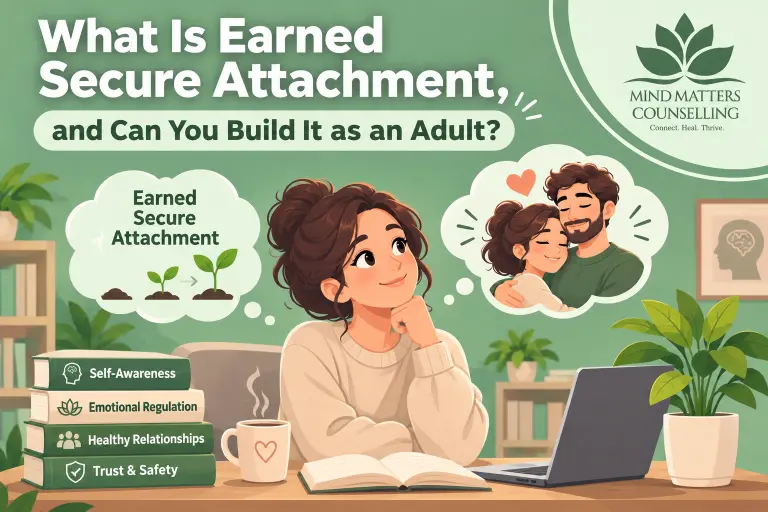
Yes, you can become securely attached as an adult. Researchers call it earned secure attachment: a person who grew up with inconsistent, distant or frightening care, but who now relates to others with the steadiness of someone raised in a secure home. It usually comes from making sense of your past and from at least one relationship that felt safe, like a partner, a friend or a counsellor.
If you have read about anxious or avoidant attachment and felt a sinking “that’s me,” this post is the other half of the story. Attachment styles describe patterns. They are not life sentences.
What does secure attachment look like in adults?
Secure attachment is not about being calm all the time or never needing anyone. It shows up in small, ordinary moments:
- You can ask for reassurance without feeling ashamed of needing it.
- A slow text reply does not send you into a spiral, and it does not make you shut down either.
- You can disagree with your partner and still feel close afterward.
- You can say no, and you can hear no, without reading it as rejection.
- When you mess up, you apologize and repair instead of defending or disappearing.
In a large US national sample, about 59% of adults described their relationships in secure terms (Mickelson, Kessler and Shaver, 1997). That leaves a big group of people who did not start out secure. Many of them are the ones who later “earn” it.
What is earned secure attachment?
The term comes from research using the Adult Attachment Interview, a structured conversation about childhood that was developed by Mary Main and colleagues. Researchers noticed something surprising. Some adults described childhoods with rejection, chaos or loss, yet they spoke about those years in a clear, balanced and coherent way. Their way of relating to others looked secure.
That group was labelled “earned secure,” as opposed to “continuous secure” for people whose early care was warm and steady (Pearson, Cohn, Cowan and Cowan, 1994). Later studies found that earned secure parents were just as sensitive with their own children as continuous secure parents, even under stress (Phelps, Belsky and Crnic, 1998).
So the key finding is this: what happened to you matters, but how you understand and hold it matters more for how you love now.
Can attachment styles change?
Yes. Attachment patterns are fairly stable, but they shift with experience. People move toward security through a long, steady relationship, a good friendship, therapy, or parenting with intention. They can also move away from security after a betrayal, a sudden loss or a very stressful stretch of life.
If you want a quick refresher on the insecure patterns, we have separate guides on anxious attachment, avoidant attachment and disorganized attachment.
Signs you are moving toward secure attachment
Progress rarely feels dramatic. Most clients notice it in hindsight. Here are the signs I look for in sessions:
- The gap between trigger and reaction gets longer. You still feel the jolt when your partner seems distant, but you pause before you text five times or go cold.
- You name feelings instead of acting them out. “I felt left out when you made plans without me” replaces slamming cupboards.
- You can tell your story without drowning in it or skipping it. You can talk about a hard childhood without falling apart and without saying “it was fine” when it was not.
- Repair happens faster. A fight that used to cost three days of silence now costs an evening.
- You choose differently. The partner who is kind and consistent stops feeling “boring.”
How earned secure attachment develops
There is no 30-day plan for this, and I would be wary of anyone who sells one. What research and clinical experience point to are a few repeated practices.
1. Make sense of your early story
Coherence is the core of earned security. That means being able to say what happened, how it affected you, and why your caregivers may have acted the way they did, without excusing harm. Journaling, therapy and honest conversations with siblings can all help you build that story.
2. Have at least one safe relationship
Most earned secure adults can point to someone: a grandparent, a teacher, a partner, a therapist. That person showed them what it feels like to be seen and not punished for having needs. Your nervous system learns safety from experience, not from reading about it.
3. Practise asking for what you need
If you lean anxious, practise asking directly once, then waiting. If you lean avoidant, practise sharing one feeling a day with someone you trust. Small reps build the new pattern.
4. Learn to repair
Secure couples fight. The difference is that they come back to each other. A simple repair sounds like: “I got defensive earlier. Can we try that conversation again?”
5. Calm your body, not just your thoughts
Attachment fear lives in the body. Slow breathing, walking, and naming what you feel (“my chest is tight, I feel scared”) help you stay present long enough to respond instead of react.
How long does earned secure attachment take?
There is no fixed timeline. In my work with clients in New Westminster and online across BC, people usually notice small shifts within a few months of steady effort. Their partners or friends often notice before they do. Deeper change, the kind where a secure response becomes your default, tends to build over a year or more.
A few things speed it up:
- A partner who is willing to learn alongside you.
- Working on both the thoughts and the body reactions.
- Gentleness with yourself when you slip back into old habits. You will, and that is part of it.
Can couples build secure attachment together?
Yes, and it is one of the most effective routes. When one partner reaches and the other responds, again and again, both people learn that closeness is safe. Approaches such as Emotionally Focused Therapy and the Gottman Method are built around this idea. If you and your partner keep getting stuck in the same fight, couples counselling gives you a structured place to practise.
When to talk to a counsellor
Self-help goes a long way. It is worth getting support if:
- Your relationships keep following the same painful script.
- You were raised with abuse, neglect or a parent who frightened you.
- Anxiety, numbness or anger take over when you get close to someone.
- You want to break the pattern before it reaches your own children.
At Mind Matters Counselling, I use attachment theory, Emotionally Focused Therapy, the Gottman Method, CBT and Internal Family Systems with individuals and couples. Sessions are available in person in New Westminster and online, in English, Hindi, Punjabi and Urdu. You can book a free 15 minute consultation by calling 236-868-6851.
Frequently asked questions
What is earned secure attachment in simple words?
Earned secure attachment means you did not grow up with secure care, but you now relate to others in a secure way. You got there by making sense of your past and through safe relationships later in life.
Can an avoidant or anxious person become secure?
Yes. Both anxious and avoidant adults can move toward security. It takes awareness of your pattern, practice with new responses, and ideally at least one relationship where those new responses are met with care.
Is earned secure attachment as strong as continuous secure attachment?
Research suggests it works just as well in relationships and parenting. Earned secure adults may feel old fears more under heavy stress, but they tend to recover and repair well.
Do I need therapy to become securely attached?
Not always. Some people earn security through a steady partner or friendship. Therapy helps when the pattern keeps repeating or when early experiences were traumatic.
How do I know my attachment style?
Look at what you do when you feel distant from someone you love. Chasing points to anxious, pulling away points to avoidant, and doing both points to disorganized. A counsellor can help you see it more clearly.
Sources
- Mickelson, K. D., Kessler, R. C., and Shaver, P. R. (1997). Adult attachment in a nationally representative sample. Journal of Personality and Social Psychology, 73(5).
- Pearson, J. L., Cohn, D. A., Cowan, P. A., and Cowan, C. P. (1994). Earned- and continuous-security in adult attachment. Development and Psychopathology, 6(2).
- Phelps, J. L., Belsky, J., and Crnic, K. (1998). Earned security, daily stress, and parenting. Development and Psychopathology, 10(1).
- Roisman, G. I., Padrón, E., Sroufe, L. A., and Egeland, B. (2002). Earned-secure attachment status in retrospect and prospect. Child Development, 73(4).
About the author: Navreen Kaur is a Registered Clinical Counsellor (RCC) with the BC Association of Clinical Counsellors and the founder of Mind Matters Counselling in New Westminster. She works with individuals and couples on attachment, relationship and cultural stress. Read Navreen’s full profile.