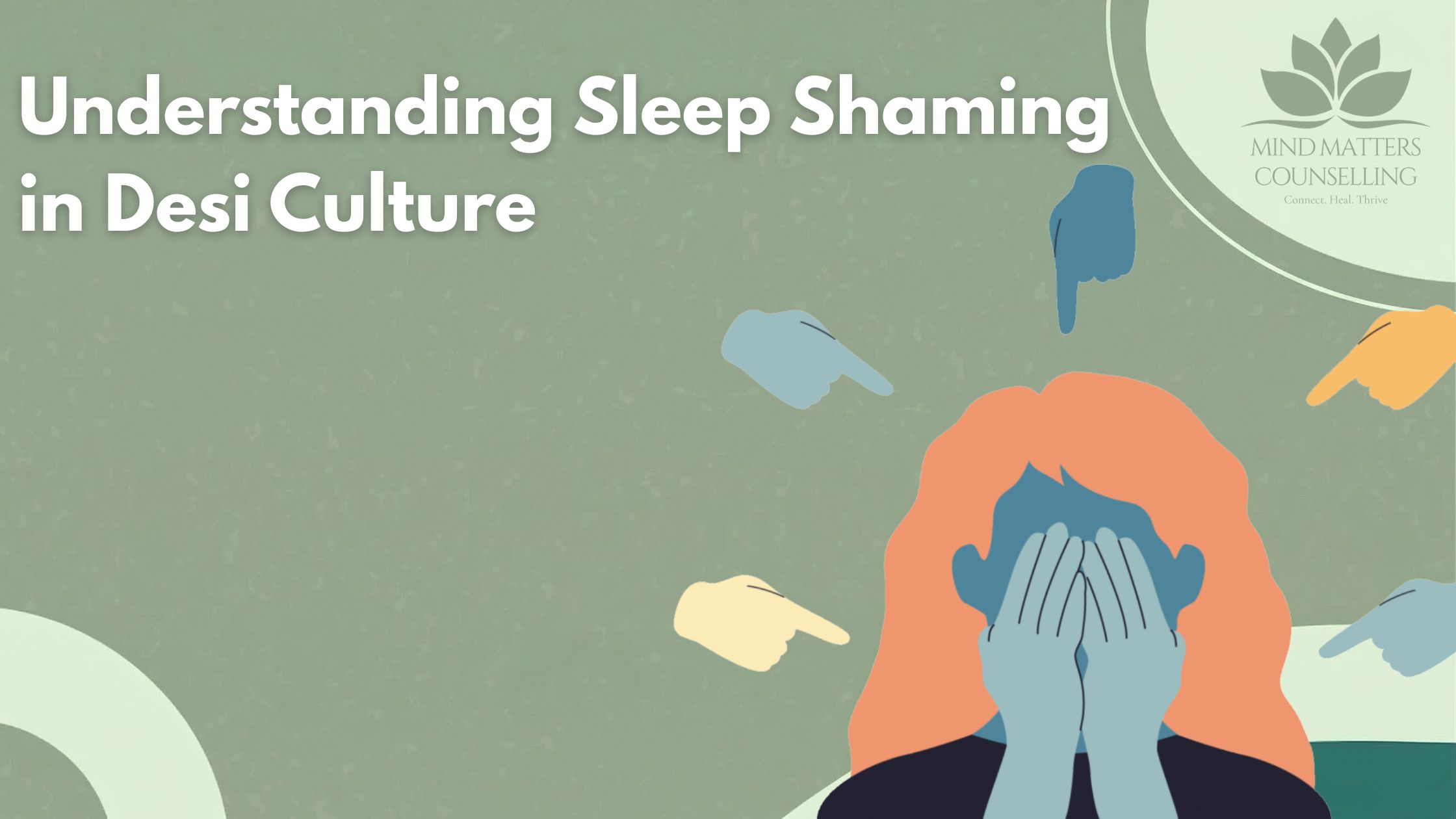
“You’re still sleeping?”
“When I was your age, I was up at 5 a.m.”
“Successful people don’t sleep this much.”
“You’re tired? What are you tired from?”
If you grew up in a South Asian household, chances are you’ve heard some version of these comments.
For many people, sleep isn’t just about rest. It’s become something they feel guilty about.
- They feel guilty sleeping in.
- They feel guilty taking naps.
- They feel guilty resting after a long day.
- And sometimes, they feel guilty for simply listening to their body’s need for recovery.
At Mind Matters Counselling, we often work with South Asian clients in New Westminster, Burnaby, Surrey, and across BC who struggle with anxiety, burnout, perfectionism, and chronic guilt around rest. Many are surprised to discover that their relationship with sleep is deeply connected to cultural messages they received growing up.
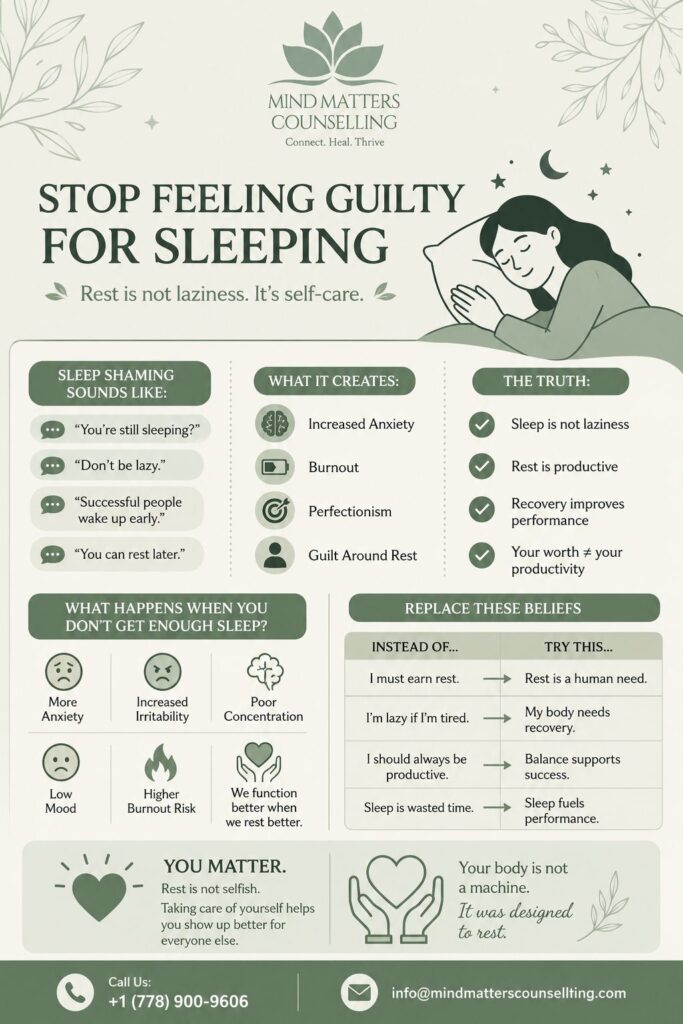
What Is Sleep Shaming?
Sleep shaming is the act of criticizing, judging, or attaching moral value to how much someone sleeps.
The message often sounds like:
“If you’re sleeping, you’re not being productive.”
Over time, this can create an unhealthy belief that rest must be earned.
Many people begin to associate their worth with how much they accomplish rather than how well they care for themselves.
Why Is Sleep Often Viewed Negatively in Desi Culture?
To understand sleep shaming, we first have to understand the values many South Asian families were built upon.
Many immigrant parents and grandparents survived through sacrifice.
- They worked long hours.
- They faced financial hardship.
- They left behind family, culture, and familiarity to build a better future.
For them, hard work wasn’t a choice, it was survival.
As a result, many children grew up hearing messages like:
- “Work hard now, rest later.”
- “Successful people don’t waste time sleeping.”
- “There are always things to do.”
- “Don’t be lazy.”
- “Keep yourself busy.”
These messages often came from love and a desire to see their children succeed.
But sometimes, those same messages unintentionally teach us that rest is selfish.
Read More: Set Boundaries in South Asian Culture
The Hidden Cost of Constant Productivity
Many South Asian adults become incredibly high-achieving.
- They excel in school.
- They build successful careers.
- They take care of their families.
- They show up for everyone.
Yet underneath, they often feel exhausted.
Many clients tell me:
“I don’t know how to relax.”
Or:
“Even when I’m resting, I feel guilty.”
Or:
“I can’t stop thinking about what I should be doing.”
This is often where anxiety, perfectionism, and burnout begin to take root.
Sleep Is Not Laziness
One of the most harmful myths many people carry is:
“Needing sleep means I’m lazy.”
The truth is that sleep is a biological necessity.
Sleep impacts:
- emotional regulation
- concentration
- memory
- mood
- stress management
- physical health
- mental health
When we don’t get enough sleep, our nervous system becomes more reactive.
We are more likely to experience:
- anxiety
- irritability
- emotional overwhelm
- difficulty concentrating
- low mood
- burnout
In other words, sleep isn’t the thing preventing you from functioning.
Sleep is often the thing helping you function.
Why Women Often Carry Extra Guilt Around Rest
For many South Asian women, sleep shaming intersects with another powerful message:
“Take care of everyone else first.”
Women are often expected to:
- work
- care for family
- manage the household
- support parents
- support partners
- support children
And somehow still have endless energy.
Many women learn that their needs come last.
As a result, they may ignore exhaustion until their body forces them to stop.
This is one reason we see so many women struggling with:
- anxiety
- burnout
- perfectionism
- people pleasing
- emotional exhaustion
The Difference Between Rest and Giving Up
Some people fear that if they allow themselves to rest, they’ll lose motivation.
But rest is not the opposite of productivity.
Rest is what makes sustainable productivity possible.
Think about your phone.
You wouldn’t expect it to function indefinitely without charging it.
Yet many people expect exactly that from themselves.
Your body was never designed to operate without recovery.
Relearning Your Relationship with Rest
For many South Asians, healing involves learning new beliefs:
| Instead of | You learn |
| “I have to earn rest.” | “Rest is a basic human need.” |
| “I’m lazy if I’m tired.” | “My body is communicating something important.” |
| “I should always be productive.” | “My worth is not determined by my productivity.” |
These shifts can feel uncomfortable at first, especially when they challenge deeply ingrained cultural messages.
But they are often essential for improving mental health.
How Mind Matters Therapy Can Help
At Mind Matters Counselling, we support individuals navigating:
- anxiety
- burnout
- perfectionism
- people pleasing
- South Asian family pressures
- chronic stress
- guilt around rest and self-care
Together, we explore where these beliefs came from and whether they’re still serving you today.
Therapy isn’t about rejecting your culture.
It’s about creating a healthier relationship with yourself within your cultural context.
You Don’t Need to Earn Your Sleep
If you’ve spent years feeling guilty for resting, sleeping in, or listening to your body’s needs, you’re not alone.
Many people have internalized the idea that exhaustion is something to be proud of.
But being tired all the time is not a badge of honour.
Sleep is not laziness. Rest is not weakness. And taking care of yourself does not make you selfish.
If you’re struggling with anxiety, burnout, perfectionism, or the pressure to constantly perform, Mind Matters Counselling is here to help.
Frequently Asked Questions
Can lack of sleep increase anxiety?
Yes. Poor sleep can significantly increase anxiety symptoms, emotional reactivity, stress, and difficulty coping with daily challenges.
Why do I feel guilty when I rest?
Many people grow up with messages that productivity equals worth. Therapy can help uncover these beliefs and develop a healthier relationship with rest.
Is sleep important for mental health?
Absolutely. Sleep plays a critical role in emotional regulation, stress management, concentration, and overall mental well-being.
Can therapy help with burnout and perfectionism?
Yes. Therapy can help individuals identify unhealthy patterns, challenge perfectionistic beliefs, and develop sustainable coping strategies.
Do you offer counselling for South Asian clients in Burnaby, Surrey, and New Westminster?
Yes. Mind Matters Counselling provides culturally informed therapy for South Asian individuals, couples, and families throughout Burnaby, Surrey, New Westminster, and across British Columbia.